

Best Brushes for Complex Hair Coloring Techniques
Table of Contents
- What Separates a Complex-Technique Brush From a Basic Tint Brush
- Balayage Brush Types: Matching the Tool to the Technique
- Best Brushes for Foil Highlights: Grip, Saturation, and Control
- How to Clean Professional Hair Color Brushes Without Damaging Bristles
- Bristle Material Science: Why Synthetic Fibers Outperform Natural Bristles in Color Work
- Ergonomic Health for Stylists: Preventing Hand Strain During High-Volume Color Days
- Essential Tools for Complex Hair Coloring Techniques: Brushes, Bowls, and Foils
- Conclusion: Building a Brush Kit That Works as Hard as You Do
- Frequently Asked Questions
Last Updated: September 15, 2026
What Separates a Complex-Technique Brush From a Basic Tint Brush
The best brushes for complex hair coloring techniques are built around saturation control, sectioning accuracy, and stain resistance, not just bristle count. A basic tint brush moves product from bowl to scalp. A complex-technique brush decides where that product lands, how much sits at the root, and how cleanly it fades into the mid-lengths.
Balayage, foiling, and root melts all depend on repeatable color placement, and the tool in your hand either supports that or fights it. This guide from ESTL+CO breaks down brush types by technique, bristle construction, and cleanup so you can build a kit that holds up to a full column.
A common mistake is buying one "all-purpose" tint brush and expecting it to handle bleach, scalp coverage, and hair painting equally well. Each technique rewards a different tip shape and bristle density.
Balayage Brush Types: Matching the Tool to the Technique
Balayage brush types split into functional families defined by tip geometry, bristle splay, and how the ferrule meets the handle. Airtouch, color melting, root shadowing, and freehand painting each reward a different tip profile. Most guides stop at "wide vs. tapered"; the useful layer is the mapping underneath.
Wide Feathered Tips for Seamless Blending
Wide feathered brushes carry more product across a broader surface, which is what hair painting needs. The splayed bristle edge sweeps color onto the surface and feathers it downward without hard stops. A 2 to 2.5 inch tip width loads a full panel in one or two passes, which matters on a dense head of hair (Greying of the human hair: a worldwide survey, revisiting the '50' rule of thumb).
For balayage and freehand highlighting, feathering is the whole point: saturation at the point of contact and gradual release as the brush lifts away. A wide base also stabilizes your grip during long sweeps, reducing the small hand adjustments that break your rhythm mid-section.
Tapered Tips for Precision Sectioning
Tapered tips create neater sections and tighter root control. On foils or a root melt, a tapered edge places product within a few millimeters of the scalp without flooding the part line, and traces a clean parting line for a root shadow.
Technique-to-Brush Mapping for Advanced Services
Each advanced technique has a brush profile that makes it repeatable.
- Airtouch: A wide feathered brush with a slightly stiffer bristle bed. You need tension to push product through the woven section without the bristles collapsing, plus enough splay to feather the ends. A floppy tip will not drive product into the interior.
- Color melting: A medium-width brush with a tapered tip and medium density. Working two or three formulas into a gradient across the mid-lengths requires controlled, thin release so the transition zone does not turn muddy. A wide feathered brush overloads the melt zone.
- Root shadow / root melt: A narrow tapered tip with sparse-to-medium density. You want a thin, even band placed close to the scalp and smudged downward; dense bristles dump too much product and create a hard line.
- Freehand balayage: A wide feathered tip with a long, flexible bristle bed. The flex produces the soft, irregular edge that reads as natural; a stiff wide brush looks uniform and painted.
- Foilyage: A medium-width brush with a tapered tip and medium density. You are saturating a section that will then be wrapped, so you need full saturation without dripping into the fold. This profile overlaps most with foil highlighting.
Keep one wide feathered brush for painting and one medium tapered brush for root and foil work, then add a narrow tapered brush only if you run a lot of root shadowing. Three brushes cover the full advanced menu without compromising tip geometry mid-service.
Best Brushes for Foil Highlights: Grip, Saturation, and Control
The best brushes for foil highlights combine a wide feathered tip with a handle that stays comfortable through a full day of foiling. Foil work is repetitive: section, place, saturate, fold, repeat. The brush has to keep a consistent product load across every panel without dripping into the fold.
Bristle Density and Product Distribution
Bristle density controls how much color the brush holds and how evenly it releases. Dense beds suit bleach application where you need heavy saturation fast; sparser beds release gradually, which helps ammonia-free formulas and permanent dye you want to distribute thinly.
| Bristle Density | Best For | Product Release |
|---|---|---|
| Dense | Bleach application, heavy saturation | Fast, high volume |
| Medium | Foil highlights, permanent dye | Even, controlled |
| Sparse | Ammonia-free formulas, toners | Slow, thin layers |
ESTL+CO's Hair Color Brushes pair a wide feathered tip with a wide base handle, which keeps the wrist neutral during the long sweeps that foiling demands. Each box ships with two brushes and comes in four stain-resistant shades.

How to Clean Professional Hair Color Brushes Without Damaging Bristles
Cleaning professional hair color brushes starts with a lukewarm rinse immediately after the service, before dye sets in the bristle bed. Warm water loosens pigment; hot water degrades synthetic fibers and warps the ferrule (pubmed.ncbi.nlm.nih.gov).
Work mild soap through the bristles from ferrule to tips, rinse until clear, then press the bristles flat against a towel. Never stand a wet brush bristle-up in a jar, because water pools in the ferrule and breaks down the adhesive holding the bristle bed together.
- Rinse immediately after each service, before pigment sets
- Use lukewarm water, never hot
- Clean from ferrule to tip, not tip to ferrule
- Dry flat on a towel, bristles angled downward
- Store bristles-up only once fully dry
Cross-contamination is the other reason this routine matters. Trace pigment from a previous client can shift the next formula, especially with ammonia-free lines where the developer has less lifting power to override a stray tone.
Bristle Material Science: Why Synthetic Fibers Outperform Natural Bristles in Color Work
Synthetic fibers outperform natural bristles in color work because they resist chemical degradation, hold their shape through repeated washings, and do not absorb pigment the way animal hair does. Natural bristle brushes were built for paint and powder, not alkaline dye and developer.
Permanent dye and bleach sit at a high pH, and that alkalinity gradually breaks down natural protein fibers (pubmed.ncbi.nlm.nih.gov).
Ergonomic Health for Stylists: Preventing Hand Strain During High-Volume Color Days
Essential Tools for Complex Hair Coloring Techniques: Brushes, Bowls, and Foils
Bowls: Why Geometry Beats Capacity
Foils: The Tool You Stop Thinking About
How the Kit Changes by Technique
The tools do not change, but the emphasis does.
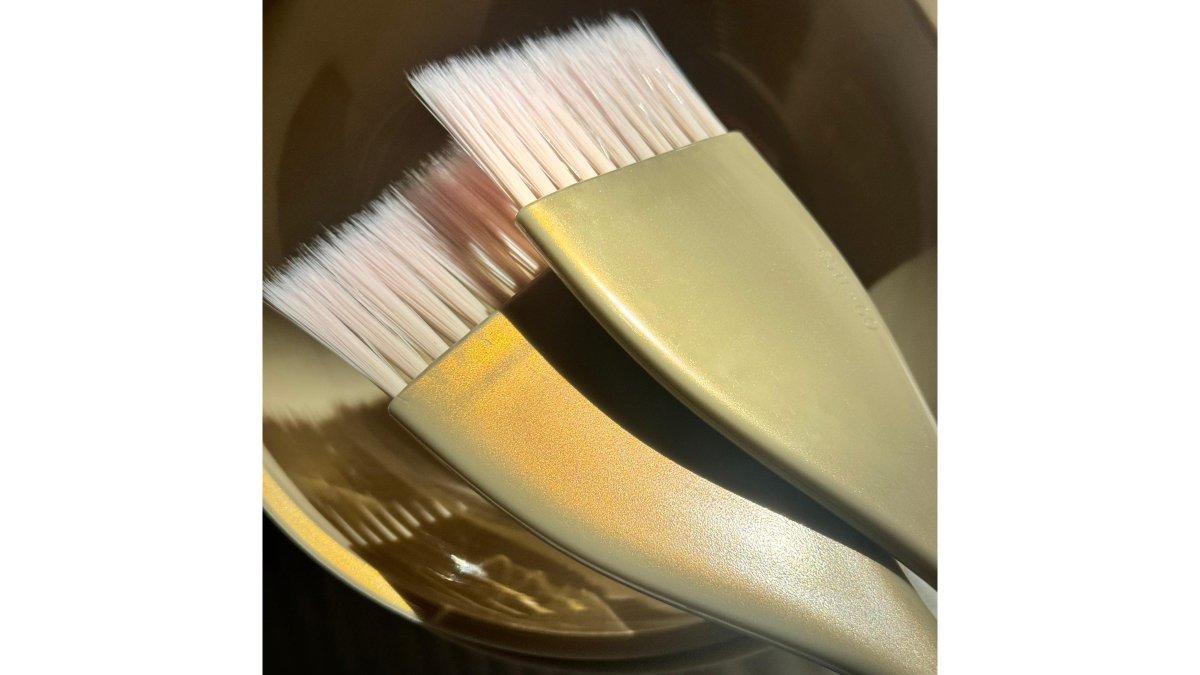
| Tool | Purpose | Price |
|---|---|---|
| Hair Color Brushes | Blending and precision placement | $16.00 |
| Hair Color Bowls | Product holding and dispensing | $19.00 |
| Asymetrie Foils | Section isolation and grip | $17.50 |
Conclusion: Building a Brush Kit That Works as Hard as You Do
Frequently Asked Questions
What are the best professional hair coloring brushes for balayage and foiling?
The best brushes for balayage and foiling have feathered bristles for seamless blending and tapered tips for precise sectioning. A wide feathered tip helps saturate hair evenly without harsh lines, while a tapered edge lets you isolate strands for foil highlights. Look for ergonomic grips and stain-resistant handles built for repeated use. ESTL+CO's Elegance Brush combines a wide base for grip with feathered bristles that distribute color smoothly across the hair.
How do feathered bristles improve complex hair coloring results?
Feathered bristles spread color across a wider surface with softer edges, which reduces visible lines and creates seamless blending for balayage and root melts. Unlike stiff, flat bristles that deposit product in stripes, feathered tips mimic the natural fall of hair, allowing for gradual color placement. This makes them ideal for techniques that require saturation without over-saturating the mid-lengths and ends.
What is the difference between a precision brush and a standard tint brush?
A precision brush has a narrower head and tapered tip for controlled application in small sections, making it better for root touch-ups, foil highlights, and detailed color placement. A standard tint brush has a wider, flatter head for covering larger areas quickly, such as all-over color or bleach application. Many colorists keep both on hand and switch based on the technique and section size.
How do I clean professional hair color brushes to make them last?
Rinse bristles under warm water immediately after each use to prevent dye from setting. Work a small amount of gentle shampoo or brush cleaner through the bristles with your fingers, then rinse until the water runs clear. Avoid soaking wooden handles or using harsh solvents that break down synthetic fibers. Lay brushes flat to dry with bristles facing down so water doesn't seep into the ferrule.
Why do professional colorists prefer ergonomic brush handles?
Ergonomic handles reduce hand fatigue during long color sessions by distributing pressure more evenly across the palm and fingers. A wider base and balanced weight help prevent the tension and pinching that cause cramps during repeated sweeping motions. For stylists doing multiple color services per day, a comfortable grip can mean the difference between finishing a full book without strain and cutting appointments short.