

Ergonomic Hair Brushes for Smaller Hands: A How-To Guide
Table of Contents
- Why Smaller Hands Need a Different Brush
- How to Measure Your Hand for the Right Grip Diameter
- Ergonomic Hair Brushes for Professional Colorists: Materials and Grip Types
- How to Reduce Wrist Strain During Hair Coloring
- Travel-Friendly and Compact Designs for Mobile Stylists
- Ergonomic Exercises to Strengthen Hands for Styling
- Common Mistakes When Choosing a Brush for Small Hands
- Conclusion
- Frequently Asked Questions
Last Updated: September 14, 2026
Why Smaller Hands Need a Different Brush
Most stylists assume brush discomfort is just part of the job. It isn't. The problem usually starts with grip diameter, and standard brushes are built for a hand size that a large share of colorists simply don't have. If you've been searching for ergonomic hair brushes for smaller hands, the issue isn't your technique. It's the tool.
At ESTL+CO, we design tint tools with professional colorists, and hand fit is one of the first things we test. A brush that's too thick forces your fingers into an overstretched position. Hold that for a full day of back-to-back color services and the strain compounds.
How Hand Size Affects Grip and Control
Grip strength drops when your fingers can't wrap comfortably around a handle. A handle that's too wide means you're pinching rather than holding, and pinching recruits smaller muscles in the forearm and thumb that fatigue fast. The result is reduced tension control on foils and balayage, exactly when you need precision most.
How to Measure Your Hand for the Right Grip Diameter
You can size a brush in about two minutes with a soft tape measure, but the two numbers most guides tell you to take, palm circumference and finger spread, only tell half the story. Handle length matters just as much as handle diameter, and the ratio between your palm length and your finger length is what predicts whether a brush will feel balanced or top-heavy in your hand.
Start with three measurements, taken on your dominant hand:
- Palm circumference. Wrap the tape around the widest part of your palm, just below the knuckles, and note the circumference in centimeters.
- Palm length. Measure from the crease at the base of your palm (where the wrist meets the palm) to the base of your middle finger. This is your palm length.
- Middle finger length. Measure from the base of your middle finger to the tip.
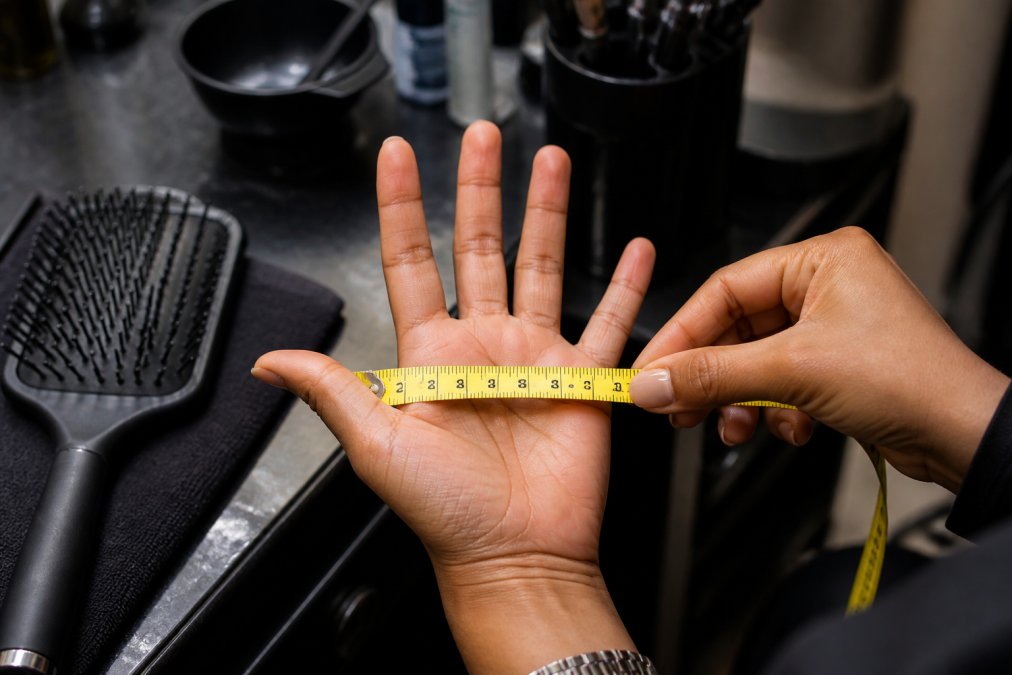
Palm-to-Finger Ratio: The Number Most Guides Skip
Divide your palm length by your middle finger length. The result is your palm-to-finger ratio, and it tells you how a brush handle will sit in your grip.
- Ratio above 1.0 (long palm, shorter fingers): You generate grip force from the palm, so a handle with a wider diameter and a shorter neck feels more secure. A long, thin handle will feel like it's escaping your hand.
- Ratio near 1.0 (balanced): Most standard ergonomic handles will fit, provided the diameter matches your palm circumference.
- Ratio below 1.0 (shorter palm, longer fingers): You wrap fingers around the handle more than you clamp with the palm, so a slimmer diameter and a longer neck give you better rotation control for feathering and blending.
This ratio is why two colorists with identical palm circumferences can prefer completely different brushes. Circumference tells you how much handle you can close around; the ratio tells you how you close around it.
Translating Measurements into Handle Length
Handle length is usually expressed as the distance from the ferrule (the metal band holding the bristles) to the base of the handle. As a working rule:
- Palm length under 9 cm: Look for handles 12-14 cm long. Longer handles shift the balance point away from your palm and increase wrist torque.
- Palm length 9-10.5 cm: Handles 14-16 cm long tend to balance at the palm.
- Palm length over 10.5 cm: Handles 16-18 cm long give you enough real estate to choke up or slide back as the task changes.
Use this quick reference for diameter:
| Palm Circumference | Recommended Grip Diameter | Brush Type |
|---|---|---|
| Under 17 cm | 2.0-2.5 cm | Slim-handle feathered brush |
| 17-19 cm | 2.5-3.0 cm | Standard ergonomic handle |
| Over 19 cm | 3.0-3.5 cm | Wide-grip or padded handle |
Most people never measure. They buy what's on the shelf and adapt. That adaptation is where wrist strain begins.
Ergonomic Hair Brushes for Professional Colorists: Materials and Grip Types
Material choice changes how a brush feels more than most stylists expect, and the reason comes down to friction, specifically, how much resistance a grip surface generates against a gloved hand when that hand is dry versus wet with developer. Silicone, rubberized plastic, and wood sit at different points on that friction curve, and each one fails in a different way under salon conditions.
Silicone, Rubber, and Wood: Comparing Grip Surfaces
Silicone grips generate the highest friction against nitrile and latex gloves, and they hold that friction even when the surface is wet. That makes them the strongest choice for colorists who develop sweaty palms during long sessions or who work in humid environments. The trade-off is that silicone attracts dust, lightener powder, and hair clippings, and it can feel tacky against bare skin. Clean it with mild soap rather than alcohol, which degrades the surface over time.
Rubberized plastic grips sit in the middle. They offer good dry traction and a firmer feel than silicone, which some colorists prefer for tension control on foils. The weakness is wet performance: once developer or lightener sits on the surface, rubberized plastic loses a noticeable amount of grip, and repeated exposure to the alkaline chemistry in lightener accelerates cracking and surface breakdown. If you go this route, wipe the handle between clients rather than letting product dry on it.
Wood handles are the traditional choice. They are warmer in the hand, often lighter than composite handles, and they develop a patina that some colorists find improves grip over time. The catch is finish. A glossy lacquered handle becomes slippery the moment developer touches it, the same failure mode as rubberized plastic, but with no recovery. An oiled or matte-finished wood handle maintains friction much better when wet. Check the finish before you buy, and re-oil unfinished wood periodically to keep the surface from drying out and cracking.
A useful way to think about it: silicone optimizes for wet grip, rubberized plastic optimizes for dry firmness, and wood optimizes for feel and weight, but only if the finish is right.
Matching Grip Material to Your Hand Condition
The right material depends on why your hand fatigues, not just on preference:
- Sweaty or clammy hands: Silicone. The friction advantage is largest exactly when other materials fail.
- Shaky hands or a weak grip: Rubberized plastic with a contoured palm swell. The firmness gives you feedback that helps you modulate pressure without over-gripping.
- Arthritis or joint sensitivity: Oiled wood with a slim diameter. Wood transmits less vibration than composite materials, and a lighter handle reduces the load your joints carry through each stroke.
- Mixed conditions (some clients, some travel): A rubberized handle with a subtle ridge pattern covers the most ground, provided you keep it clean.
A handle texture with subtle ridges or a palm-fit contour gives you feedback without requiring a death grip, regardless of material.
How to Reduce Wrist Strain During Hair Coloring
Reducing wrist strain comes down to three changes: lighter tools, a neutral wrist angle, and fewer repetitive micro-adjustments. Start by switching to a lightweight construction brush, since every extra gram is multiplied across hundreds of strokes per client. Next, keep your wrist in line with your forearm rather than flexed toward the bowl. Finally, set your tint bowl at a height that lets you dip without bending your wrist.
A common mistake is gripping harder to compensate for a slippery handle. That single habit drives most end-of-day hand fatigue. If you want to go deeper on setup and posture, the guidance from OSHA on ergonomic risk factors applies to salon work as much as to any repetitive task.
Travel-Friendly and Compact Designs for Mobile Stylists
Freelancers who move between rental studios need brushes that survive being packed and unpacked daily. Compact design matters less for storage than for durability: a shorter handle with a reinforced ferrule resists bending better than a long, thin one. Look for a brush that ships with a protective sleeve or case, and avoid anything with a painted finish that chips when it knocks against a kit.
Ergonomic Exercises to Strengthen Hands for Styling
Hand strength training is the angle most guides skip entirely, and it's the one that pays off fastest. Simple exercises build the endurance you need for a full column of color appointments.
- Tendon glides: cycle through straight, hook, fist, and full-fist positions, 10 reps, twice daily
- Thumb opposition: touch thumb to each fingertip in sequence, 3 rounds per hand
- Towel wring: roll a small towel and wring it in both directions for 30 seconds
- Wrist extension stretch: hold a gentle stretch for 20 seconds, 3 times per hand
- Grip-and-release: squeeze a soft ball for 5 seconds, release, 15 reps
Do these before your first client, not after. Pre-shift activation does more for joint comfort than post-shift recovery.
Common Mistakes When Choosing a Brush for Small Hands
The biggest mistake is buying on bristle type alone. Colorists focus on flexible bristles and detangling efficiency, then ignore the handle entirely. Bristles matter, but the handle decides whether you can use them well for eight hours.
Other frequent errors:
- Assuming "ergonomic" means "small." Many ergonomic handles are shaped for average or large hands and will feel worse, not better.
- Choosing a heavy brush for "professional" feel. Weight adds wrist strain over a full day.
- Ignoring grip diameter in favor of brand reputation.
- Skipping the wet-hand test. A handle that feels fine dry can slip once developer is on your gloves.
For a broader look at how tool design affects hand health, the CDC's guidance on work-related musculoskeletal disorders is a useful starting point.
Conclusion
If your hands ache after a full book of color services, the fix isn't working through it. It's matching the tool to your hand. ESTL+CO builds ergonomic feathered brushes with a professional-grade grip, stain-resistant tint bowls, and a design tested by working colorists, so precision holds up from your first client to your last.
ergonomics research from the National Institutes of Health
Frequently Asked Questions
What features make a hair brush ergonomic for smaller hands?
Look for a non-slip silicone surface and a lightweight construction. A palm-fit design that matches your hand width reduces the need to clench, which lowers hand fatigue during long coloring sessions. A handle that creates friction also helps you maintain maximum control without gripping harder than necessary.
How does brush handle diameter affect hand fatigue during coloring?
A handle that is too thick forces your fingers to stretch and your thumb to hyperextend, which increases wrist strain and hand fatigue over time. For smaller hands, a comfortable grip diameter lets your fingers wrap comfortably around the handle. This reduces the muscle tension needed to hold the brush steady during repetitive motion like applying tint or blending balayage.
Are there specific brush materials that improve grip for smaller hands?
Silicone grips offer the most traction and stay secure even when your hands are damp from color product.
How can professional colorists prevent repetitive strain injuries?
Rotate between brushes with different grip diameters to vary hand position, take micro-breaks every 20 minutes, and perform wrist and finger stretches between clients. Choosing ergonomic hair brushes for professional colorists that match your hand size reduces the force needed per stroke. Also keep your wrist in a neutral position rather than bending it upward during application, and avoid gripping the brush tighter than the task requires.
Small hands shouldn't mean compromised control. Start with the right grip diameter, then choose a brush built for the way you actually work. Explore the ESTL+CO feathered brush collection and tint bowls to find tools that reduce hand fatigue and sharpen your blending, applying, and defining. Get started with ESTL+CO and finish the day with steadier hands and cleaner color work.