

How to Reduce Hand Strain During Hair Coloring
Table of Contents
- Why Hair Coloring Causes Hand Strain and Fatigue
- How to Hold a Tint Brush Correctly to Reduce Hand Strain During Hair Coloring
- Ergonomic Hair Brushes for Professional Colorists: What to Look For
- Hand Stretches for Hairstylists: A 5-Minute Pre-Color Routine
- Posture and Body Mechanics That Protect Your Wrists
- The Impact of Glove Fit on Hand Tension
- Your Daily Hand Recovery Routine
- Conclusion
- Frequently Asked Questions
Last Updated: September 7, 2026
Hand strain during hair coloring is a repetitive strain injury risk that affects nearly every professional colorist who spends hours gripping tint brushes and bowls. The combination of sustained grip pressure, awkward wrist angles, and repetitive motion stresses the tendons and nerves of the hand and forearm. In this guide, we break down exactly how to reduce hand strain during hair coloring with practical techniques you can apply today.
Why Hair Coloring Causes Hand Strain and Fatigue
Holding a brush for extended periods forces the flexor muscles of your forearm to contract continuously, restricting blood flow and leading to hand fatigue and wrist stiffness. Most colorists also grip far harder than necessary because they are compensating for a brush handle that is too narrow or too slick.
A burning sensation in the thumb or a dull ache at the base of the palm are early indicators of overuse injury, not just temporary discomfort (the NIH). When these symptoms appear, the tissue is already inflamed, and continuing without changes can progress toward carpal tunnel syndrome or tendonitis. The solution is not to push through the pain but to change the mechanics of how you work.
How to Hold a Tint Brush Correctly to Reduce Hand Strain During Hair Coloring
Most colorists default to a tight pencil grip, which recruits the small intrinsic muscles of the hand and increases grip pressure dramatically. The more relaxed your hand, the less strain you place on the tendons that run through the carpal tunnel. Simply saying 'relax your grip' is not enough; you need a specific mechanical strategy to replace the ingrained pencil grip habit.
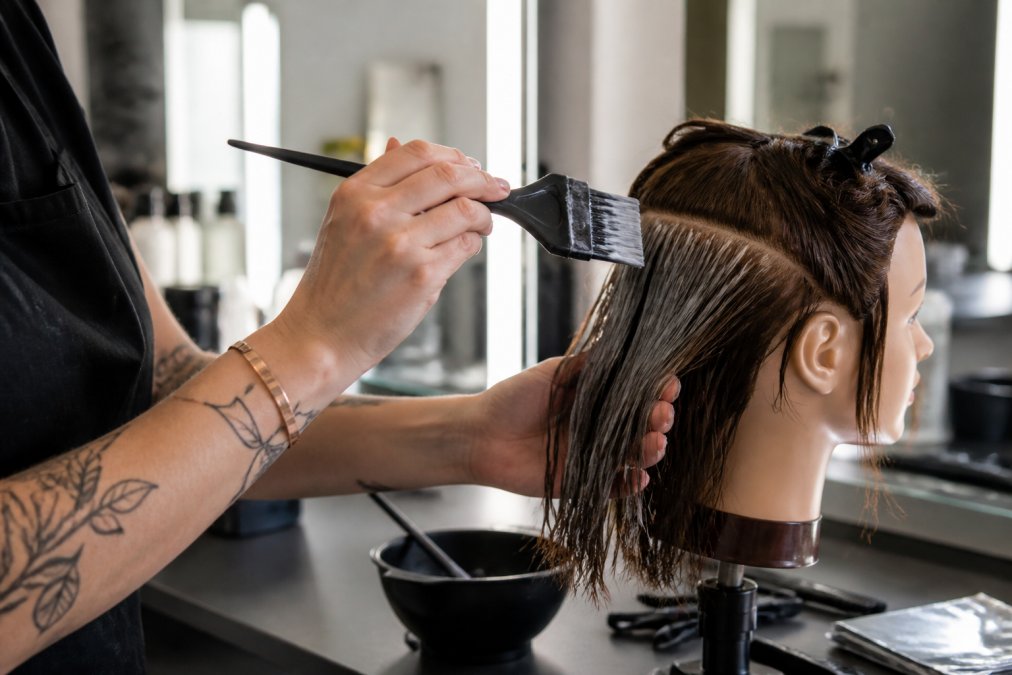
The Feathered Grip Technique for Coloring Brushes
The feathered grip shifts the workload from the small, fatigue-prone intrinsic muscles of your fingers to the larger, more powerful extrinsic muscles of your forearm. Here is the precise mechanical breakdown:
- Position the handle low: Rest the base of the brush handle in the fleshy pad of your palm, just below the base of your thumb. This is your anchor point. It transfers the weight of the brush away from your fingertips.
- Wrap for stability, not power: Wrap your ring and pinky fingers around the handle. These two fingers provide the primary stability. They should be curled firmly but not white-knuckled. The pressure should feel like you are holding a small bird, not crushing a soda can.
- Guide with the top fingers: Your index and middle fingers should rest lightly on the top of the handle, acting as guides for direction and pressure, not as the main gripping force. They should be relaxed and slightly curved, as if you were resting them on a table.
- Keep the wrist neutral: Your wrist should be in a straight line with your forearm, not bent up, down, or to the side. Imagine a laser pointer attached to your forearm; it should point exactly where the brush tip is going.
Why the Pencil Grip Fails
When you pinch the brush between your thumb and index finger, you activate the thenar muscles (at the base of the thumb) and the lumbricals (in the palm), small muscles that fatigue quickly. A tight pinch grip also compresses the median nerve as it passes through the carpal tunnel, which can lead to the tingling and numbness associated with carpal tunnel syndrome. The feathered grip avoids this pinch entirely, keeping the carpal tunnel open and uncompressed.
The Role of Brush Design in Grip Mechanics
A brush with a wide base, like the Hair Color Brush from ESTL+CO, gives your fingers more surface area to grip, naturally reducing the force required to hold it steady. The wide feathered tip also spreads color more efficiently, meaning fewer strokes and less repetitive motion.

The 'Palette Knife' Alternative for Fine Work
For precision work on the hairline or around the ears, try the 'palette knife' grip. Hold the brush like you would a palette knife: the handle rests diagonally across your palm, with the butt near the base of your pinky and the ferrule resting between your thumb and index finger. This keeps your wrist neutral and uses your shoulder and elbow for movement, rather than your finger joints, preventing the hand from curling into a strained 'C' shape.
Ergonomic Hair Brushes for Professional Colorists: What to Look For
Ergonomic hair brushes for professional colorists share a few non-negotiable design features. The handle should be wide enough that your fingers do not overlap your palm when gripping.
A brush with some grip texture requires less force to hold than a slick plastic one. For colorists with smaller hands, the wide base of a feathered brush can still feel comfortable.
Tool Modification Hacks for Brushes You Already Own
If you are not ready to replace your current brushes, you can modify them to reduce hand strain during hair coloring. Wrap the handle with self-adhering silicone tape to increase the grip diameter and add traction, reducing the grip pressure your fingers must generate.
Another practical modification is to build up the handle with polymer clay shaped to your hand and baked according to the manufacturer's instructions. For bowl-related strain, look for a bowl with a U-shaped cutout that holds the brush in place between applications, so you are not constantly pinching the brush while you section hair. The Hair Color Bowl from ESTL+CO features exactly this design, along with a tilted edge that keeps product pooled for easier pickup.

Hand Stretches for Hairstylists: A 5-Minute Pre-Color Routine
Hand stretches for hairstylists are most effective when performed before the work begins, not after the pain sets in. A short routine that warms up the tendons and increases blood flow can significantly reduce the risk of strain during a long coloring session.
- Wrist flexor stretch: Extend your arm with your palm facing up, use the opposite hand to gently pull your fingers toward the floor, and hold for 20 seconds. Repeat on both sides.
- Thumb opposition: Touch your thumb to each fingertip in sequence, then reverse the order. Repeat for 30 seconds to improve dexterity.
- Finger spread: Press your fingers apart as wide as possible, hold for 5 seconds, then relax. Repeat 10 times.
- Wrist circles: Rotate your wrists in slow, full circles, 10 times in each direction, to lubricate the joints.
- Forearm shake: Let your arms hang loose and shake your hands vigorously for 15 seconds to release accumulated muscle tension.
A stretching routine is one component of a broader approach to workplace wellness. The National Institute for Occupational Safety and Health guidance on musculoskeletal disorders emphasizes that combining stretching with ergonomic improvements is far more effective than either approach alone.
Hand Strengthening Exercises for Colorists
Beyond stretching, building strength in the hands and forearms creates a buffer against fatigue. Use a soft therapy putty to perform squeeze-and-release exercises for two minutes daily, or practice finger extensions with a rubber band around your fingers. These exercises build the muscles that support your joints, reducing the likelihood of overuse injury.
Posture and Body Mechanics That Protect Your Wrists
Hand strain rarely originates in the hand alone. Poor posture at the styling station forces your shoulders to round forward, compressing the nerves in your neck and shoulder that run down to your fingers. When your workstation is too low, you bend your wrist upward to compensate, creating the exact angle that aggravates carpal tunnel syndrome.
Position your bowl and sectioning clips so that your elbow stays at roughly a 90-degree angle and your wrist remains straight. If you find yourself hunching over the head you are coloring, raise the chair or lower the client rather than bending your spine. Taking a two-minute break every hour to roll your shoulders and extend your arms overhead interrupts the sustained posture that contributes to joint pain.
The Impact of Glove Fit on Hand Tension
Glove fit is an overlooked factor in hand strain during hair coloring. Gloves that are too tight compress the hand and restrict circulation, accelerating fatigue, while gloves that are too loose force you to grip the brush harder to maintain control.
Choose nitrile gloves that fit snugly without feeling constrictive, and check that the glove material does not create friction against the brush handle. A glove that is slightly textured on the fingers can actually improve grip, reducing the force you need to apply. If you experience a dermatological reaction or chemical irritation from latex, switch to nitrile or vinyl options, as glove material sensitivities can cause burning sensations that compound hand discomfort. The Occupational Safety and Health Administration guidance on glove selection recommends matching glove material to the specific chemicals being handled to prevent both skin reactions and grip issues.
Your Daily Hand Recovery Routine
What you do after your last appointment matters as much as your pre-color routine. A professional colorist's hands undergo hours of sustained grip and repetitive motion, creating micro-tears in muscle tissue and inflammation in the tendon sheaths. A structured recovery protocol is the difference between hands that last for a 30-year career and hands that force an early retirement.
The 15-Minute Post-Shift Protocol
Immediately after your last client, execute this 15-minute protocol:
Phase 1: Cool Down (Minutes 0-5)
Apply a cold compress or an ice pack wrapped in a thin towel to your hands and wrists for a full 5 minutes to constrict blood vessels and limit the inflammatory response. Do not apply ice directly to the skin. If you do not have an ice pack, run your hands under cold water for 2 minutes, then elevate them above your heart for 3 minutes.
Phase 2: Contrast Therapy (Minutes 5-10)
After the cold phase, switch to a warm compress or soak your hands in warm (not hot) water for 3 minutes to flush out metabolic waste products like lactic acid. Then, switch back to a cold compress for 2 minutes. This alternating constriction and dilation acts as a pump for your circulatory system. Repeat this warm/cold cycle twice.
Phase 3: Mobilization (Minutes 10-15)
While your hands are still warm, perform gentle, pain-free range-of-motion exercises. Do not stretch deeply; focus on gliding the tendons. Slowly make a fist, then fully extend your fingers. Repeat 10 times. Then, rotate your wrists in slow circles, 10 times in each direction. This prevents the tendons from adhering to their sheaths overnight, the primary cause of morning stiffness.
The Nighttime Splinting Strategy
If you experience tingling, numbness, or a dull ache that wakes you at night, consider a neutral wrist splint. Wearing a splint that holds your wrist in a neutral, straight position while you sleep prevents you from curling your wrist into a flexed position, which compresses the carpal tunnel. Consistent nighttime splinting for 2-3 weeks provides significant relief from early-stage carpal tunnel symptoms. Look for one with a rigid palmar stay.
Skin Barrier Repair and Glove Hygiene
Dry, cracked skin increases friction on every brush handle, forcing you to grip harder. After the cool-down phase, apply a thick, emollient-rich hand cream containing ceramides or shea butter to repair the skin barrier compromised by frequent hand washing and chemical exposure. For an intensive overnight treatment, apply a heavy layer of cream and wear cotton gloves to bed.
The Role of Anti-Inflammatory Support
For colorists who experience regular joint pain or stiffness, over-the-counter non-steroidal anti-inflammatory drugs (NSAIDs) like ibuprofen can be effective for acute flare-ups, but they are not a long-term solution. Persistent symptoms warrant a conversation with a physical or occupational therapist who specializes in hand therapy. They can assess your body mechanics, identify muscle imbalances, and prescribe a targeted exercise program, addressing the root cause rather than the symptom.
The cumulative effect of these practices, proper grip technique, ergonomic tools, regular stretching, and a structured daily recovery protocol, is a career that does not end prematurely due to hand damage.
Conclusion
Protecting your hands from strain requires addressing both technique and equipment. The grip adjustments, stretching routines, and recovery practices outlined here will reduce the daily stress on your wrists and fingers, but the tools you use determine how much strain remains. Ergonomic brushes with wide, comfortable handles and stain-resistant bowls are professional necessities for a long career.
ESTL+CO designs its feathered brushes and tint bowls specifically to prevent the tension and pinching that lead to cramped fingers and hand fatigue. Our stain-resistant Hair Color Brushes and palm-fitting Hair Color Bowls are built to withstand the demands of daily professional use while keeping your hands comfortable. Get started with ESTL+CO and give your hands the support they need to keep creating.
Frequently Asked Questions
Why does my hand hurt after coloring?
Hand pain after coloring usually comes from gripping a thin brush handle too tightly and holding that position for extended periods. The small muscles in your fingers stay contracted, which restricts blood flow and leads to fatigue, cramping, and stiffness. Over time, this repetitive motion can contribute to repetitive strain injury or carpal tunnel syndrome. Using a brush with a wider, ergonomic base and taking short breaks to stretch every 20 minutes helps reduce the strain on your hand during long coloring sessions.
How can hairstylists prevent carpal tunnel syndrome?
Hairstylists can prevent carpal tunnel syndrome by keeping their wrists in a neutral, straight position while coloring and avoiding prolonged bending. Switch to ergonomic hair brushes for professional colorists that have a wider grip, so your fingers don't have to squeeze as hard. Perform hand stretches for hairstylists before each client and during breaks to keep the median nerve mobile. If you feel numbness or tingling, adjust your grip immediately and apply a cool compress to reduce inflammation after work.
What is the correct way to hold a tint brush to avoid fatigue?
Hold the tint brush like you would hold a kitchen spatula, with your palm wrapping around a wide handle rather than pinching a thin stem between your thumb and index finger. This grip distributes pressure across your palm and reduces strain on the small finger muscles. Keep your wrist straight and let your elbow and shoulder do the work of moving the brush across the section. The feathered design on professional brushes allows a relaxed hold while maintaining precise control over color placement.
Are ergonomic brushes worth the investment for reducing hand strain?
Yes. Ergonomic brushes are designed with a wider base and swivel thumb area to prevent the tension and pinching that standard brushes cause. A brush priced at $16 can be a worthwhile investment. Look for features like a wide feathered tip for even color spread and a handle that fits comfortably in your palm. Pair the brush with a lightweight, palm-fitting bowl to further reduce overall hand load.