

Preventing Hand Cramps During Long Coloring Sessions
Table of Contents
- Why Hand Cramps Develop During Long Coloring Sessions
- How to Hold a Tint Brush to Reduce Strain
- Ergonomic Hair Brushes for Professional Colorists
- Hand Stretches for Hair Stylists
- Ergonomic Workspace Setup for Coloring
- Taking Micro-Breaks and Managing Session Duration
- Additional Support: Compression Gloves and Hand Care
- Frequently Asked Questions
Last Updated: September 2, 2026
Why Hand Cramps Develop During Long Coloring Sessions
Hand cramps during coloring sessions occur when repetitive fine motor movements strain small muscles and tendons in your hands and forearms (peer-reviewed research). The constant pressure required to control brush strokes, combined with gripping tension and static positioning, reduces blood circulation and causes muscle exhaustion over time.
Coloring is particularly demanding because it combines precision requirements with extended duration. Unlike other salon services, tinting demands constant fine motor control while maintaining consistent pressure. Your hand must stabilize the brush, manage layering techniques, and execute detailed application work simultaneously, exhausting specific muscle groups faster than single-motion activities.
Early warning signs include minor aching that disappears after rest, then returns the next day. Many colorists ignore these signals because they're not yet debilitating, but the problem escalates when you continue working through discomfort without addressing the underlying cause.
How to Hold a Tint Brush to Reduce Strain
The Pencil Grip Technique
Hold your tint brush like a pencil, with the barrel resting between your thumb and index finger approximately one inch from the bristles. Your middle finger supports from below, creating a tripod that distributes pressure evenly across three contact points rather than concentrating it in your palm.
Position your wrist in neutral alignment. Your hand should form a straight line from your forearm through your wrist to your fingers. Avoid bending your wrist upward, downward, or to the sides. This neutral position allows your forearm muscles to assist with brush control rather than forcing your hand muscles to work in isolation.
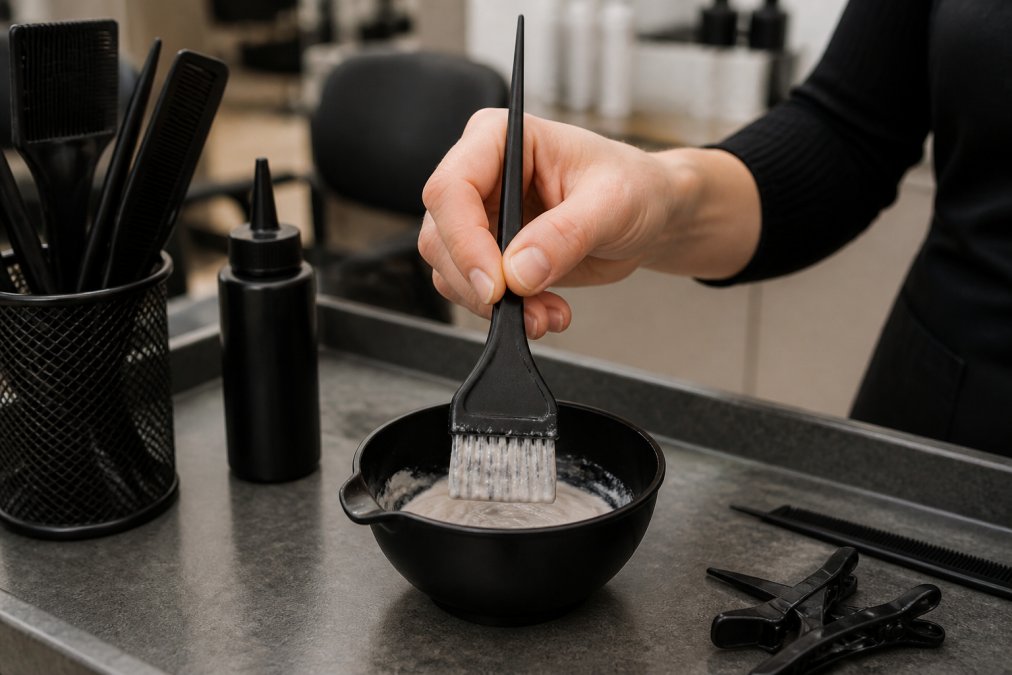
Apply only enough pressure to control the brush. Many colorists squeeze unnecessarily, thinking more pressure equals better precision. The opposite is true. A relaxed grip with confident brush movement produces cleaner application than a death grip with tentative strokes. Practice this technique on test applications before committing to client work. Your hand will feel less stable initially, but this discomfort passes within a few applications.
Adjusting Grip Pressure and Layering
Excessive pressure fatigues your muscles faster and reduces your ability to maintain precision as the session progresses. Let the brush do the work, the bristles are designed to deposit product evenly. You're guiding the brush, not forcing it.
Layering techniques reduce the need for excessive pressure. Build intensity gradually with multiple lighter passes rather than applying full-strength color in one pass. This approach gives you better control, produces superior color results, and dramatically reduces hand strain.
Alternate your grip hand periodically during longer sessions. If you're right-handed, switch to holding the brush with your left hand for certain sections when possible. This distributes fatigue across both sides of your body.
Monitor your grip pressure throughout the day by checking your hand position every 15-20 minutes. As fatigue accumulates, your natural tendency is to increase pressure to compensate for reduced control. A quick reset, consciously relaxing your grip and returning to neutral wrist position, prevents the pressure escalation that leads to cramping.
Ergonomic Hair Brushes for Professional Colorists
Why Brush Weight and Barrel Diameter Matter
Brush specifications directly impact hand strain during long coloring sessions. A heavier brush requires more muscular effort to control, accelerating fatigue. A brush with too-thin a barrel forces your fingers to grip more tightly to maintain control.
Professional-grade brushes are engineered with weight distribution in mind. The barrel diameter should allow your fingers to rest naturally without requiring a contorted grip. ESTL+CO's feathered brushes are designed with ergonomics as a primary consideration. The barrel diameter accommodates various hand sizes while the brush weight is optimized to require minimal muscular effort. This combination reduces the cumulative strain that builds during high-volume coloring days.
Test different brush weights and barrel diameters to find what feels most comfortable for your hand size and grip style. The best brush is the one that feels natural in your hand after a full day of work.
Feathered Brushes vs. Standard Brushes
Feathered brushes have bristles that taper gradually, creating softer edges and allowing for seamless blending. Standard brushes have densely packed bristles arranged in a uniform shape, excellent for precise, controlled application where you need defined edges.
Feathered brushes require less grip pressure for blending work because the tapered bristles naturally distribute product. Standard brushes, with their dense bristle packing, require more pressure to achieve smooth blending. For colorists who spend significant time on balayage or complex techniques requiring extensive blending, feathered brushes reduce hand strain considerably.
Many professional colorists maintain both brush types. Use feathered brushes for blending and seamless application work, and standard brushes for detail work and precise edge definition. This approach optimizes your technique for each application type while distributing the physical demands across different hand movements and muscle groups.
Hand Stretches for Hair Stylists
Pre-Session Warm-Up Routine
Begin your day with a structured five-minute warm-up before you start coloring. This routine prepares your hand muscles, increases blood circulation, and reduces injury risk.
Start with wrist circles. Extend your arm in front of you with your palm facing down. Slowly rotate your wrist in full circles, moving in one direction for 10 rotations, then reversing for 10 more. Do this with both hands.
Follow with finger flexion exercises. Make a tight fist, hold for two seconds, then spread your fingers wide and hold for two seconds. Repeat this 10 times with each hand.
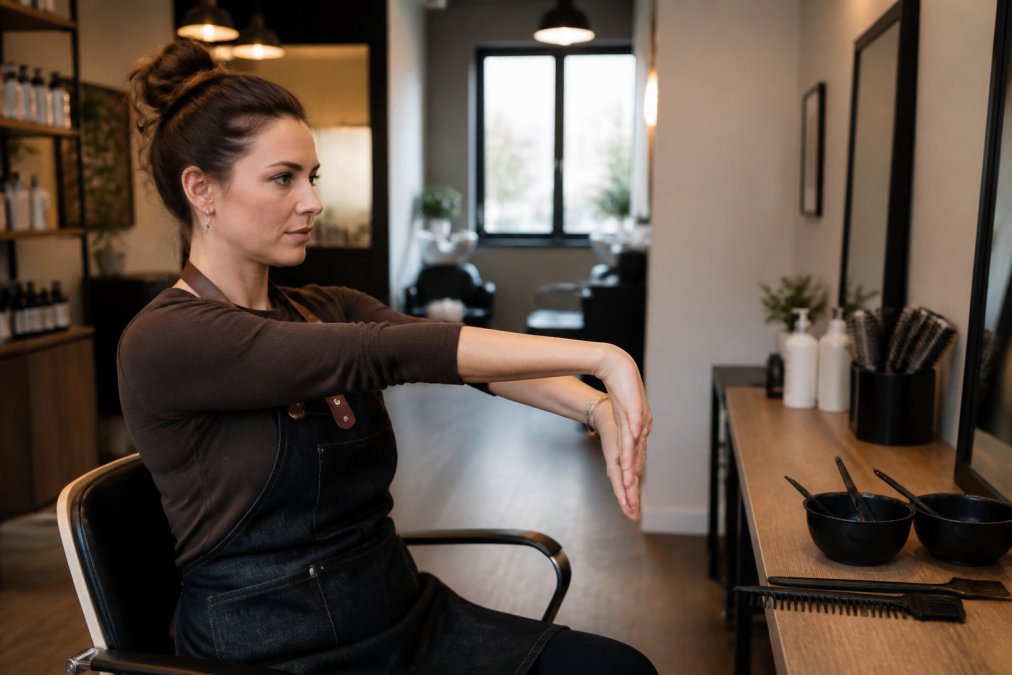
Perform the prayer stretch. Place your palms together in front of your chest with your elbows bent. Slowly lower your hands toward your waist while keeping your palms together, feeling a stretch along your inner forearms. Hold for 15-20 seconds and repeat three times.
Complete your warm-up with the reverse prayer stretch. Place the backs of your hands together behind your back. Gently press your hands together while straightening your arms slightly, feeling a stretch along the top of your forearms. Hold for 15-20 seconds and repeat three times.
Colorists who perform this warm-up consistently report reduced cramping and improved hand comfort by mid-morning.
Mid-Session and Post-Session Stretches
During your workday, take micro-breaks every hour to perform quick stretches. Even 60 seconds of stretching significantly reduces cumulative strain.
The wrist extension stretch is simple and effective. Extend one arm in front of you with your palm facing down. Use your other hand to gently pull your fingers back toward your body, creating a stretch along the top of your forearm. Hold for 15-20 seconds, then switch hands. Repeat twice per hand.
The finger extension stretch addresses individual digits. Extend one hand with your fingers spread wide. Using your other hand, gently press each finger backward for 5-10 seconds. Work through all five fingers on each hand.
At the end of your workday, perform a more comprehensive stretching routine. Include all the warm-up stretches plus additional work on your forearms and shoulders, since tension in these areas contributes to hand cramping.
The forearm self-massage is particularly effective post-session. Using your opposite hand, apply gentle pressure along your forearm muscles, working from your wrist toward your elbow. Spend 30-45 seconds on each forearm. This increases blood circulation and helps release muscle tension before it solidifies into stiffness.
Consistency matters more than intensity. Daily stretching produces better results than occasional intense stretching sessions.
Ergonomic Workspace Setup for Coloring
Your workspace significantly impacts hand strain. The ideal work surface height positions your elbows at approximately 90 degrees when your arms rest naturally at your sides (osha.gov). Your hands should reach your work surface without raising or lowering your shoulders.
Invest in a chair that supports proper posture. Your lower back should maintain its natural curve, your feet should rest flat on the floor, and your knees should bend at approximately 90 degrees. Poor seating forces you to compensate with hand and wrist tension.
Adequate lighting allows you to maintain correct posture and hand position throughout your session. Inadequate lighting forces you to lean closer to your work, which changes your hand positioning and increases strain.
Organize your tools and supplies within easy arm's reach. Reaching too far or too frequently strains your shoulders and forces your hands into awkward positions. A well-organized workspace reduces unnecessary hand movements and allows you to maintain proper positioning throughout your workday.
Tilting your station surface slightly (10-15 degrees) reduces the amount you need to bend your wrist during application work. This small adjustment significantly reduces wrist tension during long sessions.
Taking Micro-Breaks and Managing Session Duration
Micro-breaks are short interruptions, just 2-3 minutes, taken every 30-45 minutes during your workday (the CDC). These brief pauses allow your muscles to recover and prevent the cumulative fatigue that leads to cramping.
During a micro-break, step away from your work station. Shake out your hands gently, allowing your muscles to relax completely. Walk around briefly to change your posture and position. Perform 1-2 quick stretches. Return to work feeling refreshed.
The frequency of micro-breaks matters more than their length. A 2-minute break every 30 minutes produces better results than a 10-minute break every two hours.
If possible, avoid back-to-back coloring appointments without breaks. Scheduling 15-minute gaps between clients allows your hands to recover partially. Some colorists find that alternating between different types of work helps, spending an hour on precise detail work, then switching to consultation or administrative tasks for 20 minutes, then returning to coloring distributes the physical demands across your day.
Track your session duration and hand comfort to identify your personal fatigue threshold. Knowing your threshold allows you to schedule your day strategically and prevent reaching the point where cramping becomes inevitable.
Additional Support: Compression Gloves and Hand Care
Compression gloves provide external support that reduces hand strain during coloring work. These gloves apply gentle pressure to your hand muscles and joints, improving blood circulation and reducing fatigue. Many colorists find that wearing compression gloves during their workday noticeably reduces hand pain and cramping.
Choose a style that provides support without restricting your ability to perform detailed work. You need to maintain full dexterity for precise brush control. Fit is critical, gloves that are too loose provide minimal support, while gloves that are too tight restrict blood flow. Measure your hand carefully and follow sizing guidelines when selecting compression gloves.
Stay hydrated throughout your workday. Dehydration reduces blood circulation and increases muscle cramping. Drinking adequate water improves your body's ability to manage the physical demands of your work.
Maintain good overall fitness. Strong hands and forearms resist fatigue better than weak ones. Simple exercises like squeezing a stress ball or doing hand strengthening exercises 3-4 times per week build resilience.
Apply heat to your hands and forearms during breaks or after work. Warm water soaks or heat packs increase blood circulation and reduce muscle tension. Many colorists find that spending 5-10 minutes with their hands in warm water after their workday significantly reduces post-work soreness.
Preventing hand cramps during long coloring sessions requires attention to multiple factors working together. Your grip technique, brush selection, stretching routine, workspace setup, and break schedule all contribute to your hand health. Addressing these elements systematically transforms your comfort level and extends your career longevity.
At ESTL+CO, we understand that hand health directly impacts your ability to deliver precision color work. Our ergonomic feathered brushes are engineered with professional colorists in mind, featuring barrel diameters and weight distribution designed to reduce strain during high-volume days. Combined with proper technique and workspace setup, the right tools make a measurable difference in how your hands feel by day's end. Explore our collection of salon-grade tinting tools and discover how thoughtful equipment design supports your long-term career success.
Frequently Asked Questions
What stops hand cramps immediately during a coloring session?
Pause and perform a quick hand massage, focusing on the palm and forearm muscles. Stretch your fingers backward gently and rotate your wrist in slow circles. If available, apply a cold compress for 30 seconds to reduce inflammation. Loosen your grip pressure on the brush, many colorists unconsciously tighten their grip when fatigued, which accelerates cramping. Taking even a 60-second break every 20 minutes of continuous coloring prevents cramps from developing in the first place.
How does grip pressure affect hand cramping during long coloring sessions?
Excessive grip pressure is one of the primary causes of hand fatigue and cramping. When you squeeze the brush barrel too tightly, forearm muscles contract continuously, reducing blood circulation and accelerating muscle exhaustion. Professional colorists apply just enough pressure to control the brush, typically the same force you'd use to hold a pen for writing. Lighter pressure distributes the workload across more hand muscles rather than overloading specific tendons and joints. Practicing pressure control with ergonomic brushes reduces strain significantly.
Why does repetitive coloring cause hand pain?
Repetitive hand motions during long coloring sessions cause repetitive strain on tendons, muscles, and joints. The fine motor skills required for precision work, especially balayage and complex techniques, demand constant micro-adjustments in grip, wrist angle, and finger positioning. Without adequate breaks and stretching, this repetitive strain leads to inflammation, tendonitis, and carpal tunnel symptoms. Hand fatigue also worsens posture and grip pressure, creating a cycle that accelerates pain. Proper ergonomic technique, micro-breaks, and targeted stretches interrupt this cycle and allow tissues to recover.
Can ergonomic brushes really reduce hand strain compared to standard brushes?
Yes. Ergonomic brushes designed for professional colorists feature lighter barrels, optimized grip zones, and balanced weight distribution that reduce the muscular effort required to control the brush during long sessions. Feathered brushes with contoured grips encourage proper hand positioning and reduce grip pressure naturally. Standard brushes often have heavier, slicker barrels that require tighter gripping and more wrist tension. Colorists who switch to ergonomic brushes report noticeably less hand fatigue by the end of their shift, especially during high-volume days requiring precision work like balayage and foil placement.
This article was written using GrandRanker