

How to Lighten Dark Hair Without Harsh Lines
Quick Summary
To lighten dark hair without harsh lines, work in thin layers, avoid heavy block sections, and feather product from mid-length toward the ends and root. Do a strand test first, rinse when the lift matches it, and tone away any brassy warmth.
- Do a strand test on a hidden section and check lift at five-minute intervals.
- Use diagonal or zigzag partings instead of straight, horizontal block sections.
- Apply thinner product at the ends, since ends lift faster and create banding.
- Blend each section's edge into its neighbor instead of stopping at the section line.
- Tone after rinsing to neutralize the red-orange warmth dark brown hair lifts to.
Table of Contents
- Why Dark Hair Shows Harsh Lines When Lightened
- Assessing Your Hair Before You Lighten It
- How to Lighten Dark Brown Hair Without Bleach
- How to Lighten Dark Brown Hair at Home Step by Step
- Balayage Tools for Seamless Highlights
- How to Fix Hair Dyed Too Dark Without Creating Banding
- Booking Your First Blended Lightening Session with ESTL+CO Tools
- Frequently Asked Questions
Why Dark Hair Shows Harsh Lines When Lightened
Dark hair shows harsh lines because the lightening is uneven, not because lighten dark hair is wrong to attempt. When a section lifts faster than the sections next to it, the difference shows up as a band of brassy color with a sharp edge. The fix is blending the lightener into the hair so the transition stays soft.
Most harsh lines come from three things. Lightener sits too heavy at one point. Sections overlap in a block instead of a sweep. Or the lightener is pulled straight to the ends with no feathering.
- Heavy application: Thick product lifts faster and leaves a visible stripe.
- Block sections: Straight part lines lift as one solid band.
- Dry-looking ends: Ends often lift more than roots, creating a clear line.
Keep this in mind as you read. The goal is color that fades into the rest of the hair, not a shape that stands out.
Assessing Your Hair Before You Lighten It
Before you mix anything, sort your hair into one of two categories, because the two behave differently under lightener and lead to different plans.
Category 1: Natural, untreated hair. Virgin hair, never dyed, bleached, relaxed, or permed, lifts in a more predictable way. Dark brown and black natural hair typically goes through a warm progression as it lifts: red, then red-orange, then orange, then yellow-orange. That warmth is normal and is what toner corrects later. Natural dark brown hair can lift several levels in one session with a professional lightener, but the risk of damage climbs as lift increases.
Category 2: Previously colored or chemically treated hair. This is where harsh lines are born. Color does not reliably lift color. If your hair has dye on it, especially a box dye or a color applied over another color, a lightener has to push through the artificial pigment first, and it will lift unevenly wherever the old color sat thicker or older.
Porosity and texture change the timing. High-porosity hair, hair that absorbs and releases moisture quickly, often from heat styling, sun, or prior chemical work, takes lightener fast and can over-process before you notice. Low-porosity hair resists lift and may need more time or a higher volume developer, which raises damage risk. Fine hair lifts faster than coarse hair; coarse hair may need a longer processing time but tolerates it better.
Do a strand test on every category, every time. Take a small hidden section, behind the ear or at the nape, and run the exact product and timing you plan to use. Check the lift at five-minute intervals rather than trusting the package time. Note two things: the level it reaches and whether the color is even from root to tip. If the strand shows a visible band where the old color meets the new growth, your full application will too, and you need a different plan.
Watch out: If the strand test feels gummy, stretches when wet, or breaks with a light tug, stop. That hair is not a candidate for lightening until it recovers, and proceeding will create breakage rather than a soft blend.
How to Lighten Dark Brown Hair Without Bleach
Bleach is the usual choice when you want to lighten dark hair, but not every person wants it. Dark brown hair can lighten a few shades without bleach, though the results are gentler and slower.
Expect less lift. Non-bleach methods usually work best on hair that only needs a slight change in tone or brightness.
Natural Methods and Their Limits
Many people try lemon juice, chamomile or honey. These can add a slight lift in strong sun, but results are unpredictable. They rarely lift dark brown hair more than a shade or two, and the lift is often uneven.
Clarifying shampoo can fade dye too, but it removes color rather than lifting it. It will not create a blended, lighter effect on its own.
Use natural methods when your goal is a subtle change or you want to avoid chemicals. Choose a professional lightener when you need a clear, even lift.
How to Lighten Dark Brown Hair at Home Step by Step
The steps below are ordered so that the blending happens by design, not by luck. The single biggest cause of harsh lines is applying lightener in a solid block and hoping the edge fades. It will not. You have to build the fade into the placement.
- Prepare the hair. Wash with a clarifying shampoo one day before, not the same day, to remove buildup so the lightener contacts hair evenly. Do not condition just before lightening; conditioner can block lift and create patchy results. Do not wash the day of the application.
- Section with a purpose. Skip the straight, block-like parts. Work in small, loose sections no wider than about a quarter inch, and take diagonal or zigzag partings rather than horizontal lines. Diagonal partings stagger where the lightener starts, so any line that does form is broken up instead of running straight across the head.
- Mix to the package ratio and no thicker. Follow the manufacturer's ratio exactly. A common mistake is mixing a thicker paste because it feels easier to control, thick product sits heavy, lifts faster in that spot, and leaves a stripe. Keep the consistency close to the package recommendation.
- Apply mid-length first, then feather both directions. Start the lightener at the mid-length of each section, then feather it upward toward the root and downward toward the ends with a light, sweeping brush motion. Keep the product thinner at the ends than at the mid-length. Ends are more porous and lift faster; a heavy application there is what creates the dry-looking band at the bottom.
- Blend every edge into its neighbor. After placing a section, take the brush and feather the edge of that section into the hair beside it, do not stop at the section line. This is the step most at-home applications skip, and it is the one that produces a soft transition instead of a visible edge.
- Work in passes, not one heavy coat. Apply a thin layer, let it process, check, then add another thin layer if you need more lift. Thin passes give you control; one heavy coat gives you a stripe.
- Check the lift against your strand test, not the clock. Look at the strand test result and compare. Rinse when the lift matches the strand test, even if the package time has not elapsed. Over-processing past the strand test result is how warmth turns brassy and how damage starts.
- Tone to correct warmth. Dark brown hair almost always lifts warm. A toner neutralizes the red-orange or orange and makes the result read as a soft brown or brown-blonde rather than a brass band. Tone after rinsing and before deep conditioning.
- Deep condition and assess. Use a deep conditioner to address dryness. Wait at least a few days before judging the final color; tone and condition settle over the first wash or two.
| Step | Goal | Common Mistake |
|---|---|---|
| Clarify | Clean, even base | Skipping it or conditioning right before |
| Section | Staggered starts | Straight, horizontal block parts |
| Apply | Thin at ends, mid-length first | Heavy, thick application |
| Blend | No visible edge | Stopping at the section line |
| Check | Match the strand test | Rinsing on the clock instead |
| Tone | Neutralize warmth | Skipping toner on warm lift |
Watch out: If you see banding forming mid-process, a visible line where one section has lifted further than the next, do not try to fix it by adding more lightener to the darker side in the same session. Rinse, assess, and correct in a separate session. Layering more product over a band in one sitting usually makes the band sharper, not softer.
Balayage Tools for Seamless Highlights
The right tools make blending easier. A feathered brush helps you sweep color softly, so the edge of each section fades into the hair around it. The Hair Color Brushes come with two professional salon hair color brushes per box, in Black, Beige, Mauve and Violet, at $16.00.
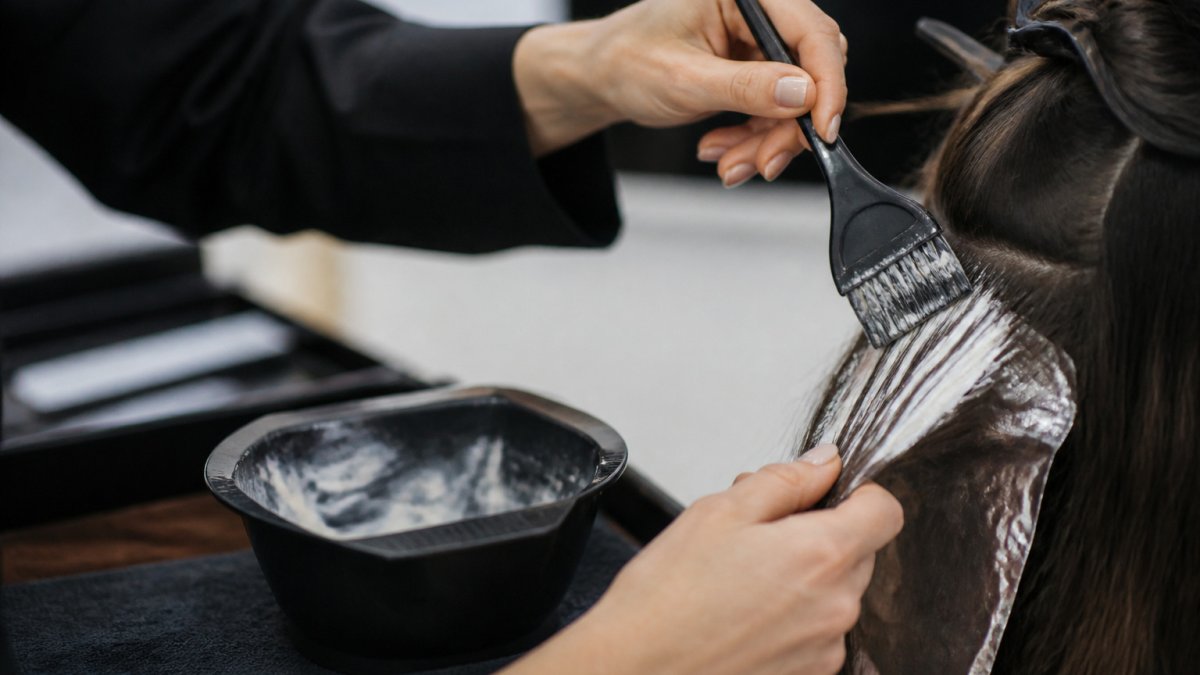
For mixing and holding product, the Hair Color Bowls come with two bowls per box, in Black, Mauve and Beige, at $19.00. The U-shaped cutout holds the brush in place between sweeps, and the tilted edge keeps product in the bowl.
The feathered brush is designed for blending, and its tapered tip creates neater sections. You can browse the Hair Color Brushes for soft, seamless application and choose the set that suits your sweeps.

Hair Color Brushes: https://estlco.com/products/hair-color-brushes
Hair Color Bowls: https://estlco.com/products/hair-color-bowls

For more on choosing tools, read Best Hair Color Tools for Balayage: Pro Picks for 2026. If you want a guide to brushes for blending color, see Best Brushes for Color Melting: A Seamless Blend Guide.
How to Fix Hair Dyed Too Dark Without Creating Banding
Banding happens when corrected sections lift at a different rate than the rest of the hair. To fix it, work slowly and blend every edge.
Start with a strand test to see how the hair responds. Apply the product in thin layers and check the results between passes. Stop when the color is even, even if it is not as light as you planned.
For a deeper walkthrough, see How to Achieve Seamless Hair Color Blends 2026. For fixing brassy tones after lightening, see Hair Color Correction for Brassy Blonde: A Step-by-Step Guide.
Watch out: Lightening hair that already has heavy dye or recent chemical treatment can cause breakage. If the hair feels gummy or stretches easily when wet, stop and seek help from a professional colorist.
Booking Your First Blended Lightening Session with ESTL+CO Tools
Blended lightening is a skill that improves with practice. ESTL+CO makes professional hair color tint brushes and bowls designed for precise, controlled application. The brushes feature a feathered design, and the bowls hold product in place during the process.
Start with the Hair Color Brushes at $16.00 and the Hair Color Bowls at $19.00. Use a strand test on your next session, then apply in thin, blended sweeps.
Ready to try blended lightening? Shop Hair Color Brushes and Hair Color Bowls from ESTL+CO and get your tools ready for your next session.
Frequently Asked Questions
How can I lighten my dark hair without damaging it?
Lighten in small, gradual steps rather than one aggressive session. Start with a strand test on a hidden section to see realistic lift, use a lower-volume developer when possible, and avoid reapplying lightener to hair that is already porous or breaking. Deep conditioning between sessions helps protect the hair shaft. If the hair feels gummy, stretchy, or snaps easily when wet, stop and let it recover before any further lightening.
How do you lighten dark hair without creating harsh lines?
Apply product in soft, feathered sweeps and blend the placement into the surrounding color rather than painting solid sections. A tapered brush and a tint bowl that holds product in place are the tools built for this kind of controlled placement. Feathering the ends of each section and checking the transition halfway through the process prevents the abrupt band that often shows up when dark hair is lifted too quickly.
Can you lighten dark brown hair without bleach?
Yes, but the lift is limited. Natural options such as lemon juice or sun exposure can brighten dark brown hair slightly, though results are uneven and inconsistent across strands. Clarifying shampoo can fade some artificial color. For a noticeable change on dark brown hair, a lightener designed for that purpose is generally more reliable, and a strand test will show you how much lift to expect before you commit to the full head.
How can I fix hair that was dyed too dark?
Start with a clarifying shampoo to remove some surface color, then assess how the hair responds. Color removers can lift artificial dye, but they can also cause damage if overused, so follow the product directions closely and stop if the hair becomes overly dry or breaks. For best results, allow hair to recover between attempts and consult a professional colorist for correction if the color is uneven or the hair is compromised.
