

Best Hair Color Tools for Balayage: Pro Picks for 2026
Table of Contents
- Why the Right Balayage Tools Make or Break Your Color Work
- Quick Comparison: Best Hair Color Tools for Balayage
- 1. Hair Color Brushes: The Feathered Brush That Reduces Hand Fatigue
- 2. Hair Color Bowls: Stain-Resistant Bowls Built for Back-to-Back Clients
- 3. Asymetrie Collection Foils: No-Slip Foils for Complex Balayage Work
- 4. Barrier Cream Stick: Protecting the Hairline During Color Services
- How to Build a Professional Balayage Brush Set
- Balayage Application Techniques for Beginners
- Frequently Asked Questions
Last Updated: September 26, 2026
Why the Right Balayage Tools Make or Break Your Color Work
The best hair color tools for balayage are the ones that let you place product exactly where you intend, section after section, without your hand cramping by client four. Balayage lives or dies on soft, seamless transitions, and those transitions come from control: the right bristle shape, a bowl that stays put, foils that grip instead of slide, and a barrier that keeps color off the skin.

This guide from ESTL+CO breaks down the four tools that do the heavy lifting in a professional balayage setup, what each one actually changes about your application, and how to build a brush set that holds up to back-to-back services.
Here's what most guides get wrong: they treat balayage as a technique problem. It's usually a tool problem wearing a technique costume.
Quick Comparison: Best Hair Color Tools for Balayage
Here's the short version before the detail. Every pick below is professional grade and built for repeated color services.
| Tool | Price | What It Fixes | Best For |
|---|---|---|---|
| Hair Color Brushes | $16.00 (2 per box) | Hand fatigue, uneven saturation | Freehand color placement |
| Hair Color Bowls | $19.00 (2 per box) | Staining, brush mess, tipping | High-volume color stations |
| Asymetrie Collection Foils | $17.50 (500 sheets) | Sliding foils, slow setup | Complex foil and balayage work |
| Barrier Cream Stick | $26.50 (35 g) | Color bleeding at the hairline | Sensitive skin, clean hairlines |
1. Hair Color Brushes: The Feathered Brush That Reduces Hand Fatigue
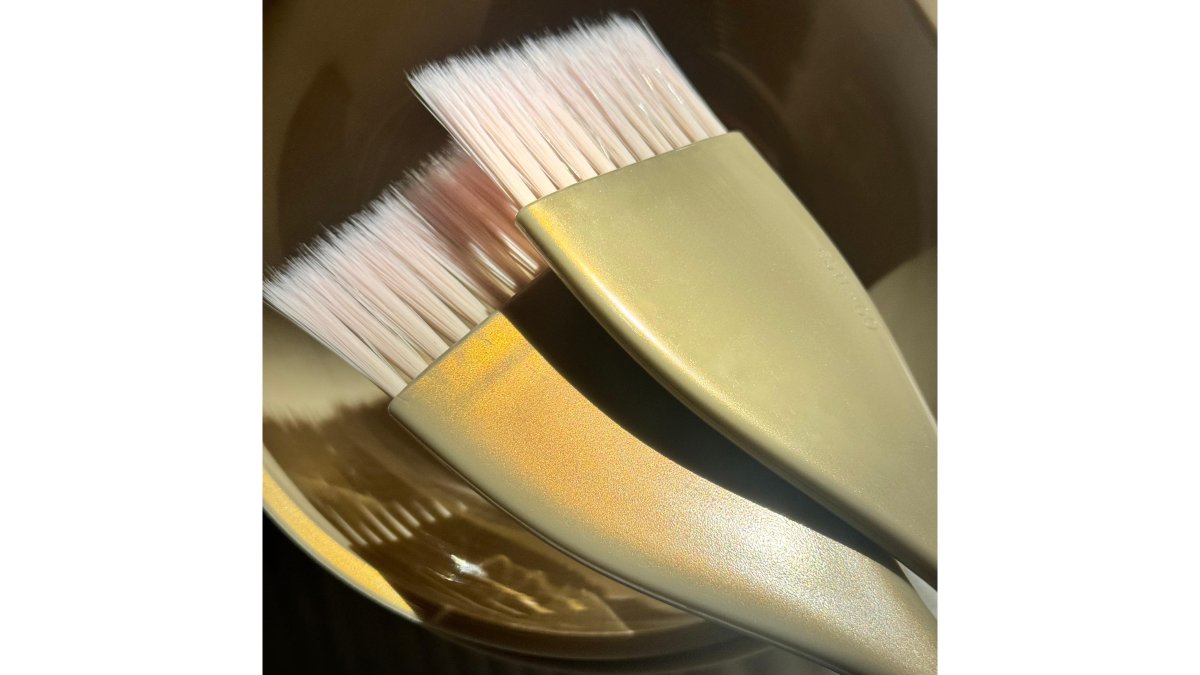
A feathered brush is a tint brush with a widened bristle area that spreads color across a section in fewer sweeps. ESTL+CO's Hair Color Brushes ($16.00 for two) use a wide feathered tip and a tapered tip for neater sections. The wide base gives you an easier grip, and the ergonomic handle is shaped to prevent the tension and pinching that leaves your fingers cramped.

For balayage, saturation is everything. A stiff-bristled brush drags product; a feathered brush lays it down so the lightener meets the hair evenly, which is what produces a seamless transition instead of a stripe.
2. Hair Color Bowls: Stain-Resistant Bowls Built for Back-to-Back Clients
A professional color bowl should hold product, hold your brush, and survive a full day of services without staining. ESTL+CO's Hair Color Bowls ($19.00 for two) are stain resistant in every shade, sized to sit in the palm of your hand, and shaped with a tilted edge that keeps dye in the bowl while you work.
The U-shaped cutout is the detail most people miss. It parks your brush between sweeps of color application, so you're not balancing a loaded brush over a client's shoulder or wiping it on a towel every 30 seconds.
3. Asymetrie Collection Foils: No-Slip Foils for Complex Balayage Work
Sliding foils ruin precision work. The Asymetrie Collection ($17.50) uses an embossed, no-slip design that stays stable at the root and holds dyed hair in place while you apply color or bleach. Each sheet measures 5 inches by 11 inches at 12 microns thickness, with 500 pre-cut, pre-folded sheets per box in an easy-pop dispenser.

That pre-folded format matters more than it sounds. Setup time per client drops when you're not folding foils by hand, and the pop-up box keeps the stack organized on a crowded station.
4. Barrier Cream Stick: Protecting the Hairline During Color Services
Color bleeding at the hairline is the fastest way to turn a clean balayage into a cleanup job. The Barrier Cream Stick ($26.50) applies in stick form for a fast, mess-free line around the hairline. It's hypoallergenic with a subtle vanilla scent, made in the USA with an Italian formulation, and sized at 35 grams, the largest on the market.
For clients with sensitive skin, a hypoallergenic barrier is worth having on the station.
How to Build a Professional Balayage Brush Set
A professional balayage brush set comes down to three things: a feathered brush for blending, a precision applicator for detail work at the root, and a bowl that holds both without tipping. But the brush that works on a fine-haired client is not the brush that works on coarse, curly hair, and most guides skip that distinction entirely. Bristle stiffness and brush width should change with the hair in front of you.
Match bristle stiffness to hair texture.
- Fine or low-density hair: Use a softer, more flexible bristle. Stiff bristles dump too much product on fine strands, which floods the section and kills the soft transition balayage depends on. A soft feathered brush lets you feather the lightener out gradually.
- Medium texture, straight to wavy: A medium-stiffness feathered brush is the workhorse. It holds enough product to saturate a panel in one or two sweeps without dragging.
- Coarse, thick, or curly hair: Use a firmer bristle and a wider brush head. Coarse cuticles resist absorption, so you need more product delivered faster and with more pressure to drive it in. A stiff brush also helps you separate dense curl patterns without re-dipping every few seconds.
Here's the practical build order:
- Feathered brush first. It handles the bulk of color placement and blending across most hair types.
- Add a precision applicator. Use it for root touch up work, face-framing pieces, and tight sectioning.
- Add a firmer brush if you work on coarse or curly hair regularly. This is the tool most starter sets are missing.
- Match your bowl to your volume. Two bowls means one mixing while the other is in use.
- Keep foils within reach. Pre-cut sheets cut setup time on foil-heavy services.
Balayage Application Techniques for Beginners
Balayage application techniques for beginners start with sectioning and saturation, not speed. Section the hair cleanly with clips, load the brush consistently, and work in thin, manageable panels so the lightener meets the hair evenly. But the mistakes that ruin beginner balayage are almost always tool mistakes, not technique mistakes, and most guides never connect the two. Here is how to diagnose the problem by the result you are seeing.
- Keep saturation even. Thin, patchy application shows up as banding after processing.
- Respect processing time. Check the hair rather than trusting the clock alone.
- Watch for bleeding. A barrier at the hairline prevents color from creeping onto skin.
- Match tools to hair porosity. Porous hair grabs color fast, so work in smaller sections and check sooner.
- Sanitize between clients. Clean brushes and bowls protect your results and your reputation.
Frequently Asked Questions
What tools are essential for professional balayage?
A professional balayage setup requires a feathered tint brush for seamless color placement, a stain-resistant color bowl, sectioning clips, foils for isolating strands, and protective gloves. A barrier cream stick helps prevent color stains along the hairline. Each tool serves a specific purpose: the brush controls saturation, the bowl holds mixed lightener, and foils manage processing. Investing in ergonomic, professional-grade tools reduces hand strain during long appointments and improves color placement consistency.
How do feathered brushes improve balayage application?
Feathered brushes have a widened bristle area that spreads color more evenly across the hair section. The tapered tip creates cleaner sections, while the feathered edge softens the transition between painted and unpainted hair. This produces the seamless, dimensional color that defines good balayage. The wider base also gives a more comfortable grip, which reduces tension and pinching during repetitive sweeping motions. For freehand highlighting and hair painting, this control directly affects how natural the final blend looks.
What is the difference between standard tint brushes and balayage-specific brushes?
Standard tint brushes work for root touch-ups and full-color applications where precision at the scalp matters most. Balayage-specific brushes, like feathered brushes, have a wider, softer bristle spread designed for sweeping color across mid-lengths and ends. The feathered edge creates a softer saturation line, which is critical for the seamless transition balayage requires. Using a standard brush for freehand highlighting often leads to harsh lines or uneven saturation because the bristles are too stiff and narrow for sweeping motions.
How do you maintain professional hair color tools for longevity?
Rinse brushes immediately after each service to prevent color from drying in the bristles. Use warm water and a mild soap, working from the ferrule to the tip. Store brushes bristle-up in a clean container. Stain-resistant bowls should be wiped and washed after every client. Foils are single-use, but keeping them in their pop-up dispenser prevents creasing. Regular sanitization between clients is both a hygiene requirement and a way to extend the life of your tools.
Are there specific tools recommended for hand-painted balayage techniques?
Hand-painted balayage relies on a feathered brush with a wide bristle area for controlled saturation and a lightweight bowl that fits comfortably in the palm. The brush needs enough flex to sweep color without dragging, and the bowl should have a U-shaped cutout to hold the brush between sweeps. A barrier cream stick protects the hairline during freehand work. These tools support the fluid, sweeping motion that hand-painted balayage requires, especially when working on multiple clients in a day.