

Benefits of Feathered Bristles for Color Application
Table of Contents
- What Feathered Bristles Actually Do for Color Application
- Feathered vs. Straight Bristle Color Brush: When to Use Each
- Choosing a Hair Color Brush for Balayage and Foilayage
- How a Hair Color Brush for Blending Creates Seamless Transitions
- Brush Size and Section Coverage: Matching the Tool to the Job
- How to Clean Hair Color Brushes and Extend Bristle Life
- When Feathered Bristles Are the Wrong Choice
- Frequently Asked Questions
Last Updated: October 7, 2026
What Feathered Bristles Actually Do for Color Application
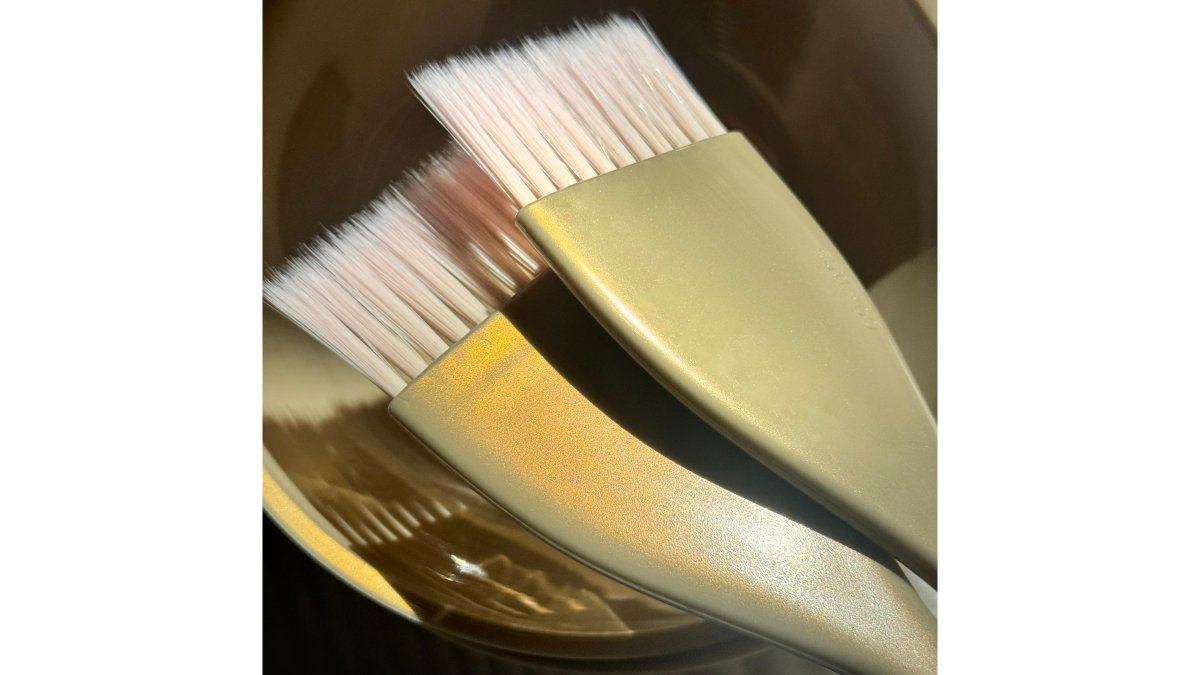
Feathered bristles are the soft, tapered fibers at the tip of a color brush that spread dye evenly across a strand instead of dumping it in one spot. At ESTL+CO, we build every feathered brush around one goal: control over where color lands and how it fades into the next section.

A stiff brush pushes product in a thick stripe; a feathered brush releases it in a soft, graduated layer. The benefits come down to three things: softness, flexibility, and taper.
Bristle Softness, Flexibility, and Color Distribution
Soft bristles hold liquid without flooding the strand. Too much product gives you a hard line; too little looks patchy.
Flexible bristles bend as you sweep, following the curve of the head so you can push color through a section in one smooth stroke.
Here is how the three traits work together:
- Softness controls how much color releases on contact
- Flexibility keeps the brush moving with the hair, not against it
- Taper narrows the tip so you can place color with precision
Tapered Edges and Controlled Placement
Tapered edges turn a broad brush into a precision tool. The wide base covers ground fast.
Sweep the bulk of the section with the flat of the bristles, then flip to the taper for the hairline or a delicate face-frame line.
A common mistake is treating a feathered brush like a flat brush. If you press hard, you lose the taper's advantage.
Feathered vs. Straight Bristle Color Brush: When to Use Each
A feathered brush blends; a straight bristle brush saturates. Straight bristles are firm and flat across the tip, pushing a lot of product fast, great for full-coverage root retouches that need a solid, even blanket of color. Feathered bristles are soft and tapered, releasing color gradually, the better pick for anything that needs a soft transition.
| Job | Best Brush Type | Why |
|---|---|---|
| Full root retouch | Straight bristle | Firm tip saturates fast |
| Balayage sweep | Feathered bristle | Soft release, no hard line |
| Foilayage packing | Straight or medium | Even saturation in the foil |
| Face-frame detail | Feathered bristle | Tapered tip for control |
| Color melting | Feathered bristle | Gradual blend between shades |
Most working colorists keep both on the station: feathered for blending and detail, straight for bulk saturation.
If you only own one, match it to your main service. Balayage and freehand specialists get more daily use from a feathered brush.
Choosing a Hair Color Brush for Balayage and Foilayage
A hair color brush for balayage needs a soft tip and a comfortable grip you can hold for hours.
For balayage, look for a feathered tip that lets you feather the color upward as you paint, keeping ends saturated and mid-lengths soft.
For foilayage, the foil does some of the work, but a medium feathered brush keeps the application even so the foil processes uniformly.
Freehand Painting and Interweave Techniques
Freehand painting rewards a light touch: hold the brush at a low angle and sweep with the direction of the hair. The feathered tips deposit color where they touch and skip where they lift. Interweave is the same idea on a finer scale, weave the brush through small subsections to break up the color for a softer grow-out. Both techniques depend on bristle flexibility: a stiff brush cannot feather, it leaves a footprint, while a feathered brush leaves a gradient.
How a Hair Color Brush for Blending Creates Seamless Transitions
A hair color brush for blending releases color in layers rather than one solid block: each pass adds a thin veil of pigment, and stacked veils create a seamless blend. That layering depends on three variables you control before the brush touches the hair: product viscosity, hair texture, and stroke angle.
The Mechanism: How Feathered Tips Layer Pigment
A feathered tip has graduated bristle density: sparse outer fibers and a dense inner core. When you sweep, the outer fibers release a thin film of color first, and the core releases more as pressure increases, creating a soft zone instead of a line.
A straight-cut brush has uniform density, so every bristle releases at the same rate and the deposit edge is as sharp as the bristle line, it cannot feather no matter how lightly you press.
Product Consistency Changes Everything
Viscosity determines whether your feathered tip can actually layer:
- Thin, fluid color (lightener with a loose consistency): releases fast and floods the taper. Reduce load to one-quarter of the bristle length and sweep faster.
- Medium cream (standard permanent color): the ideal match for feathered tips. Loads evenly, holds the taper, releases in a controlled film.
- Thick, stiff color (heavy ash or high-lift formulas): resists release from soft bristles. You will press harder to compensate, which flattens the taper and defeats the brush. Thin the formula slightly or switch to a medium-firm brush.
If your blend keeps coming out patchy, check consistency before you blame the brush.
Hair Texture and Density Adjustments
Hair type changes how much pressure the feathered tip needs:
- Fine, low-density hair: very light pressure. The cuticle absorbs quickly and a feathered tip can over-deposit in a single pass.
- Medium texture, normal density: standard pressure, one smooth stroke per subsection.
- Coarse, high-density hair: the cuticle resists penetration. Use firmer pressure on the first pass, then feather the second pass with light pressure to soften the transition.
For coarse hair that resists a light deposit, pair a firm brush for the base with the feathered tip for the transition zone.
Stroke Angle and the Pressure Gradient
Hold the brush at roughly a 30- to 45-degree angle to the section. A low angle keeps the tips in contact with more surface area, spreading the deposit; a high angle concentrates them into a narrow line, sharpening the edge. Vary pressure within a single stroke: start firm at the darker end and ease off as you pull into the lighter shade.
A few habits that sharpen your blending:
- Start the stroke in the darker shade and pull into the lighter one
- Keep the brush moving; stopping creates a blotch
- Wipe the tip between shades to avoid muddying the transition
Brush Size and Section Coverage: Matching the Tool to the Job
Brush size decides how much hair you can cover in one pass: a wide brush covers larger sections fast, a narrow brush gives control on small areas. The useful question is not 'which size' but 'which size for this subsection', where placement actually succeeds or fails.
Match Brush Width to Subsection Width
The practical rule: your brush width should roughly equal the width of the subsection you are painting, not the whole section. If you part a two-inch section and weave it into half-inch subsections, you want a brush that covers about half an inch in one pass.
A common pattern among colorists working freehand:
- Wide feathered brush (roughly 2 to 2.5 inches): back of the head, large mid-length panels, bulk balayage sweeps where the subsection is wide and the placement is simple.
- Medium feathered brush (roughly 1.5 inches): the workhorse. Mid-size sections, blending zones, foilayage packing where you want even saturation without flooding.
- Narrow tapered tip (roughly 0.5 to 1 inch): hairline, part line, face frame, and any interweave work where subsections are thin.
If your brush is wider than the subsection, color bleeds past the placement line. If it is narrower, you make multiple passes and risk overlapping deposits that read as a band.
Sectioning Geometry That Supports the Brush
Clean, even sections let a wide brush do its job. Messy sections force you back to a small brush. The geometry matters more than most colorists admit:
- Horizontal partings for balayage sweeps that move side to side. The brush travels along the parting line.
- Diagonal partings for face-framing and money-piece work. The diagonal follows the natural fall of the hair and hides the transition.
- Vertical partings for foilayage and root-to-end saturation. The brush moves down the section in one direction.
Keep subsection depth consistent, if one is an inch deep and the next three inches, your brush load and pressure will be inconsistent, and the deposit will show it.
Detail Level Determines the Tool
Ask one question before you pick up a brush: how precise does this placement need to be?
- Low precision (bulk coverage, back of head): wide brush, fast strokes, load generously.
- Medium precision (blending zones, mid-length transitions): medium brush, controlled strokes, load to one-third of the bristle.
- High precision (hairline, part line, face frame, interweave): narrow tapered tip, slow strokes, light load.
Matching precision to tool keeps a complex service from turning into a correction:
- Large sections and back of the head: wide feathered brush
- Mid-size sections and blending zones: medium brush
- Hairline, part line, and face frame: narrow tapered tip
ESTL+CO's professional salon hair color brushes come two to a box with a wide feathered tip and a tapered edge. That pairing covers both bulk application and detail work in one purchase.
How to Clean Hair Color Brushes and Extend Bristle Life
Here is a routine that protects feathered bristles:
- Rinse the bristles under lukewarm water right after use
- Work a drop of gentle soap through the fibers with your fingers
- Rinse until the water runs clear
Standing a wet brush upright lets water seep into the handle and loosen the bristles over time.
Bristle shedding usually signals harsh cleaning or heat: hot water and rough handling break down the fibers, while lukewarm water and a light touch keep them whole.
A well-cared-for feathered brush holds its softness for months of daily use, longevity that matters especially if you move between studios and pack your kit often.
When Feathered Bristles Are the Wrong Choice
Feathered bristles are not the answer for every service.
Where feathered bristles fall short:
- Heavy root coverage that needs dense saturation
- Sharp, graphic color blocking with hard edges
- Very thick, coarse hair that resists a light deposit
The honest limitation: a feathered brush trades speed for control. If your service does not need control, you are giving up time for nothing. Pick the tool that matches the job.
Color work lives and dies on control, and the brush in your hand decides how much of it you have. Get started with ESTL+CO and give every blend, sweep, and detail line the precision it deserves.
Frequently Asked Questions
What are feathered bristles on a hair color brush?
Feathered bristles are soft, flexible bristles with tapered edges that fan out slightly rather than forming a flat, uniform wall. On a color brush, this shape lets you pick up and release product gradually, so color spreads evenly instead of landing in one heavy patch. The tapered tip also creates neater sections, which matters when you are working close to the root or painting a fine highlight. ESTL+CO's Hair Color Brushes use a wide feathered tip for this reason, and each box includes two brushes.
What is the difference between feathered and straight-bristle color brushes?
Straight-bristle brushes hold a firm, flat edge that pushes product into the hair with more pressure. They work well for saturating large sections quickly, such as a full root retouch. Feathered bristles flex as you sweep, which softens the edge of each stroke and makes blending easier. The trade-off is control versus speed: feathered bristles give you gradual color distribution and smoother transitions, while straight bristles give you faster coverage on dense sections.
Are feathered tint brushes better for balayage?
For balayage and foilayage, feathered bristles are usually the better fit because the technique depends on soft, diffused placement rather than saturated blocks of color. The flexible tip lets you feather the product out as you paint, which creates the natural-looking gradient balayage clients ask for. A firm brush tends to leave a harder line where the stroke ends. That said, many colorists keep both on the station and switch depending on the section they are working.
How should you clean and care for a hair color brush?
Rinse the bristles under lukewarm water as soon as you finish, working from the base of the bristles outward. Use a small amount of mild soap and comb through with your fingers to clear product trapped near the ferrule. Shape the bristles back into place and dry the brush flat or bristle-down, never upright, so water does not sit in the handle. Stain-resistant brushes like ESTL+CO's hold up better to repeated color exposure, but consistent rinsing is what actually extends bristle life.