

7 Steps to Keep Dimensional Hair Color Looking Fresh
Last Updated: November 1, 2026
Quick Summary
Dimensional hair color fades unevenly because highlights and lowlights sit on different strands with different porosity, so each piece loses tone at its own pace. To keep it fresh between salon visits, wash less often in lukewarm water, use a color-safe shampoo, and refresh tone with depositing products matched to the shade you are fighting.
- Use a color-safe, sulfate-free shampoo and rinse lengths with cool water.
- Strand-test any depositing product before applying it to your whole head.
- Use depositing shampoo once or twice a week and masks every one to two weeks.
- Watch for buildup on bleached ends and pause depositing products if it appears.
- Ask your colorist for a written maintenance plan before you leave the salon.
Table of Contents
- Why Dimensional Color Fades Faster Than Solid Color
- Step 1: Choose a Color-Safe Shampoo for Highlights
- Step 2: Wash Less Often and Use Cool or Lukewarm Water
- Step 3: Refresh Tone With Color-Depositing Products
- Step 4: Add a Hair Gloss Treatment Between Visits
- Step 5: Protect Lengths From Heat, Sun, and Mineral Buildup
- Step 6: Plan Balayage Touch-Ups on a Realistic Schedule
- Booking Your Next Color Appointment With a Maintenance Plan
- Frequently Asked Questions
Why Dimensional Color Fades Faster Than Solid Color
Dimensional hair color fades faster than solid color.
Lightened lengths are the usual culprit. Bleached strands have lost some natural protection, so they take on moisture, heat and sun more readily than the untouched hair around them, which is why highlights turn brassy while the root area still looks fine.
Here is what usually happens over time:
- Highlighted ends turn warmer or more yellow
- Lowlights lose depth and look flat
- Root regrowth creates a hard line against the lightened mid-lengths
Knowing this helps you plan. You cannot stop fading, but you can slow it and keep the transitions soft.
Step 1: Choose a Color-Safe Shampoo for Highlights
Start with the shampoo you use every day. A sulfate-free, color-safe formula is generally a gentler choice for lightened hair, since harsh cleansers can strip tone and moisture quickly.
Look for these features on the label:
- Labeled color-safe or sulfate-free
- Gentle cleansing agents
- Added moisture or conditioning ingredients
If your highlights tend to go brassy, a color-depositing shampoo can help. It adds a small amount of tone with each wash, which keeps cool shades looking clean. Use it once or twice a week rather than with every shampoo, since too much can leave a tint you did not plan for.
Step 2: Wash Less Often and Use Cool or Lukewarm Water
Frequent washing can contribute to color loss, since each wash can lift pigment and dry out the hair.
Water temperature matters too. Hot water opens the cuticle, which lets color molecules escape. Cool or lukewarm water seals the cuticle and keeps shine higher.
Try this simple routine:
- Wet hair with lukewarm water, not hot
- Focus shampoo on the scalp, not the lengths
- Rinse the lengths with cool water as the last step
Watch out: skipping washes entirely can leave scalp oil and buildup, which dulls color just as surely as over-washing does.
Step 3: Refresh Tone With Color-Depositing Products
Between salon visits, tone usually needs the most attention. A toner, gloss, or depositing mask can bring back the shade your colorist created without a full appointment, but only if you match the product to your actual tone and use it at the right frequency.
Match the product to the tone you are fighting
Depositing products work on a simple color-wheel principle: you neutralize a tone with its opposite. Use this as a starting point, then confirm with your colorist.
- Yellow or brassy blonde: violet-based shampoo, mask, or gloss
- Orange or copper tones on brunette or dark blonde: blue-based product
- Green or muddy cast (common on very light or over-toned hair): pink or red-based product used sparingly
A common mistake is buying a purple shampoo for every blonde. It works well on warm, yellow tones, but it can leave a dull, grayish cast on very light, fine, or already-cool hair. The reverse applies too: a blue shampoo on a warm brunette can turn ends ashy if left on too long.
Strand-test before you commit
Porous, lightened hair can absorb pigment quickly, so a strand test is a sensible precaution. Before applying any depositing product to your whole head:
- Snip a small section from an inconspicuous area, or test on a hidden under-layer near the nape.
- Apply the product exactly as directed and time it.
- Rinse, dry, and check the result in daylight, not bathroom lighting.
- If the tone is too strong, shorten the next application time; if it is too weak, lengthen it slightly rather than switching to a stronger product.
This five-minute test is the best way to avoid a tint you did not plan for.
Frequency and buildup
Depositing products add a small amount of pigment with each use, and that pigment accumulates. A workable pattern for most people:
- Depositing shampoo: once or twice a week, alternating with your regular color-safe shampoo
- Depositing mask or gloss: every 1 to 2 weeks, or as your colorist recommends
- Intense toning mask: no more than once a week, and only on the lightened areas
Watch for buildup: ends that look flatter or darker than the mid-lengths, a grayish or muddy cast that does not rinse out, or color that feels coated. When that happens, pause the depositing product for a week or two and use a clarifying or chelating wash once to reset. Buildup is especially common on high-porosity bleached ends, which absorb pigment faster than the healthier hair above them.
When a depositing product is the wrong tool
A depositing product refreshes tone; it does not lift color, cover gray roots, or fix uneven lightening. If your concern is root regrowth, a hard line between natural and lightened hair, or bands from a previous service, those are stylist-level fixes.
A colorist can adjust the developer and processing time to your hair's porosity when applying a professional toner. If your highlights have turned brassy and you need a bigger fix, our guide to Hair Color Correction for Brassy Blonde: A Step-by-Step Guide walks through the process. For choosing a professional blend that melts color into dimensional highlights, see Which Professional Toner Blends Best for Color Melting?.
Between visits, matching the product to the tone you are fighting makes the biggest difference.
| Tone problem | Product to use | Watch out for |
|---|---|---|
| Yellow or brassy blonde | Violet-based shampoo, mask, or gloss | Can look grayish on very light or fine hair |
| Orange or copper on brunette or dark blonde | Blue-based product | Can turn ends ashy if left on too long |
| Green or muddy cast | Pink or red-based product, used sparingly | Use only when the cast is clearly present |
| Dull or faded, no strong cast | Clear gloss or shine-focused mask | Not a toner; adds shine only |
| Warm red or copper gone flat | Red- or copper-depositing mask | Not a purple product |
Step 4: Add a Hair Gloss Treatment Between Visits
A gloss treatment adds shine and softens the line between your highlights and your natural color. It is a good middle step between a full toner and a salon visit, and many people use one every few weeks.
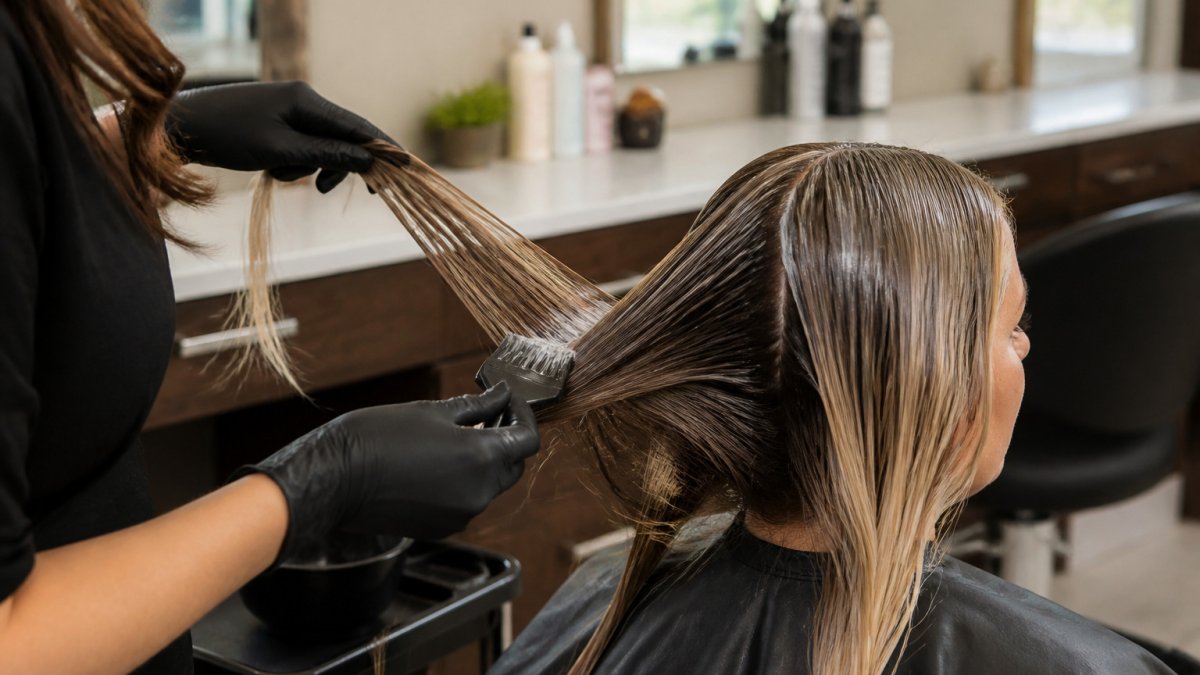
Glosses coat the hair with a thin layer of tinted or clear conditioning product, leaving smoother strands that reflect more light. This makes dimensional color look fuller, even when fading has started.
Ways to use a gloss between visits:
- Use a clear gloss to add shine without changing tone
- Use a tinted gloss to refresh a specific shade
- Apply to clean, damp hair after shampooing
Step 5: Protect Lengths From Heat, Sun, and Mineral Buildup
The lengths of your hair are the oldest and most damaged part, and they often hold the lightest color.
Heat is a major factor. Use a heat protectant before blow-drying or flat ironing, and keep the tool temperature moderate.
Sun exposure works the same way.
Minerals can also build up.
For a closer look at how placement and technique affect where fading shows first, see Balayage Placement Techniques for Face Framing.
Step 6: Plan Balayage Touch-Ups on a Realistic Schedule
Balayage is designed to grow out gracefully, but it still needs a plan. Fading and brassiness can appear in the first few weeks after a service, when the toner is freshest. A practical schedule, the first 72 hours, the first two weeks, and the months between appointments, keeps dimensional color looking intentional instead of patchy.
The first 72 hours after coloring
This is the window where the most color is lost, so treat it like a recovery period:
- Wait at least 48 to 72 hours before your first shampoo. This gives the cuticle time to close and the toner to settle.
- Skip the pool, hot tub, and sauna during this window; chlorine and heat both accelerate pigment loss.
- Avoid tight hats, ponytails, and clips on the freshly colored areas, which can leave creases while the cuticle is still settling.
Weeks 1 through 4
Once you have shampooed, settle into the maintenance rhythm:
- Shampoo two to three times a week with a sulfate-free, color-safe formula, focusing on the scalp and letting suds rinse through the lengths.
- Use cool or lukewarm water, finishing with a cool rinse on the lengths.
- Start your depositing product only if your colorist recommended one, and follow the frequency in Step 3.
Weeks 4 through 12
This is where dimensional color either holds or starts to drift:
- Gloss or tone every 2 to 4 weeks, as needed, to keep the tone clean.
- Add a weekly deep-conditioning or bond-building treatment to keep lightened lengths from drying out and grabbing tone unevenly.
- Trim every 8 to 12 weeks if your ends are splitting; split ends travel up and make color look dull.
Months 3 through 4 and beyond
A full balayage touch-up is usually due around the three- to four-month mark, depending on your natural color, how much contrast you want, and how fast your hair grows. Fast-growing hair or a strong gray pattern may need a root touch-up sooner; low-contrast balayage can often stretch to four or five months.
Think of your schedule in layers:
- Every 2 to 4 weeks: gloss or toner, as needed
- Every 8 to 12 weeks: a light refresh on the lightest pieces and a trim
- Every 3 to 4 months: a full balayage touch-up
Ask your colorist to write the plan down before you leave: the shade and formula they used, the at-home products they recommend, the frequency for each, and the date your next appointment should fall. A written plan is the difference between maintaining dimensional color and constantly correcting it.
Root regrowth versus fading: what you can fix at home
It helps to separate the two problems, because they need different solutions:
- Fading through the lengths is a tone issue. Depositing products, glosses, and cooler washing habits can manage it at home.
- Root regrowth is a coverage issue. At-home root sprays and touch-up powders can blur the line temporarily, but permanent gray coverage and root melts require a stylist. Lightening your own roots to match balayage is best left to a professional, as overlapping lightener on already-lightened hair can cause damage.
If your main concern is the line between natural roots and lightened mid-lengths, ask your colorist about a root shadow or a smudge technique at your next visit, it softens the transition and buys you more time between full appointments.
For a closer look at how placement and technique affect where fading shows first, see Balayage Placement Techniques for Face Framing.
Booking Your Next Color Appointment With a Maintenance Plan
Bring your home routine to your next salon visit. Tell your colorist what you have been using, how often you wash, and where the color fades first.
Before you leave, ask for a written plan covering your shampoo, how often to tone or gloss, and when to book next.
For professional tints, bowls and brushes that help colorists apply dimensional color with precision, explore the ESTL+CO collection.
Frequently Asked Questions
How long should you wait between dimensional hair color appointments?
The right interval depends on how quickly the lengths lighten and how much root regrowth is visible. Lighter, more contrasted dimension often shows fading sooner. A colorist can check the tone and lengths at each visit and suggest a realistic interval based on your hair's condition and how you wash and style it.
Can using the wrong shampoo ruin dimensional hair color?
A harsh shampoo can strip tone and dull highlights faster than expected, particularly on lightened lengths that are more porous. Sulfate-based cleansers are a common culprit. Choosing a color-safe shampoo for highlights, washing less often, and using cool or lukewarm water helps slow fading. Using the wrong product will not ruin the color outright, but it can shorten the time between visits.
Why does dimensional color lose its tone between salon visits?
Lightened hair is more porous, so it absorbs and releases moisture and pigment more easily. Heat styling, sun exposure, hard water, and frequent washing all contribute to brassiness and dullness. Toners and color-depositing products can refresh the tone between visits, but they work best when used on a consistent schedule rather than only when brassiness has already appeared.
