

Professional Hair Colorist Tool Kit Essentials
Table of Contents
- What Every Professional Hair Colorist Tool Kit Needs
- Best Professional Hair Color Brushes for Precision Work
- Application Techniques and the Tools That Support Them
- Ergonomics: Protecting Your Hands and Body Over a Full Day
- How to Organize a Hair Colorist Kit for Any Work Setting
- Hair Colorist Tool Maintenance Tips That Extend Tool Life
- Budget vs. Investment: Choosing the Right Tier for Your Kit
- Conclusion
Last Updated: August 20, 2026
What Every Professional Hair Colorist Tool Kit Needs
A professional hair colorist tool kit is the foundation of an efficient, high-output color session. The difference between a colorist who finishes on time and one who scrambles often comes down to what's on their station, not their technique.
Below, we break down every category of tool you need, why each one matters, and what separates professional-grade equipment from cheap alternatives that slow you down.
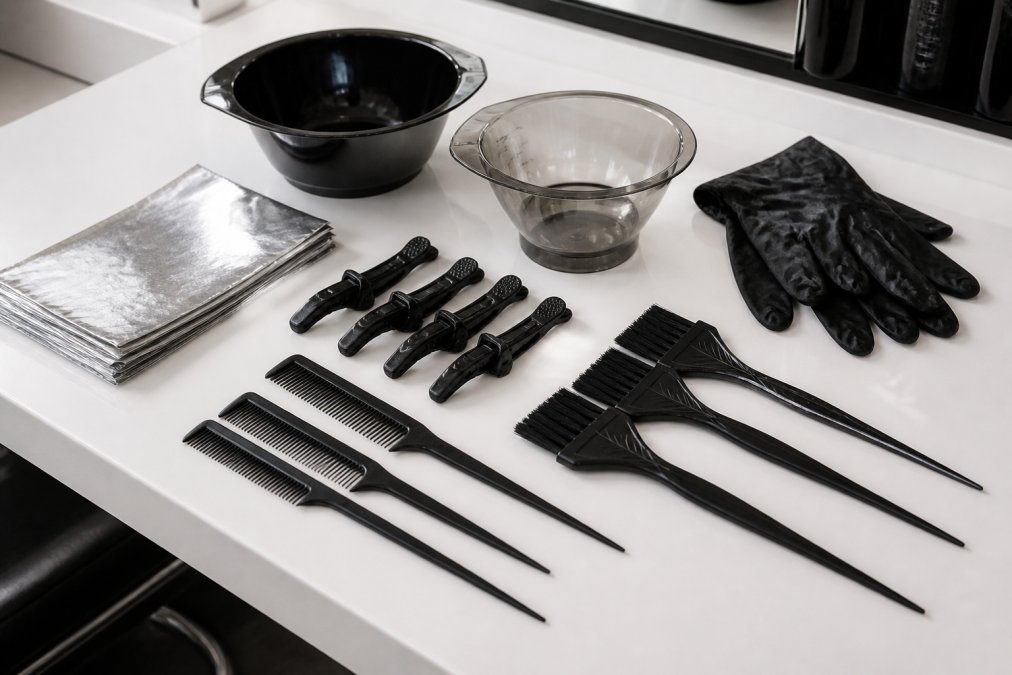
Mixing Bowls and Digital Scales
A mixing bowl directly affects color saturation, consistency, and service speed. Professional-grade tint bowls resist staining after repeated exposure to oxidative color and bleach, while cheap plastic bowls absorb pigment and degrade under sanitization. Stain-resistant bowls maintain surface integrity for accurate color reading across hundreds of services.
Pair your bowl with a digital scale that measures in grams and fluid ounces. A reliable scale removes guesswork from formulation and cuts product waste. For colorists mixing custom formulas, a scale is non-negotiable.
Sectioning Clips and Tail Combs
A good tail comb creates crisp, consistent partings for root touch-ups, highlights, and balayage. The pointed tail allows for weaving and slicing, which determines how natural a finished look appears. For fine weaving in babylights, a rat-tail comb with a thin, rigid tail gives you control a wide-tooth comb cannot.
Sectioning clips should hold tension without slipping. Duck-bill clips secure flat sections cleanly, while butterfly clips manage larger volumes during processing. Stock both.
Protective Gear: Gloves, Aprons, and Barrier Cream
Powder-free latex gloves provide a precision fit that preserves tactile feedback during brush application. For colorists with latex sensitivities, nitrile alternatives offer comparable dexterity and chemical resistance.
A quality salon apron protects clothing while carrying tools in functional pockets. Aprons with adjustable cross-back straps distribute weight across the shoulders rather than loading the neck, which matters significantly over a full eight-hour day.
Barrier cream applied around the hairline before color application prevents scalp staining and reduces skin irritation from developer.
Processing Caps and Highlighting Foils
Processing caps seal heat around the hair during color development, accelerating processing time for demi-permanent and semi-permanent formulas. Clear caps allow visual monitoring without removing the cap.
Highlighting foils are the backbone of technique-driven color services. Having a range of widths on hand allows you to adapt for fine babylights versus chunky highlights. Heavier foil holds its fold during processing and reduces bleed-through.
Best Professional Hair Color Brushes for Precision Work
The best professional hair color brushes determine how accurately color lands on the hair shaft and how efficiently you move through a service. Brush selection is the primary variable between a clean, precise result and a muddy, uneven one.
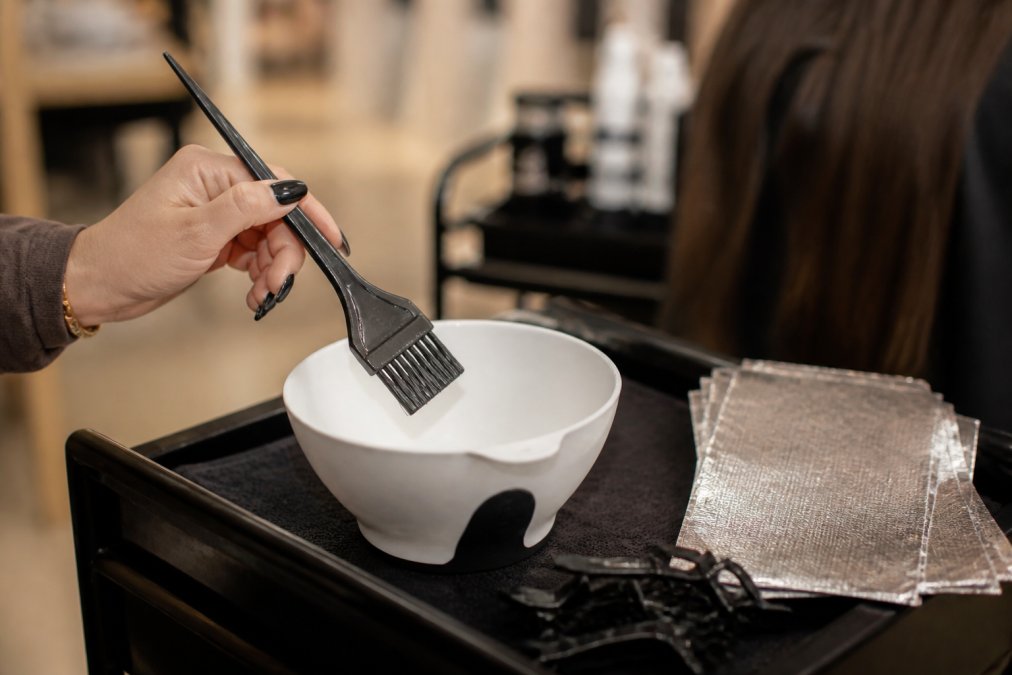
Tint Brushes for Root Touch-Ups and All-Over Color
A standard tint brush for root touch-up work needs a flat, firm bristle head that holds product without dripping and deposits color evenly at the scalp. A 1-inch brush handles precision root application, while a wider brush covers ground faster on all-over color services. Having multiple brush sizes staged on the station cuts transition time between sections.
Feathered Brushes for Balayage and Hair Painting
Feathered brushes are the specialist tool for balayage and hair painting. The splayed, feathered bristle tip creates a soft, diffused application that blends seamlessly into natural hair, producing the graduated, lived-in results clients request most. An ergonomic handle reduces hand fatigue during the sweeping, repetitive strokes that balayage requires. Using a standard flat tint brush for balayage rarely produces results as clean as the right brush.
Boar Bristle and Specialty Brushes for Blending
Boar bristle brushes blend and soften color lines after initial application. The natural bristle distributes product through the hair shaft without harsh demarcation, making them ideal for softening foil lines and blending root shadows. Specialty brushes, including fan brushes for scattered highlight effects and paddle brushes for seamless blending on long hair, round out a complete kit.
Application Techniques and the Tools That Support Them
Technique and tool are inseparable. The wrong tool for a given application produces a result that looks like the wrong technique, even when the colorist's skill is not in question.
| Technique | Primary Tool | Secondary Tool | Key Consideration |
|---|---|---|---|
| Root touch-up | Flat tint brush (1") | Tail comb | Even saturation at scalp |
| Balayage / hair painting | Feathered brush | Balayage board | Controlled product load |
| Full highlights | Sectioning clips + foils | Tail comb for weaving | Foil weight and fold integrity |
| Babylights | Fine rat-tail comb | Narrow flat brush | Slice precision |
| Ombre | Wide flat brush | Sponge or paddle brush | Seamless blend through mid-lengths |
| Demi-permanent all-over | Wide tint brush | Processing cap | Even heat distribution |
According to Occupational Safety and Health Administration guidance on chemical handling, proper protective gear during chemical application is required in professional salon environments. Gloves, apron, and barrier cream are part of compliant, professional practice.
Balayage and hair painting benefit from a balayage board, a flat, rigid surface held beneath the section during application. The board prevents color from bleeding onto adjacent sections and allows you to work product into the hair without contaminating surrounding hair.
Ergonomics: Protecting Your Hands and Body Over a Full Day
Repetitive strain is one of the leading reasons experienced colorists reduce their hours or leave the profession. A color service involves sustained grip, repeated sweeping strokes, and prolonged standing. Over a full day of balayage and foil work, a brush with a poorly shaped handle creates cumulative strain in the fingers, wrist, and forearm.
According to National Institute for Occupational Safety and Health guidelines on musculoskeletal disorders, repetitive hand and wrist motions in professional service roles are a recognized risk factor for musculoskeletal disorders. Colorists performing eight or more color services per day are in a high-repetition category.
Practical steps to reduce strain:
- Choose brushes with ergonomic handles that fit your hand size
- Alternate between brush types during a service to vary muscle groups
- Take 60-second wrist breaks between clients
- Wear gloves that fit snugly
- Position your mixing bowl at elbow height to avoid shoulder elevation
An apron with adjustable cross-back straps distributes tool weight across the upper back rather than loading the neck.
How to Organize a Hair Colorist Kit for Any Work Setting
Organization changes depending on whether you work in a fixed salon station, a rental studio, or as a mobile colorist.
Fixed salon station: Organize tools by service phase. Prep tools (clips, combs, gloves, barrier cream) at the front. Application tools (brushes, bowls, scale, foils) in the center. Finishing tools to the side or in a drawer. The goal is zero searching during a service.
Rental studio: A structured tool roll or hard-sided case protects brushes and combs during transport. Store bowls nested with cloth between them to prevent scratching. Keep a dedicated sanitization kit in a sealed pouch to prevent cross-contamination between locations.
Mobile colorist: Prioritize tool durability. Brushes with metal ferrules and solid handles hold up better than plastic-only construction. A compact digital scale with a protective case prevents calibration drift from impact.
Audit your kit quarterly: if you haven't used a tool in 30 days, it doesn't belong on your station.
Hair Colorist Tool Maintenance Tips That Extend Tool Life
Professional-grade tools earn their value through proper maintenance. A well-maintained brush lasts years; a neglected one lasts months.
Brushes: Rinse tint brushes immediately after each use. Oxidative color hardens in bristles within minutes, permanently deforming bristle shape. Use gentle brush cleaner or dish soap, reshape bristles, and lay flat to dry. Never store brushes bristle-down in a cup.
Mixing bowls: Rinse immediately after use. For sanitization, wipe with barbicide-grade disinfectant and allow to air dry. Avoid abrasive scrubbers that create micro-grooves where bacteria accumulate.
Digital scales: Wipe the weighing surface after every use. Calibrate monthly using a known weight to ensure accuracy hasn't drifted.
Sectioning clips and tail combs: Soak metal clips in disinfectant between clients. Check tail comb tips regularly; replace damaged combs immediately.
As noted in EPA guidelines on salon chemical waste disposal, used color chemicals must be disposed of according to local environmental regulations.
Budget vs. Investment: Choosing the Right Tier for Your Kit
Professional hair colorist tool kit essentials span many price points. The right tier depends on your service volume, technique specialization, and career stage.
Entry-level tier: Appropriate for cosmetology students and first-year colorists. Functional tools that teach proper technique without significant upfront cost. The trade-off is durability: lower-cost brushes require replacement every six to twelve months with heavy use.
Mid-tier professional: The right level for most working colorists. Tools offer professional-grade materials, better ergonomics, and meaningful durability. A mid-tier feathered brush handles daily balayage work without bristle degradation.
Investment tier: Purpose-built for high-volume colorists and specialists in complex techniques. Designed for longevity under daily professional use. The cost-per-use calculation usually favors investment tools when you're performing ten or more color services per day.
| Tier | Best For | Key Trade-off |
|---|---|---|
| Entry-level | Students, first-year colorists | Lower durability, higher replacement frequency |
| Mid-tier professional | Most working colorists | Balanced performance and cost |
| Investment | High-volume, complex techniques | Higher upfront cost, lower cost-per-use |
Most colorists get tiering wrong by buying entry-level tools for professional use because they seem adequate at the start. Adequate tools create adequate results. Professional hair colorist tool kit essentials at the investment tier are the infrastructure of a high-performing practice.
ESTL+CO tools are built for the investment tier, designed by professionals who work in high-volume color environments. Visit estlco.com to see current pricing and availability.
Frequently Asked Questions
What do professional hair stylists use to color hair?
Professional colorists rely on a core set of tools: tint brushes for precise application, mixing bowls and digital scales for accurate formula ratios, sectioning clips and tail combs to part hair cleanly, highlighting foils for balayage and foil work, and protective gear including gloves and aprons. Professional-grade versions of these tools are built from chemical-resistant materials, sized for all-day comfort, and designed to maintain color saturation and precision across high-volume service schedules.
What is the difference between professional and consumer-grade color tools?
Professional-grade tools are built for repeated daily use under chemical exposure. The materials are denser and more resistant to staining, bristles are engineered for even color distribution rather than general use, and handles are shaped to reduce hand fatigue over a full shift. Consumer tools are typically made from lighter plastics with less precise bristle construction. Over time, professional tools hold up better structurally, which lowers the cost-per-use compared to replacing cheaper alternatives frequently.
What are the essential tools for balayage and foil work?
Balayage requires a feathered or paddle-style tint brush that deposits color with a soft, tapered edge to mimic hand-painted strokes. A balayage board keeps sections lifted and flat during application. For foil work, you need pre-cut highlighting foils, a fine-tooth tail comb for clean partings, sectioning clips to hold surrounding hair, and a flat tint brush for precise bleach application. A digital scale ensures your lightener-to-developer ratio stays consistent across every foil.
How do you maintain and sanitize professional hair coloring tools?
Rinse tint brushes and mixing bowls immediately after each service before color dries and bonds to the surface. Wash with a brush cleanser or mild shampoo, reshape bristles, and air-dry flat. Sanitize non-porous tools between clients using an EPA-registered disinfectant solution, following contact time instructions on the label. Stain-resistant bowls reduce the need for harsh scrubbing that degrades plastic over time. Store tools dry and separated to prevent bristle deformation and cross-contamination.
Will ergonomic brushes actually reduce hand strain for colorists?
Hand and wrist fatigue in colorists is largely driven by grip force and repetitive motion over a full day of services. Brushes with thicker, contoured handles reduce the grip force needed to maintain control, which lowers cumulative stress on tendons and joints. Feathered or lightweight brush heads also reduce the wrist rotation required during balayage strokes. While no tool eliminates strain entirely, switching to an ergonomically designed brush is one of the most practical adjustments a colorist can make for long-term hand health.
How should a freelance colorist organize their kit for portability?
Freelance and mobile colorists need a kit that travels without tools shifting, breaking, or contaminating each other. Use a roll-up brush case to protect bristles during transport, store mixing bowls nested inside each other with clips and foils packed inside them to save space, and keep gloves and barrier cream in a sealed pouch. Label compartments so setup at a new location takes under two minutes. Prioritize tools made from durable materials that can handle repeated packing and unpacking without cracking or warping.
The challenge every colorist faces is building a kit that performs under real salon pressure without requiring constant replacement or compromise on technique. ESTL+CO's collection of stain-resistant tint bowls and ergonomic feathered brushes is built specifically for that demand, giving colorists the precision and durability to deliver consistent results across a full day of services. Get started with ESTL+CO and build a kit that works as hard as you do.
This article was written using GrandRanker