

Tips for Organizing Professional Hair Color Tools
Table of Contents
- Essential Components of a Professional Hair Colorist Tool Kit
- How to Categorize Color Tubes and Developer by Volume
- Space-Saving Storage Solutions for Small Salons and Rental Studios
- Workflow Efficiency: Station Layout and Ergonomic Mapping
- How to Clean and Maintain Hair Tinting Tools
- Labeling Systems and Inventory Rotation for Color Inventory
- Tips for Organizing Professional Hair Color Tools: Digital Tracking and Sustainability
- Conclusion: Building a System That Works Behind the Chair
- Frequently Asked Questions
Last Updated: September 13, 2026
Essential Components of a Professional Hair Colorist Tool Kit
A professional hair colorist tool kit is the curated set of implements used for every service: color bowls, tint brushes, foils, barrier cream, clips, gloves, and the organizers that hold them. Get it right and every service runs faster; get it wrong and you spend the day hunting for a whisk mid-application.

Tips for organizing professional hair color tools start with knowing what belongs at the station. This guide from ESTL+CO breaks down the storage, labeling, and workflow systems that keep a station service-ready.
The core kit breaks into four groups:
- Mixing tools: color bowls, tint brushes, whisks, measuring cups
- Application tools: foils, barrier cream, sectioning clips, gloves
- Processing tools: timers, heat-resistant holders, cap and foil storage
- Organization tools: acrylic organizers, wall-mounted racks, labeled bins, swatch rings
The container matters as much as the contents: a bowl with a U-shaped cutout holds your brush between sweeps, cutting drips through back-to-back services.
How to Categorize Color Tubes and Developer by Volume
Categorize color tubes by shade family, then sub-sort by level, and store developer separately by volume, so you reach for the right tube without reading labels while a client waits.
Start with shade families: naturals, ash, gold, red, and fashion tones. Within each family, order tubes by level number so a 6N sits beside a 7N and an 8N. Colorists who work this way report fewer misreads during a rushed service, because a tube's position confirms its shade.
Developer needs its own zone: separate 10, 20, 30, and 40 volume into distinct, clearly marked holders. Never store developer loose with tubes; a tipped bottle can soak labels and make shade identification guesswork.
For backstock, apply FIFO: new stock goes behind old, and you pull from the front. Tubes have a shelf life, and rotation keeps inventory fresh without a weekly audit.
| Category | Storage Zone | Sort Order | Rotation Rule |
|---|---|---|---|
| Color tubes | Drawer or rack at station | Shade family, then level | FIFO, front-pull |
| Developer | Separate upright holder | Volume number | FIFO, check dates monthly |
| Foils | Pop-up dispenser box | N/A | Refill when half empty |
| Barrier cream | Station caddy | N/A | One open, one sealed backup |
Space-Saving Storage Solutions for Small Salons and Rental Studios
Small salons and rental studios need vertical storage, not more drawers. When square footage is fixed, the wall above your station is the most underused real estate in the room.
Start with a footprint audit. Measure your counter depth (most stations run 18 to 24 inches), then subtract the mixing zone for a bowl and brush, roughly 12 by 14 inches (osha.gov). Whatever is left is your only true counter storage; everything else goes up, down, or onto wheels.
Wall-mounted storage. A magnetic strip or slotted rack holds tint brushes and whisks upright, where they dry faster and stay visible. Two constraints:

- Adhesive strips and removable hooks are rental-friendly but hold only a few pounds, fine for brushes, clips, and gloves, but use a stud-mounted or toggle-bolt rail for anything heavier.
- In a booth rental, check your lease before drilling. Many agreements require landlord approval for wall penetrations, and patching drywall on move-out costs real money. A freestanding over-the-mirror shelf or tension-pole rack avoids the issue.
Rolling carts. A three-tier rolling cart covers a full color service in under two feet of floor space and rolls out of the way between clients. Look for locking casters so it doesn't drift while you mix, and check the weight rating, a loaded cart gets heavy fast. Keep the heaviest items on the bottom tier.
Stackable acrylic drawers. Clear acrylic drawers for foils and gloves free up the counter and let you see inventory without opening anything. The trade-off is scratching and clouding; a mild soap wash (not abrasive cleaners) keeps them clear. Stack no more than three or four high, or the bottom unit cracks.
Over-the-mirror and rail storage. A wall-mounted rail above the mirror adds storage without blocking the client's view. Keep it low-profile and mount it high enough that a seated client isn't staring at the underside of your foils.
Transport for mobile and multi-location colorists. For colorists moving between locations, a locking caddy that converts to a transport case is the practical answer: everything packs in one unit, nothing gets left behind. Look for a lid that seals, so a tipped developer bottle doesn't soak the rest of your kit.
Specifics that hold up in practice:
- Label every bin on the outside, not the lid, so contents stay identifiable when stacked
- Keep a small "overflow" bin for the shades you use less than once a week, and store it below the station rather than at eye level
Workflow Efficiency: Station Layout and Ergonomic Mapping
Workflow efficiency comes down to reach distance. Map your station so every tool you touch during a color service sits within arm's length, eliminating the small movements that add up to end-of-shift fatigue.
The mapping exercise takes ten minutes. Stand at your station as if mid-service and note every tool you pick up, in order: bowl, brush, whisk, foils, clips, barrier cream, timer. Place each where your hand naturally falls. Constant-use tools go in front of you; occasional tools one step to either side; backstock behind or below.
The biggest mistake is storing by category instead of by frequency. A perfectly organized drawer that sits behind you still costs you a turn every time you open it. Frequency beats tidiness.
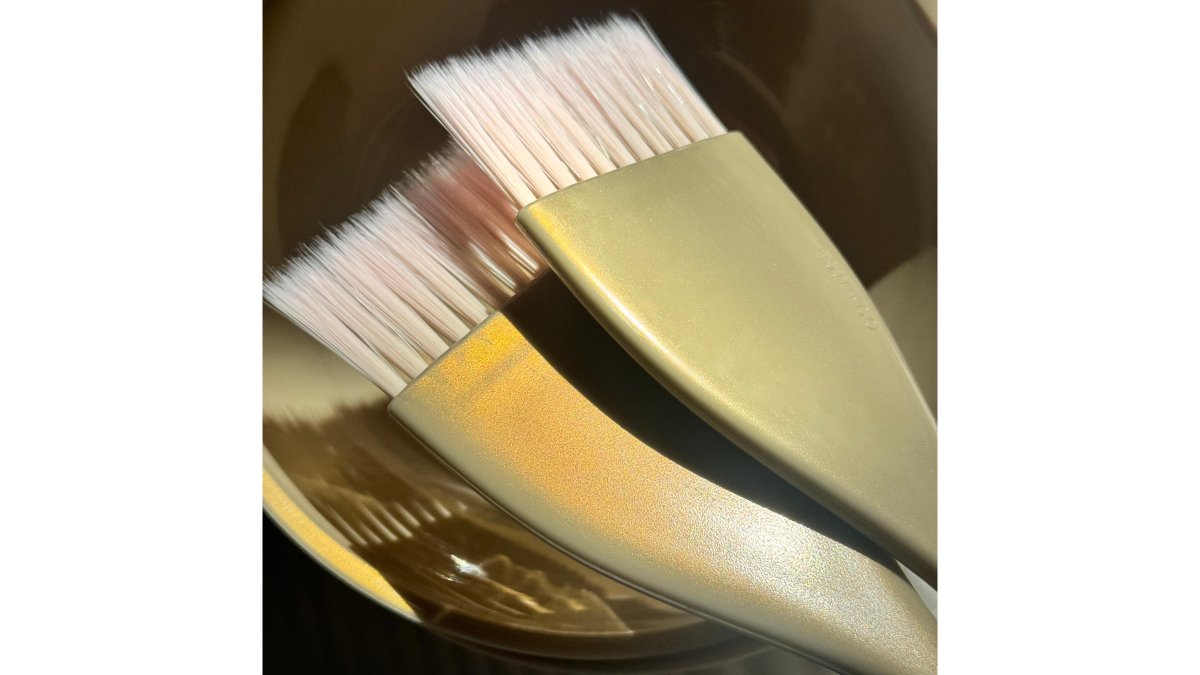
Station ergonomics matter as much as placement. A brush with a wide base and ergonomic handle reduces the tension and pinching that builds over a day of application. When your grip stays relaxed, control improves, and precision work like blending at the hairline gets easier.
How to Clean and Maintain Hair Tinting Tools
Cleaning hair tinting tools properly means rinsing immediately after each service, washing with warm water and mild soap, and drying fully before storage. Skip the drying step and you invite buildup that shortens every tool's life.
Tint brushes and bowls need attention before color sets. Rinse under warm water as soon as the service ends, while residue is soft, a quick rinse beats a hard scrub. A stain-resistant bowl makes this easier because pigment doesn't bond to the surface like it does on cheaper plastic.
What most guides miss is the drying step. Trapped moisture in a brush ferrule or a stacked bowl grows bacteria and breaks down the material. Air-dry brushes upright, bristles up, and dry bowls separately rather than nesting them wet.
A weekly maintenance routine keeps the whole kit serviceable:
- Deep-clean bowls and brushes with warm soapy water
- Check brush bristles for fraying or splaying
- Wipe down storage bins and organizers
- Inspect foils and dispensers for damage
- Restock barrier cream and gloves
- Rotate backstock using FIFO
For sanitization, follow the guidance your state cosmetology board publishes for tool disinfection, and check the CDC guidance on cleaning and disinfecting for general principles on preventing cross-contamination between clients.
Labeling Systems and Inventory Rotation for Color Inventory
A labeling system turns color inventory from guesswork into a glance. But "label everything" isn't a system, the system is deciding what goes on the label, where it lives, and how it stays readable after a year of chemical exposure.
What belongs on a label. A working label carries four fields:
- Shade family and level (for example, "Ash 7")
- Brand and line, if you carry more than one
- Reorder threshold (the count at which you reorder)
- Date received, for FIFO rotation
A label with only the shade name tells you what's inside but not when to reorder or whether the tube is old. The date-received field is the one most colorists skip and the one that prevents the "is this tube still good?" guesswork.
Where the label goes. Label the outside of every bin, drawer, and holder, never the lid. Lids get swapped, stacked, and lost. For individual tubes, a small wrap label near the cap survives handling better than one on the tube body, which gets squeezed and smeared during mixing.
Color-coding that actually scales. Assign a color to each shade family and apply it consistently across drawers, backstock bins, and swatch rings. The failure mode is too many colors: with twelve, nobody remembers which is which. Cap it at five or six families (naturals, ash, gold, red, fashion tones) and print the word alongside the color so the system survives a colorblind team member or a faded label.
Rotation. New product goes behind existing product, and you always pull from the front. This FIFO method keeps older tubes moving first, which matters because color products have a shelf life and a tube untouched for two years may not perform as expected. Pair rotation with the date-received label so a slow-moving shade is visible before it expires.
The digital layer most guides skip. Physical labels tell you what's on the shelf, not what's running low until you're standing in front of the drawer. Digital inventory tracking closes that gap without expensive software:
- A simple spreadsheet or notes app works: list each shade, its level, current count, and a reorder threshold.
- When a tube drops to your threshold, it goes on the order list automatically.
- Many colorists pair the sheet with a photo of their swatch ring, so anyone covering a shift can match a formula fast.
- Some salon management platforms include stock alerts, but a spreadsheet gets you 80% of the benefit at zero cost.
This prevents the two most common inventory failures: running out mid-service and over-ordering shades you rarely use.
Swatch rings. Pair your physical system with a color swatch ring. Swatches confirm a shade visually before you mix and are the fastest way to match a returning client's formula without pulling every tube off the shelf. Keep the ring at the station, not in backstock, it's a working tool, not a reference book.
Tips for Organizing Professional Hair Color Tools: Digital Tracking and Sustainability
Digital tracking and sustainable disposal are the two angles most storage guides skip, and they're where a professional setup pulls ahead of a merely tidy one.
On the sustainability side, how you dispose of color waste matters. Mixed color, developer, and foil waste shouldn't go down the drain. Check with your local sanitation or environmental agency for household hazardous waste guidance, since rules vary by municipality. Rinsing bowls into a designated waste container rather than the sink keeps pigment out of the water system and protects your plumbing.
Storage units need a sanitization protocol too. Wipe down bins and organizers weekly, and use a salon-appropriate disinfectant between clients. This keeps a storage system hygienic rather than just neat.
ESTL+CO builds the tools at the center of this system. The U.S. Small Business Administration notes that efficient workspace organization supports productivity for small operations, and for a solo colorist or a small studio, that starts with equipment designed for the work. The Hair Color Bowls from the Elegance Collection are stain-resistant and shaped with a U-cutout that holds your brush in place between sweeps, so your mixing station stays clean through a full day. The Hair Color Brushes use a wide feathered tip and an ergonomic base to reduce the tension and pinching that builds in your fingers. For colorists who want the whole station sorted in one purchase, the Complete Station Bundle packages two brushes, two bowls, and a barrier cream stick for $52.50.

Conclusion: Building a System That Works Behind the Chair
The hardest part of organizing a color station isn't buying the bins; it's building a system you'll actually maintain on a busy Saturday. A station that works behind the chair is one where everything has a home, rotation is automatic, and cleanup takes minutes, not an hour.
ESTL+CO makes the tools that make that system hold up: stain-resistant tint bowls that rinse clean, ergonomic feathered brushes that reduce hand strain, and a bundle that sets up a full station in one order. Get started with ESTL+CO and build a station that keeps pace with your busiest color service.
Frequently Asked Questions
How often should professional hair color tools be replaced or reorganized?
Replace tint brushes when bristles splay or shed, typically every 3-6 months with daily use. Color bowls should be replaced if cracked or heavily stained. Reorganize your station weekly to remove empty tubes and expired developers. A full inventory audit every quarter keeps your color inventory accurate and prevents mid-service shortages.
How do you sanitize and store professional hair color brushes?
Rinse brushes immediately after each service to remove wet color. Wash bristles with mild soap and warm water, then disinfect with a salon-approved EPA-registered disinfectant. Dry handles upright and store brushes bristle-up in a holder. Never soak wooden handles. For daily storage, keep brushes in a covered container to prevent cross-contamination.
What are the best storage solutions for hair tint bowls and whisks?
Stack bowls by size in a cabinet or on a shelf with a non-slip liner. Use a wall-mounted rack or acrylic organizer to keep bowls accessible. Store whisks in a separate compartment to avoid bending tines. For small salons, a rolling cart with divided drawers keeps bowls, whisks, and brushes organized and mobile.
Are there specific OSHA guidelines for storing chemical-exposed salon tools?
OSHA's Hazard Communication Standard (29 CFR 1910.1200) requires salons to maintain safety data sheets for chemicals like hair color and developer. Store these products in labeled, closed containers away from food and heat. Tools exposed to chemicals should be cleaned and stored separately to prevent cross-contamination. Follow manufacturer instructions for ventilation and personal protective equipment.