

Buy Salon Grade Hair Tinting Tools: 2026 Pro Guide
Table of Contents
- What Makes Hair Tinting Tools Salon Grade?
- Hair Dye Brush and Bowl Set: What to Look For
- Best Hair Color Brushes for Salons: ESTL+CO Feathered Brushes
- Stain-Resistant Tint Bowls Built for Daily Use
- How to Clean Professional Hair Tint Brushes and Bowls
- Reusable Hair Coloring Tools: Cost Per Service vs. Disposables
- Complete Station Bundle: The All-in-One Kit
- Conclusion: Where to Buy Salon Grade Hair Tinting Tools
- Frequently Asked Questions
Last Updated: October 12, 2026
What Makes Hair Tinting Tools Salon Grade?
Salon grade means the tool survives repeated chemical exposure, daily sanitizing, and hours of grip without failing. When you buy salon grade hair tinting tools, you pay for material density, seam quality, and ergonomics that hold up across hundreds of services.
Three things separate professional tools from beauty-supply basics: the plastic resin, the bristle cut, and the handle geometry. Cheap bowls crack at the rim after months of developer and lightener; cheap brushes splay in the middle, ruining sectioning precision.
Material Quality and Stain Resistance
Stain resistance comes from the resin itself, not a surface coating. A coated bowl eventually chips and holds color in the scratches. A dense, non-porous bowl resists absorption from the first service to the last.
Check three things before buying:
- Wall thickness. Thin walls flex when you squeeze, and flexing leads to hairline cracks.
- Rim finish. A smooth, rolled rim wipes clean in one pass.
- Colorfast pigment. Bowls that fade unevenly usually stain unevenly too.
Ergonomics and All-Day Comfort
Hand fatigue is cumulative. A brush that forces a tight pinch grip costs you nothing on client one and everything by client eight. Wide bases, balanced weight, and tapered tips reduce cramping tension.
Hair Dye Brush and Bowl Set: What to Look For
A hair dye brush and bowl set is only as good as its weakest piece. Most kits pair a decent brush with a warping bowl, or a solid bowl with a shedding brush.
Look for a bowl with a U-shaped cutout that holds the brush between sweeps, keeping color off your station and the brush where your hand expects it.
Match the Tool to the Technique
Most buying guides stop at "wide brush for big sections, narrow brush for detail." That is incomplete: the right width, bristle cut, and bowl depth shift depending on what you are doing at the chair.
| Technique | Brush Width | Bristle Cut | Bowl Depth | Comb / Sectioning |
|---|---|---|---|---|
| Root touch-up | 1.5-2 in | Firm, flat-cut or slightly tapered | Shallow, 2-3 in | Tail comb for clean parts |
| All-over color | 2-3 in | Feathered, medium flex | Standard, 3-4 in | Wide-tooth comb for saturation |
| Foil highlights | 1-1.5 in | Firm, tapered tip | Shallow, for controlled pickup | Rat-tail comb plus clips |
| Balayage / freehand | 2-3 in | Soft, feathered, long tip | Standard, with tilted edge | Wide-tooth comb, no clips needed |
| Bleach retouch | 1.5-2 in | Firm, synthetic, chemical-resistant | Shallow, non-porous | Tail comb for precision parts |
Why those numbers work:
- Root touch-up. A wide brush overloads the part and bleeds onto lightened mid-lengths. A 1.5-2 inch firm brush lays a controlled bead along the part line.
- All-over color. Speed matters more than precision. A 2-3 inch feathered brush saturates a section in one pass; a flat-cut bristle forces a second pass and risks patchy development.
- Foil highlights. You need pickup control, not coverage. A narrow, firm, tapered brush places product exactly where the foil will sit; a soft feathered brush splays and smears.
Bowl Geometry Beyond the U-Cut
Depth is the spec most buyers ignore. A deep bowl holds more product but makes you reach for the last of it, where drips start; a shallow bowl keeps product at the working edge but runs out mid-section on long hair.
The tilted edge and U-shaped brush rest are not cosmetic. The tilt pools product toward the working end so you are not chasing color around the rim, and the brush rest keeps the handle off the station surface between foils.
Kit Contents Worth Paying For
| Kit Component | What to Check | Why It Matters |
|---|---|---|
| Tint bowl | U-shaped brush rest, tilted edge, 3-4 in depth | Less mess, less product waste |
| Applicator brush | Feathered tip, wide base grip, synthetic bristle | Even spread, less hand strain, chemical resistance |
| Tint comb | Fine teeth on one side, wide teeth on the other | One tool for parting and saturation |
| Clips | Spring tension, non-slip coating | Sections stay put through processing |
| Barrier cream | Stick format, hypoallergenic | Protects the hairline without extra gloves |
A set that covers root work, all-over color, and foiling without a trip to the supply closet beats a set with ten pieces you never touch. Buy for the techniques on your book, not the piece count.
Best Hair Color Brushes for Salons: ESTL+CO Feathered Brushes
The best hair color brushes for salons combine a wide feathered tip with a base wide enough to grip without pinching. Our Elegance Brush delivers a wide base for easier grip, a tapered tip for neater sections, and feathered bristles that feel comfortable against the client's scalp.

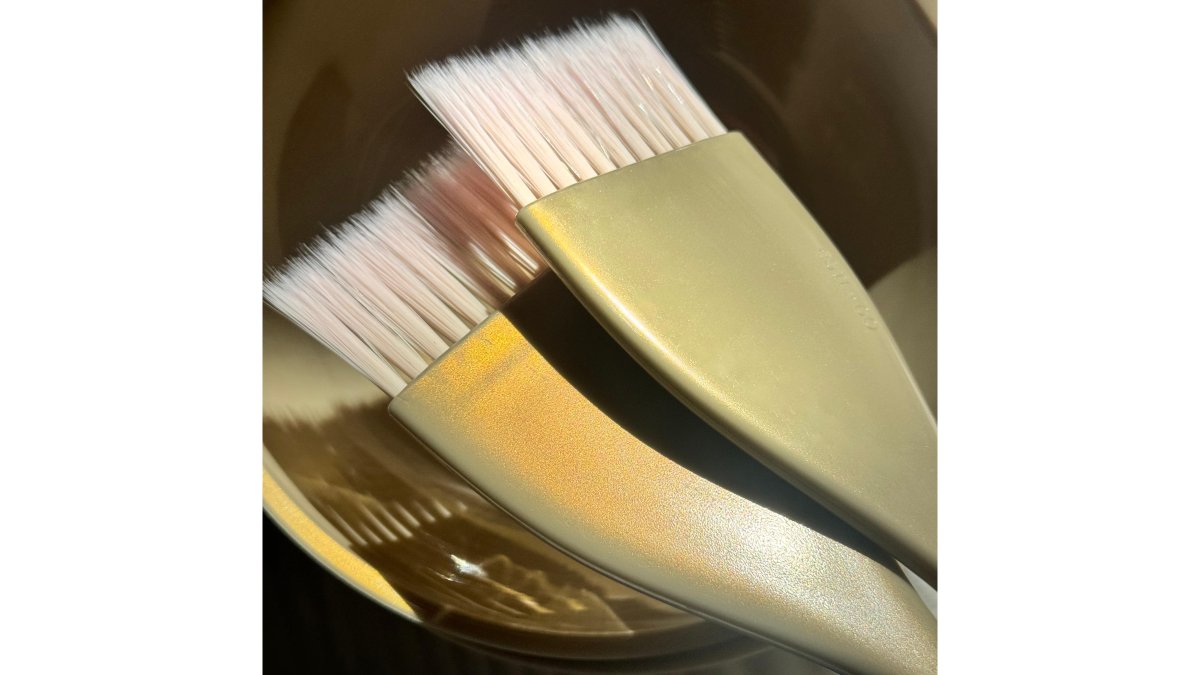
The ergonomic shape is the part most reviews skip. Standard tint brushes force your fingers into a cramped position for a full color service; ours prevents that tension and pinching.
Each box contains two professional salon hair color brushes, available in Black, Beige, Mauve, and Violet. The set runs $16.00, which works out to $8.00 per brush.
Stain-Resistant Tint Bowls Built for Daily Use
Stain-resistant tint bowls hold their color through repeated exposure to dye, developer, and lightener. Our Hair Color Bowls from The Elegance Collection are molded to fit your palm, with a U-shaped cutout that holds the brush between sweeps.

The tilted edge keeps dye in the bowl instead of creeping toward the rim, and the material sustains drops, so a bowl that hits the floor mid-service does not crack.
Each box includes two bowls for $19.00. That is $9.50 per bowl, and they outlast the thin disposable-style bowls sold in multi-packs at beauty supply stores.
Cheap bowls look cheaper per unit, but you replace them several times a year. A durable bowl that survives daily sanitizing costs less per service once you stop rebuying.
How to Clean Professional Hair Tint Brushes and Bowls
Cleaning professional hair tint brushes and bowls takes under two minutes per set if you do it immediately after the service. Rinse while the color is still wet and you avoid most scrubbing. But cleaning and disinfecting are two different jobs, and reusable tools only pay off if you do both.
The Two-Step Routine
Step one: clean. Remove visible product and residue.
- Wipe the bowl first. Scrape excess color into the trash, not the sink. Color in the drain is a plumbing problem, and developer in a septic system is worse.
- Rinse both in lukewarm water. Hot water sets some pigments and can warp thin plastics.
- Work a drop of dish soap into the bristles. Use your palm, not a brush comb, to avoid pulling bristles loose at the ferrule.
- Rinse until the water runs clear. Any residue left in the bristles will transfer to your next client's formula and can shift the tone.
- Air dry bristle-side down or flat. Standing a wet brush upright traps water in the ferrule and loosens the bristle bond over time.
Step two: disinfect. Cleaning removes product; disinfection kills organisms. Most state cosmetology boards require an EPA-registered hospital-grade disinfectant for tools that contact skin or scalp, and the label contact time is not a suggestion, a ten-minute product does not work in two minutes.
What Actually Damages Reusable Tools
| Threat | What It Does | How to Avoid It |
|---|---|---|
| Hot water | Warps thin plastic, sets pigment | Lukewarm rinse only |
| Submersion overnight | Water seeps into ferrule, loosens bristles | Air dry flat or bristle-down |
| Harsh solvents | Cloud the resin, dull the finish | Use the disinfectant at label dilution |
| Abrasive scrubbers | Scratch the bowl surface, create stain traps | Soft sponge or your palm |
| Leftover lightener | Pits non-porous plastic over time | Rinse immediately, do not let it dry |
Lightener is the worst offender. Left to dry, it hardens into a chalky film that pulls bristles when you finally rinse. The fix is not a stronger cleaner, it is rinsing before the product sets.
Cross-Contamination and Client Safety
Color tools touch the scalp, hairline, and sometimes broken skin, making them a cross-contamination risk if you do not separate clean from dirty.
- Two-bowl system. Keep one bowl for mixing and one for application, or clean between clients without exception. A bowl that held lightener should not touch the next client's toner without a full clean-and-disinfect cycle.
- Gloves. Nitrile gloves protect you from developer and dye and keep your hands from transferring product between tools. Change them between clients, not between sections.
- Barrier cream. Apply along the hairline before color to protect skin and reduce product on the client, and on your tools.
Extending the Life of a Reusable Set
A salon-grade brush and bowl set should survive hundreds of services if you treat it right. The habits that matter most:
- Rinse within five minutes of finishing, before product dries.
- Disinfect at the label contact time, not a quick dip.
- Store brushes bristle-up in a clean, dry holder, not loose in a drawer where bristles bend.
Busy salons often buy cheap and replace often, but the math rarely works. A set that survives daily sanitizing costs less per service once you stop rebuying, and it removes the mid-service failure no colorist wants to explain to a client.
Reusable Hair Coloring Tools: Cost Per Service vs. Disposables
Reusable hair coloring tools win on cost per service, but only if you actually reuse them.
Do the math on your volume. Eight color services a day, five days a week, is roughly 2,000 services a year.
| Factor | Disposable Tools | Reusable Salon-Grade Tools |
|---|---|---|
| Cost pattern | Small, constant | One-time, then near zero |
| Precision | Inconsistent batch to batch | Consistent every service |
| Waste | High, per-client | Minimal |
| Stain behavior | Often absorbs color | Resists staining |
| Best for | Rare one-off color services | Daily professional use |
For a colorist booking color every day, reusable is the only option that makes financial sense. For someone coloring their own hair twice a year, disposables are fine.
Complete Station Bundle: The All-in-One Kit
Buying pieces individually works, but it costs more and leaves gaps. Our Complete Station Bundle puts the essentials in one kit for $52.50: two feathered brushes, two color bowls, and one barrier cream stick.

That covers application, mixing, and skin protection in one purchase.
The Barrier Cream Stick alone is worth a look at $26.50. It is a hypoallergenic barrier cream in stick form, made in the USA with an Italian formulation, with a subtle vanilla scent.
For foiling techniques, the Asymetrie Collection foils run $17.50 for 500 pre-cut, pre-folded sheets at 5 by 11 inches and 12 microns thick.
Conclusion: Where to Buy Salon Grade Hair Tinting Tools
The hard part is not finding tools. It is finding tools that survive your actual schedule without cracking, shedding, or staining by month three.
We built ESTL+CO around that problem. Our stain-resistant tint bowls hold their finish through daily sanitizing, our feathered brushes reduce grip strain over a full column, and the Complete Station Bundle puts the whole setup in one box.
Get started with ESTL+CO and give your station tools that keep up with your booking volume.
Frequently Asked Questions
What should I look for in a professional hair tint brush?
Focus on four things: bristle design, handle ergonomics, material durability, and stain resistance. A feathered tip spreads color evenly across wide sections, while a tapered edge creates clean partings. The handle should have a wide base that reduces hand fatigue during back-to-back services. Stain-resistant materials matter because color buildup degrades bristles over time. ESTL+CO's feathered brushes, for example, are designed with an ergonomic wide base to prevent tension and pinching during long coloring sessions.
Are salon grade hair tinting tools worth the investment?
For working colorists, yes. A reusable bowl and brush set costs more upfront but replaces dozens of disposable alternatives over its lifespan. ESTL+CO's Hair Color Bowls start at $19 for a two-pack, and the Hair Color Brushes start at $16 for two. When you calculate cost per service across hundreds of clients, professional tools that survive daily use cost less than constantly restocking cheap alternatives that crack, stain, or lose bristles mid-application.
How do you clean professional hair tint brushes?
Rinse bristles under warm running water immediately after each service to prevent color from setting. Work a small amount of gentle shampoo through the bristles, then rinse until the water runs clear. Lay brushes flat to dry with bristles hanging over the edge of a counter. Never stand them upright while wet, because water seeps into the ferrule and breaks down the glue holding bristles in place.
Can reusable hair tint bowls and brushes be used with different hair color products?
Yes, as long as you clean them thoroughly between uses. Stain-resistant bowls handle permanent color, demi-permanent, semi-permanent, bleach, and toners without absorbing pigment. ESTL+CO's bowls are designed to withstand multiple color applications in a day. Rinse and wash between clients to prevent cross-contamination. Brushes with synthetic bristles tolerate all color lines. The key is not letting product dry on the tool, because dried bleach and developer can stiffen bristles and etch bowl surfaces over time.
How often should hair tint brushes and bowls be replaced?
With proper cleaning, bowls can last longer if they remain crack-free and stain-resistant. Replace any brush where bristles no longer hold a clean edge, because a splayed tip causes uneven application. Replace bowls that develop cracks, since cracks harbor bacteria and leak product. Rotating two or three brush sets extends the life of each one.