

HairArt Products Alternative for Modern Studios
Table of Contents
- Why Modern Color Studios Are Rethinking Their Tool Kits in 2026
- What to Look for in a HairArt Products Alternative
- Professional Tint Bowls: Why Shape and Material Matter Behind the Chair
- Hair Color Application Brushes: Precision, Grip, and Hand Fatigue
- Professional Hair Colorist Tool Kit Essentials for Every Station
- Total Cost of Ownership: Pricing Breakdown for Studio-Scale Purchasing
- Building a Standardized Tool System Across Your Color Team
- Frequently Asked Questions
Last Updated: October 14, 2026
Why Modern Color Studios Are Rethinking Their Tool Kits in 2026
The modern color studio runs on tighter margins and higher client expectations than five years ago.
Color services now account for a larger share of salon revenue, and clients book back-to-back with less buffer time.
Most legacy kits assumed a colorist would replace tools constantly.
Below, we break down what separates professional-grade tint tools from cheap imitations, how to evaluate bowls and brushes on real criteria, and what studio-scale purchasing actually costs.
What to Look for in a HairArt Products Alternative
The best HairArt products alternative is not a single item but a system of tools sharing consistent materials, ergonomics, and stain resistance so your whole team works the same way. Mixing brands creates small inconsistencies that add up over a week of services.
Stop looking for a like-for-like replacement and start looking for a better-specified tool. Legacy kits prioritize low unit cost over durability; modern studios need the opposite.
Five Criteria That Separate Professional Tools From Cheap Imitations
- Material and stain resistance. A bowl or brush that absorbs dye is a bowl or brush you replace. Stain-resistant surfaces wipe clean between clients.
- Ergonomic grip. Wide bases and balanced handles reduce the tension and pinching that leave fingers cramped by mid-afternoon.
- Bristle design. Feathered tips spread color evenly; tapered tips create cleaner sections. Both matter for precision work.
- Durability under daily use. Tools should survive drops, repeated washing, and the wear of a full appointment book.
- Consistency across a team. If every colorist uses the same tools, color results become more predictable and training gets faster.
Professional Tint Bowls: Why Shape and Material Matter Behind the Chair
A professional tint bowl is the mixing and holding vessel a colorist works from, and its shape determines how cleanly you apply color.
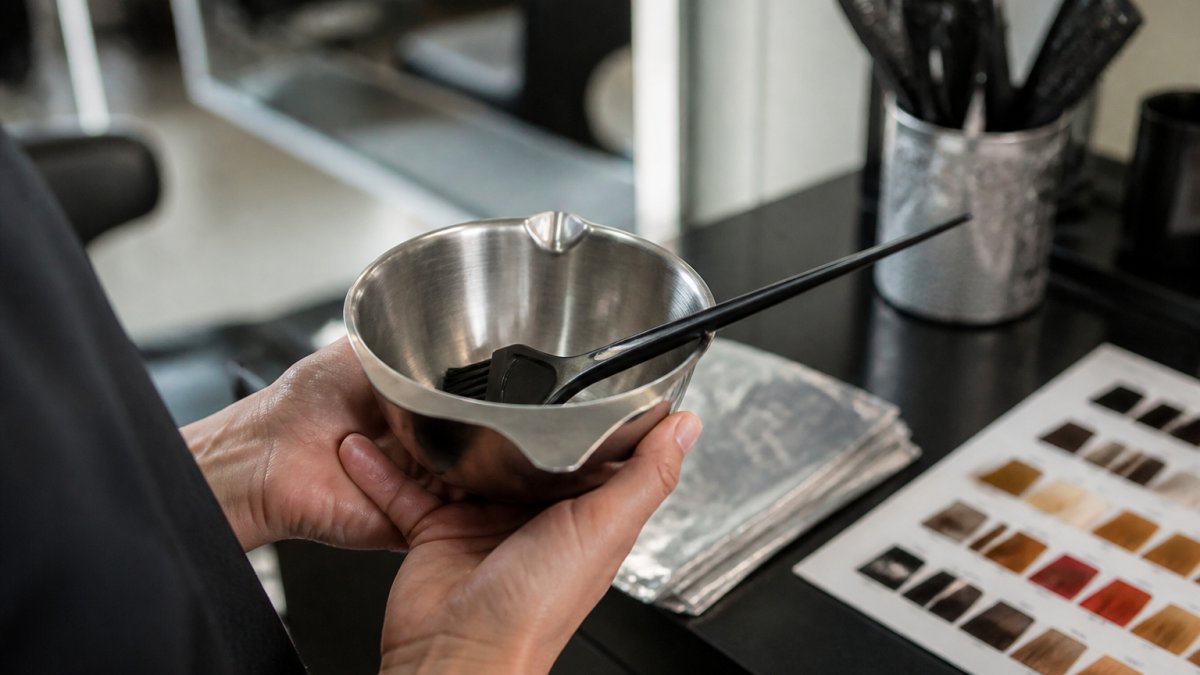
Those features sound minor until you have done six services in a day.
Material matters just as much. Our Hair Color Bowls are built from a sturdy, drop-resistant material and come two to a box in black, mauve, and beige, all stain resistant.

Stain-Resistant Tint Bowls That Survive Back-to-Back Color Services
Back-to-back services are the real test: a bowl that stains on the first bleach application looks worn within a week. Look for a surface that resists pigment absorption and a shape that fits comfortably in the palm.
Hair Color Application Brushes: Precision, Grip, and Hand Fatigue
Hair color application brushes determine how evenly color spreads and how much strain your hand absorbs over a full day. The two variables that matter most are bristle shape and handle geometry.
A wide feathered tip spreads product across a section in fewer passes, useful for balayage, complex foil work, and basic tint. A tapered tip places color precisely at the root or along a foil edge.
Grip is the underrated factor: a wide base makes for an easier hold, and an ergonomic profile prevents the tension and pinching cheaper brushes leave behind. Our Hair Color Brushes use a wide feathered tip with a tapered end and a wide-based handle, two to a box in four colors.

If you do a lot of foil work, pair your brushes with foils that stay put. Our Asymetrie Collection foils are 12 microns thick, pre-cut and pre-folded, with an embossed no-slip design that keeps hair stable at the root while you apply color or bleach.

Professional Hair Colorist Tool Kit Essentials for Every Station
A complete station needs four things: a bowl, a brush, foils, and skin protection. Building your professional hair colorist tool kit essentials around those four categories keeps stations consistent and restocking simple.
Here is how the categories break down for a working studio:
| Tool Category | What It Does | Why It Matters | ESTL+CO Option |
|---|---|---|---|
| Tint bowl | Holds and mixes color | Shape controls mess and speed | Hair Color Bowls, $19.00 |
| Application brush | Spreads and places color | Bristle design drives precision | Hair Color Brushes, $16.00 |
| Foils | Isolate sections during processing | Grip keeps hair stable | Asymetrie Collection, $17.50 |
| Barrier cream | Protects skin at the hairline | Prevents staining and cleanup | Barrier Cream Stick, $26.50 |
Skin protection is the category most studios overlook. Our Barrier Cream Stick applies quickly around the hairline to protect the client's skin from color stains. It uses an Italian formulation, is hypoallergenic, and comes in a 35-gram gold tube.
Total Cost of Ownership: Pricing Breakdown for Studio-Scale Purchasing
Total cost of ownership is where cheap tools lose. A bowl that stains or cracks after a few weeks costs more over a year than a stain-resistant bowl that lasts, because you buy it repeatedly and lose time to replacements.
To evaluate a HairArt products alternative, model four cost lines together: purchase price, usable lifespan, replacement frequency, and labor minutes lost to cleaning, re-mixing, and mid-service swaps.
A Simple Cost-Per-Service Model
Here is the framework we recommend to studios setting up multiple chairs.
| Cost Line | Cheap Alternative | Professional-Grade Option |
|---|---|---|
| Tint bowl (per unit) | Lower upfront, stains within weeks | $9.50 per bowl ($19.00 per two-bowl box) |
| Application brush (per unit) | Lower upfront, bristles splay early | $8.00 per brush ($16.00 per two-brush box) |
| Foils (per pack) | Thin, slips at the root | $17.50 per Asymetrie Collection pack, 12-micron embossed no-slip |
| Barrier cream | Often skipped entirely | $26.50 per 35-gram Barrier Cream Stick |
| Complete Station Bundle | Not offered | $52.50 for 2 brushes, 2 bowls, 1 barrier stick |
A station running 20 color services a week touches its bowl and brush roughly 1,000 times a year. A stain-resistant bowl that survives the full year eliminates reorders and downtime.
Why the Bundle Math Wins at Studio Scale
The Complete Station Bundle at $52.50 bundles two feathered brushes, two color bowls, and one barrier cream stick, less than the same items bought separately. For a studio resetting multiple chairs, it scales cleanly: ten stations is a single purchase order with one shipping charge and one arrival date, instead of ten orders trickling in across a month.
| Buying Approach | What You Get | Price | Best For |
|---|---|---|---|
| Complete Station Bundle | 2 brushes, 2 bowls, 1 barrier stick | $52.50 | New stations and full resets |
| Individual items | Same tools, bought separately | More than $52.50 combined | Filling one gap at a time |
| Single brush box | 2 brushes | $16.00 | Replacing worn brushes |
| Single bowl box | 2 bowls | $19.00 | Adding mixing capacity |
Priced per station, the bundle wins for studios setting up multiple chairs: per-station cost drops, the reorder cadence consolidates, and the team stops working around mismatched tools.
Studio-Scale Purchasing and Standardization
Bulk ordering is not just about unit price, it is about consistency.
A workable pattern for a multi-chair studio: standardize on the four core categories, set a reorder threshold of one full backup kit per station, and keep the backup in a shared supply closet rather than individual stashes.
For training programs and academies, the same logic applies at a larger scale.
Building a Standardized Tool System Across Your Color Team
Standardizing tools across a team is the highest-use move a studio lead can make. When every colorist works from the same bowl shape and brush style, color application becomes more consistent and new hires learn faster. The gap most studios fall into is treating standardization as a preference rather than an operational system. It needs specifications, a reorder rule, and a purchasing cadence.
Step 1: Lock the Specifications
Write down the exact specifications for each of the four core categories so every reorder matches what the team already uses: bowl shape and material, brush bristle profile and handle geometry, foil thickness and cut, and barrier cream format. A U-shaped cutout with a tilted edge behaves differently from a flat-edged bowl, and a wide feathered tip spreads product differently from a tapered tip.
Step 2: Set a Reorder Threshold
A single standardized kit per station reduces both waste and the small inconsistencies that show up in client results. Set a threshold that keeps one full backup kit per station in a shared supply closet, and place one consolidated order when it drops below. This prevents the two most common failure modes: a stylist running out of foils mid-service, and emergency single-item orders that cost more per unit and arrive late.
Step 3: Centralize the Supply Closet
Individual stashes hide consumption; a shared closet makes usage visible, which allows accurate inventory planning. Assign one person to track the closet and place orders, removing the ambiguity of who restocks in a studio with rotating staff.
Step 4: Plan for Training Programs
If your studio runs an academy or takes on apprentices, treat training inventory separately from service inventory. Students consume bowls and brushes at a higher rate than working colorists and need replacements matching the exact specifications they trained on. Bundle quantities keep per-student cost down and ensure a student who breaks a brush mid-assessment gets an identical replacement.
A Standardization Checklist
- One bowl shape and material across every station
- One brush bristle profile and handle geometry across every station
- One foil thickness and cut across every station
The tools you choose set the ceiling on how fast and how consistently your team can work. That is why we build ours the way we do.
Frequently Asked Questions
What should a professional hair colorist look for in tint bowls and brushes?
Look for bowls that fit comfortably in your palm, have a tilted edge to keep product contained, and resist staining after repeated use. Brushes should have a wide base for grip, feathered bristles for smooth color spread, and a tapered tip for neat sectioning. Stain-resistant materials matter because they hold up to daily color and bleach exposure without discoloring. The ESTL+CO Hair Color Bowl and Hair Color Brushes both meet these criteria, with bowls priced at $19.00 for a two-pack and brushes at $16.00 for a two-pack.
How do you choose stain-resistant tools for hair color services?
Check the material and finish, not just the label. Stain-resistant tint bowls and brushes should resist absorbing dye after multiple services. Look for bowls with a smooth, non-porous interior and brushes with sealed bristles that do not trap pigment. The ESTL+CO line uses stain-resistant materials across its bowls and brushes, and the barrier cream stick adds skin protection.
What tools are essential for a professional hair colorist's kit?
A working colorist needs at least two tint bowls, two application brushes, foils, and a barrier cream for skin protection. The ESTL+CO Complete Station Bundle covers the basics with two feathered brushes, two color bowls, and one barrier cream stick for $52.50. Add the Asymetrie foils at $17.50 for 500 pre-cut sheets if you do a lot of balayage or foil work. Having duplicates means you are never stuck mid-service without a clean tool.
Are ergonomic tint brushes worth it for busy studios?
Yes, if your team does multiple color services per day. Ergonomic brushes with a wide base and balanced weight reduce hand tension and cramping compared to thin-handled brushes. The ESTL+CO Hair Color Brushes are designed with a wide base for easier grip and feathered bristles that spread color evenly. For a studio with several colorists, the reduction in hand fatigue across a full day of appointments adds up. Smaller hands may find the tapered tip and wide grip still comfortable because the brush is not oversized.
What is the best alternative to HairArt products for professional colorists?
ESTL+CO offers a direct alternative with stain-resistant tint bowls, ergonomic feathered brushes, pre-cut foils, and a 35-gram barrier cream stick. Pricing starts at $16.00 for a two-pack of brushes and $19.00 for a two-pack of bowls. The Complete Station Bundle at $52.50 gives you a full station setup. These tools are designed by a professional for professional use, with a focus on precision, durability, and reducing hand strain during long color sessions.
Every color studio eventually faces the same problem: tools that slow the team down, stain too early, or wear out mid-quarter. ESTL+CO builds salon-grade tint tools designed by professionals for professionals, with stain-resistant color bowls, ergonomic feathered brushes, and a complete station bundle that keeps every chair consistent. Get started with ESTL+CO and give your team tools that hold up to a full appointment book.