

Why Use Professional Grade Tint Bowls: A Colorist's Guide
Table of Contents
- Why Professional Grade Tint Bowls Change Your Color Work
- Professional vs Consumer-Grade: What the Price Difference Actually Buys
- Professional Hair Color Bowls: Material, Capacity, and Design Differences
- Why a Stain-Resistant Tint Bowl Protects Your Investment
- How to Clean Hair Color Bowls Without Damaging Them
- Building a Hair Tint Bowl and Brush Set for Your Studio
- Cost of Ownership: Replacement Frequency and Value
- Conclusion
- Frequently Asked Questions
Last Updated: October 17, 2026
Why Professional Grade Tint Bowls Change Your Color Work
A tint bowl looks like the least important object on your station, yet it's the tool you touch more than almost anything else during a color service.
Here is the short answer to why it matters: a professional grade tint bowl is a mixing and holding tool built to survive repeated chemical exposure, keep product where you put it, and fit your hand and brush together as one system. Consumer bowls are built to a price. Professional bowls are built to a service count.
The gap isn't cosmetic: it shows up in mixing consistency, wasted color, and replacement frequency. Below, we break down what the price difference buys, how to clean a bowl so it lasts, and how to build a tint bowl and brush set for your studio.
Professional vs Consumer-Grade: What the Price Difference Actually Buys
Professional bowls withstand multiple color applications a day, holding up to developer and dye without clouding, warping, or absorbing pigment.
Most roundups stop at "professional is better," which doesn't help you buy. Here is the side-by-side comparison built around the criteria that actually change how a bowl performs on the floor.
| Criterion | Basic consumer bowl | Professional grade tint bowl | Why it matters in service |
|---|---|---|---|
| Material and wall thickness | Thin, flexible plastic that flexes when squeezed | Rigid, thicker-walled plastic that holds its shape under a loaded brush | A flexing bowl spills mixed color and distorts your measurement reference |
| Surface finish | Glossy or roughly molded interior that scratches | Smooth, non-porous interior that resists scratching | Scratches trap pigment and make it hard to judge true mixed tone |
| Measurement markings | None, or molded marks that fade or are hard to read | Clear interior graduations at common mixing volumes | Repeatable developer-to-dye ratios instead of eyeballing |
| Capacity and shape | One small size, straight walls | Sized options with a tilted edge and pour-friendly rim | Fewer refills on full-color services and less product running over the rim |
| Brush rest | No cutout; brush lies in the bowl or on the station | U-shaped cutout that cradles a feathered tint brush | Keeps the brush handle up and the tip out of pooled dye between sweeps |
| Grip and stability | Slippery base that slides on a wet station | Weighted or textured base that stays put in the palm | One-handed mixing without chasing the bowl across the station |
| Chemical resistance | Clouds, warps, or absorbs pigment after repeated developer exposure | Holds finish and color across repeated developer and dye contact | The bowl still reads clean on the station after a week of dark formulas |
| Cleaning behavior | Residue clings to scratches and needs scrubbing | Residue rinses from a smooth surface with mild soap | Faster turnarounds between clients |
Two rows deserve a closer look because they drive most of the daily frustration.
Measurement markings. Clear interior graduations let you measure developer and dye against the same reference every time, keeping your ratio consistent from client to client and your processing predictable.
Brush compatibility. A bowl sized for a feathered tint brush lets you load and sweep without fighting the sides, and the U-shaped cutout holds the brush between sweeps so you're not laying it in a puddle of dye.
To test any bowl before committing to a set: squeeze the walls (if they flex, it will spill when loaded), run a thumbnail across the interior (a visible mark means that surface will collect pigment), and check whether graduations are molded in or printed on top (printed marks wear off first). Those three checks take under a minute.
Professional Hair Color Bowls: Material, Capacity, and Design Differences
Professional hair color bowls differ from consumer versions in three measurable ways: stain-resistant material, capacity and markings that support accurate mixing, and a design that keeps the bowl stable and the brush accessible. Each one changes how you work through a color service.

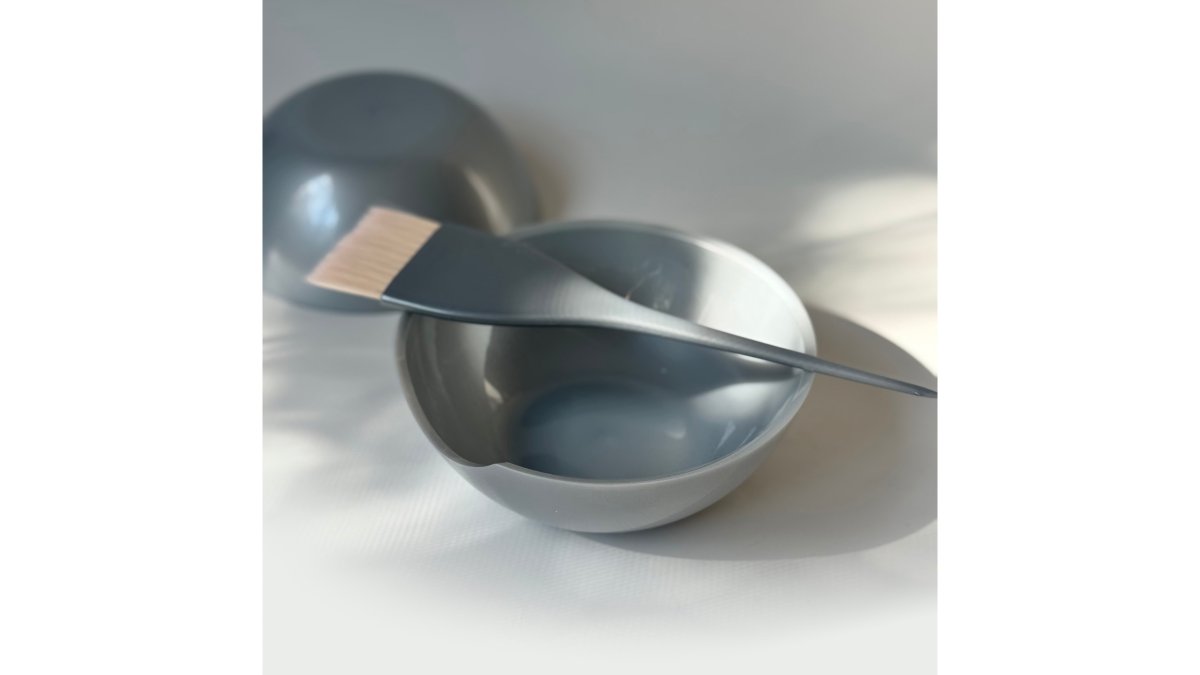
Measurement Markings and Mixing Consistency
Measurement markings are the difference between a color you can repeat and one you guess at. Clear interior markings let you measure developer and dye against the same reference every time, keeping ratios consistent from client to client and processing predictable. Without them, you eyeball volume, and eyeballing drifts over a long day.
Grip, Stability, and Brush Compatibility
A good bowl fits in your palm and stays put while you work. The U-shaped cutout holds your hair color brush between sweeps, so you're not chasing a rolling brush or laying it in a puddle of dye, and the tilted edge keeps product from running over the rim. A bowl sized for a feathered tint brush lets you load and sweep without fighting the sides.
Why a Stain-Resistant Tint Bowl Protects Your Investment
A stain-resistant tint bowl protects two investments: the bowl itself and your professional presentation. Pigment that bonds to a surface doesn't come out, and a bowl that looks dirty undermines client confidence in your station hygiene. Stain resistance also speeds cleaning when you're turning chairs all day.
The benefit is simple: mix dark, vivid, and light colors in the same bowl across a week and it still reads clean. Our stain-resistant bowls come in black, mauve, and beige, and all three shades keep their finish color after color.
How to Clean Hair Color Bowls Without Damaging Them
Cleaning a hair color bowl means removing residue without scratching the surface, because scratches are where stains start. Rinse with warm water as soon as the service ends, before dye dries, use a soft cloth or sponge with mild soap, and dry fully before stacking so moisture doesn't sit in the base.
A few habits keep a bowl in service longer:
- Rinse immediately after mixing and after the service, before pigment sets
- Skip abrasive scrubbers and harsh solvents that dull or scratch the surface
- Dry completely before storing to prevent residue buildup
- Store bowls so they aren't crushed or stacked under heavy tools
For brushes, work color out of the bristles under warm running water, then reshape the feathered tip and lay it flat to dry. Never stand a wet brush bristle-down in a cup, because that bends the tip and ruins the edge you rely on for precision.
Building a Hair Tint Bowl and Brush Set for Your Studio
A hair tint bowl and brush set should match your actual techniques, not a generic starter kit. For balayage and foils, precision at the brush tip matters more than a large bowl; for big full-color batches, capacity and stable footing matter more. Build the set around the work you do most.
Here is how we'd think through a set for a working studio:
| Your priority | What to look for | Why it matters |
|---|---|---|
| Precision work (balayage, foils) | Feathered brush tip, bowl with U-shaped cutout | Control at the tip and a brush that stays put |
| High-volume full color | Larger capacity, tilted edge | Fewer refills, less product spill |
| Mobile or rental studio | Sturdy material, compact stacking | Survives being packed and moved |
| Team purchasing | Consistent sizing, stain resistance | Uniform workflow across colorists |
For most colorists, start with a stain-resistant bowl and an ergonomic feathered brush, then add a second bowl to keep light and dark formulas separate. Our Hair Color Bowls come two to a box at $19.00, making that two-bowl setup straightforward, with a U-shaped cutout that holds your brush between sweeps and a tilted edge that keeps dye in the bowl.
Cost of Ownership: Replacement Frequency and Value
Cost of ownership is where professional grade tint bowls win the argument.
Most buying guides treat price as the only cost. The ownership picture is broader: up-front price, replacement frequency, cleaning time, and compatibility with the rest of your kit. Here is how those costs play out.
Replacement frequency. A basic bowl typically shows permanent scratches within weeks of daily use, and once pigment bonds into them it's effectively retired from light and blonde work.
Cleaning time as a cost. Every minute scrubbing a stained bowl is a minute not spent turning the chair.
Sanitation and chemical resistance. A bowl that clouds, warps, or absorbs pigment is harder to disinfect reliably, because residue clings to the damaged surface.
Compatibility with the rest of your kit. A bowl only saves money if it works with what you own.
For a salon owner buying for a team, that difference multiplies across every colorist on the floor. Uniform, stain-resistant bowls keep the station consistent, simplify ordering, and reduce the mid-service scramble when a cheap bowl gives out. Value is durability plus performance plus compatibility, not the lowest line item on the supply order.
Conclusion
The tools you reach for every service shape how fast you work and how consistent your color comes out. A professional grade tint bowl keeps your mix accurate, your brush in place, and your station looking the part across hundreds of services instead of a handful. If your current bowls are stained, wobbly, or forcing you to eyeball ratios, that's a workflow problem you can fix today.
At ESTL+CO, we build stain-resistant tint bowls and ergonomic feathered brushes designed by professionals for professional colorists. Our bowls fit in the palm of your hand, hold your brush in the U-shaped cutout, and keep dye in the bowl with a tilted edge, and they come two to a box at $19.00 so you can set up a light/dark pair right away. Get started with ESTL+CO and give your color work the tools it deserves.
Frequently Asked Questions
What is the difference between a professional tint bowl and a regular bowl?
A professional grade tint bowl is built for repeated color mixing: stain-resistant material, measurement markings, a tilted edge that keeps dye inside during application, and a U-shaped cutout that holds the brush between sweeps. A regular bowl or kitchen container lacks those features, so color slips, measurements drift, and the surface stains or cracks after a few uses. The difference shows up in mixing consistency, cleanup time, and how many bowls you replace in a year.
Are stain-resistant tint bowls worth the extra cost?
For anyone coloring hair daily, yes. A stain-resistant tint bowl keeps its color and surface after repeated developer and dye exposure, so you are not replacing bowls every few weeks or working with a bowl that looks dirty in front of clients. ESTL+CO's Hair Color Bowls cost $19.00 for a two-bowl box in black, mauve, or beige, all stain resistant. Compare that to repeatedly buying cheap bowls that stain, warp, or crack, and the per-use cost drops quickly.
How do you clean and maintain a hair color bowl?
Scrape leftover color into the trash before it sets, then rinse with warm water and a mild soap, using a soft cloth or your gloved fingers. Avoid abrasive scrubbers and harsh solvents that dull the surface. Dry fully before stacking to prevent residue buildup. Prompt cleaning matters most: color left to harden overnight takes more scrubbing and wears the bowl faster. A stain-resistant bowl makes this routine quicker because dye does not bond to the surface.
Can you reuse a tint bowl after mixing hair color?
Yes, a professional-grade bowl is made to be reused color after color. Rinse and wash it after each service, check for cracks or rough spots, and retire it if the surface breaks down. Reusing is safe and normal in salons; the key is cleaning before residue dries. Cheap bowls often cannot survive repeated reuse because dye stains soak in and the plastic warps, which is where the replacement cycle starts.