

How to Set Up an Essential Hair Color Mixing Station
Last Updated: October 29, 2026
Quick Summary
An essential hair color mixing station setup is a dedicated, organized workspace where you measure, mix, label, and stage hair color before application. Stock it with two bowls, two tint brushes, a digital scale accurate to 0.1 oz or 1 g, developer in 10, 20, and 30 volume, gloves, barrier cream, and bowl labels. Place the scale at the center, developer within arm's reach, clean bowls left, and used tools right.
- Clear and disinfect the station surface daily, which takes about 10 minutes.
- Tare the bowl on the scale before adding color, then add color first and developer second by weight.
- Label each bowl immediately with client name, formula, ratio, and start time using masking tape.
- Reset the station after every client in about 90 seconds: wipe the mat, cap developer, and toss gloves.
- Raise the station so you are not bending to mix, keeping the scale and bowls at elbow height.
Table of Contents
- Why Your Hair Color Mixing Station Decides Your Service Speed
- Hair Color Mixing Tools You Actually Need (and What to Skip)
- Salon Color Bar Setup: Layout, Lighting, and Surfaces
- Your Salon Station Setup Checklist, Step by Step
- Hair Color Station Organization That Survives a Busy Day
- Sanitation, Chemical Safety, and Ergonomics at the Mixing Station
- Build Your Station Around ESTL+CO Tools
- Frequently Asked Questions
Why Your Hair Color Mixing Station Decides Your Service Speed
The U.S. hair color market is projected to reach $8.12 billion in 2026, according to Hair Bar NYC's 2026 salon guide. Maintaining this level of efficiency across other service areas requires a similar commitment to a professional station setup, ensuring that every tool remains within reach to streamline the workflow for complex beauty treatments.
Many colorists treat the station as an afterthought. It gets whatever counter space is left over. Then service speed can drop, mixing errors can creep in, and the station can look wrecked by the afternoon.
Below, we break down the exact tools, layout, and daily routines that fix this.
Hair Color Mixing Tools You Actually Need (and What to Skip)
The core of any hair color mixing station comes down to a complete inventory, not a random collection. This section gives you a checklist so you can stock the station in one trip.
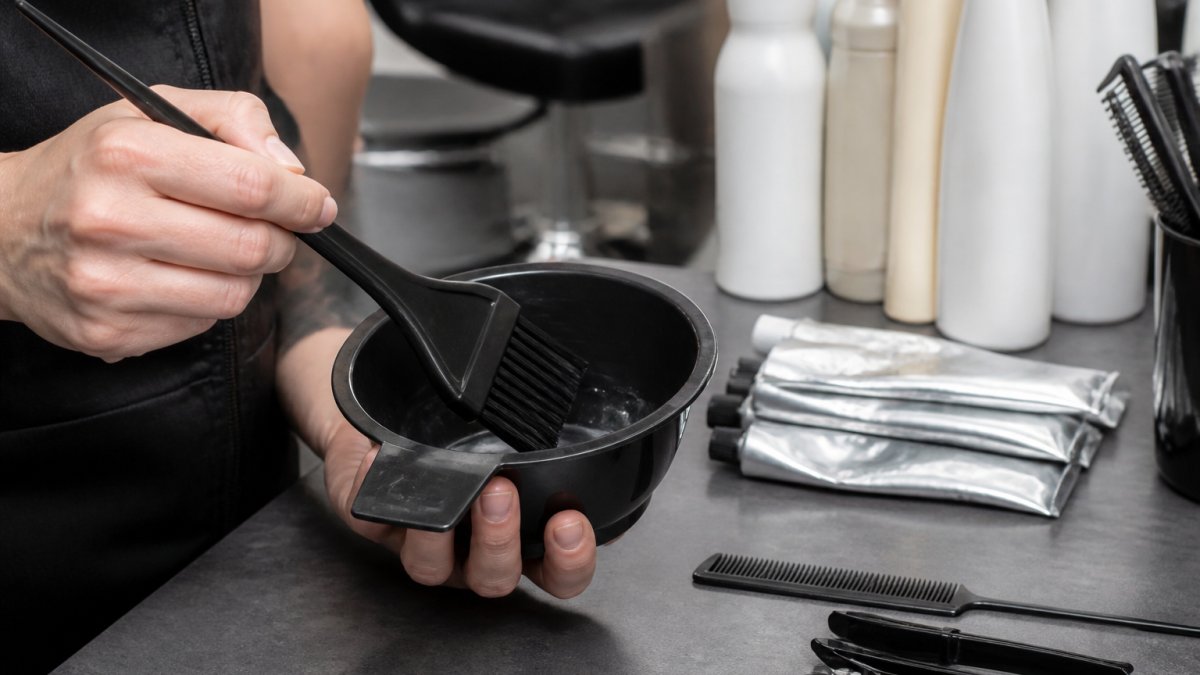
The Complete Mixing Station Inventory Checklist
Use this list as your stocking guide. Quantities assume a single colorist working a full day.
Mixing and measuring
- Two color bowls minimum (one in use, one clean and ready)
- Two tint brushes: a wide feathered brush for full coverage, a smaller one for detail work
- Digital scale accurate to 0.1 oz or 1 g, with a tare function
Color and developer
- Developer bottles in 10, 20, and 30 volume, clearly marked
- Color tubes organized by level and tone
- Dispensers or pump tops for high-volume developers
- Mixing sticks or spatulas for scooping thick color
Protection and cleanup
- Barrier cream stick for the client's hairline
- Nitrile gloves in the colorist's size, stocked within reach
- Color-safe surface mat that contains drips and wipes clean fast
- Salon disinfectant spray or wipes for between clients
Labeling and tracking
- Masking tape or color-coded bowl labels
- Permanent marker
- Formula log or client record system (paper or salon software)
A common mistake is buying too many bowls and too few brushes. Brushes can wear out and slow you down when they splay.
Color Measurement, Labeling, and Formula Tracking
Weighing and labeling are where most mixing errors start. A fixed 1:1 ratio does not fit every product, so the station needs a repeatable procedure, not a guess.
- Tare the bowl on the scale before adding color. This removes the bowl weight from every measurement.
- Add color first, then developer by weight, following the manufacturer's ratio. Record both weights, not just the ratio.
- Label the bowl immediately with client name, formula, ratio, and start time. A strip of masking tape on the bowl works and peels off clean.
- Log the formula in the client record before application, including developer volume and processing time. This is what makes a color repeatable on the next visit.
- Set the timer at the moment the last section is applied, not when mixing starts.
What You Can Skip
Skip decorative caddies that hide your tools. Skip giant dispensary racks if you work in a small space. Skip bowls that stain easily, because a stained bowl makes it harder to judge color accurately.
If you want to browse actual bowls before you commit, see our professional salon hair color bowls, which come in boxes of two. Our hair color brushes use a wide feathered tip and tapered end.

Salon Color Bar Setup: Layout, Lighting, and Surfaces
A salon color bar setup works best as a zone, not a corner. The layout should follow one path: measure, mix, label, apply.
Place the scale at the center. Keep developer bottles within arm's reach behind it. Put clean bowls to the left and used tools to the right.
Lighting matters more than most colorists expect.
For surfaces, pick non-porous countertops.
Your Salon Station Setup Checklist, Step by Step
Follow this salon station setup checklist in order. Total time is about 60 minutes.
- Clear the surface completely. Remove everything, then wipe with salon disinfectant. [10 minutes]
- Set the mixing mat. Center it on the countertop, leaving space at the back for bottles.
- Place the scale. Put it center-left, away from water and drips.
- Stage developer bottles. Line up 10, 20, and 30 volume behind the scale, labels facing out.
- Arrange bowls and brushes. Clean bowls left, brushes in a holder, nothing lying flat.
- Add the barrier cream stick. Keep it forward, where your hand naturally lands.
- Set a waste bin below. Small bin for foils, gloves, and empty tubes.
- Label the zone. A small sign keeps other staff from parking cups and phones there.
Expected result: every tool reachable in one motion, with no crossing over wet product.
| Step | Task | Time | Frequency |
|---|---|---|---|
| 1 | Clear and disinfect surface | 10 min | Daily |
| 2-6 | Stage tools and products | 15 min | Daily |
| 7 | Empty waste bin | 2 min | After each client |
| 8 | Restock developer and bowls | 10 min | Weekly |
Hair Color Station Organization That Survives a Busy Day
Hair color station organization fails for one reason: there is no reset routine. A station set up beautifully at 9 a.m. is chaos by noon unless someone resets it between clients.
The fix is a 90-second reset after every service. Wipe the mat. Return bowls to the clean side. Cap the developer. Toss gloves. That is it. The sections below turn that habit into a system that holds up on a full book.
The Between-Client Reset, Step by Step
- Cap and wipe developer bottles. A crusted cap slows the next pour and contaminates the bottle mouth.
- Scrape and stack used bowls. Scrape excess color into the waste bin, then stack used bowls on the dirty side, never on the clean side.
- Wipe the mat and scale. Color residue on a scale platen throws off the next tare.
- Replace gloves and barrier stick. Restock before the next client sits, not after.
- Reset the label station. Tape, marker, and formula log back to their marked positions.
Sanitation and Chemical Safety
Chemical exposure at the mixing station is a real concern. A Johns Hopkins University study from 2023 found that hairdressers of color had higher levels of chemicals in their bodies than women working in offices. The study did not publish sample sizes or specific measurements, but the direction is clear.
Watch out: mixing with bare hands and no ventilation is the most common safety gap we see. Build these habits into the station:
- Gloves on before the first bowl. Nitrile, not latex, and sized so dexterity is not compromised.
- Ventilation on before mixing. A running exhaust fan or open airflow near the station, not just in the room.
- No food or drink at the mixing surface. Designate a separate break area.
- Dispose of color waste per the manufacturer's instructions. Never pour mixed color or developer down a drain.
Ergonomics and Accessibility
Ergonomics matter too. Raise the station so you are not bending to mix. Keep the scale and bowls at a comfortable height, with the most-used items within easy reach.
An ergonomic brush with a wide base is designed to reduce tension and pinching. A focused task lamp at the station helps you see tone while mixing.
Labeling and Formula Tracking
A single fixed mixing ratio does not fit every product. Hair Bar NYC's professional color mixing guide shows ratios like 1:1 and 1:1.5 depending on the manufacturer's instructions. So label every bowl with the client name, formula, and ratio before you start. A strip of masking tape on the bowl works.
For deeper routines, read our guide on organizing professional hair color tools.
Sanitation, Chemical Safety, and Ergonomics at the Mixing Station
Chemical exposure at the mixing station is a real concern. A Johns Hopkins University study from 2023 found that hairdressers of color had higher levels of chemicals in their bodies than women working in offices.
Watch out: mixing with bare hands and no ventilation is the most common safety gap we see. Wear gloves, keep the station ventilated, and avoid eating or drinking at the mixing surface.
Ergonomics matter too. Raise the station so you are not bending to mix. Keep the scale and bowls at elbow height.
If you want to understand stain-resistant bowl maintenance, our news article on stain-resistant bowls covers durability and care.
Build Your Station Around ESTL+CO Tools
A working station needs tools that hold up to daily color work. The Complete Station Bundle gives you two feathered brushes, two color bowls, and a barrier cream stick for $52.50.

Our stain-resistant bowls have a U-shaped cutout that holds the brush between sweeps and a tilted edge that keeps product in the bowl. Our feathered brushes are ergonomically designed to reduce tension and pinching.
Frequently Asked Questions
What do you need at a hair color mixing station?
A working mixing station needs a stain-resistant bowl, a feathered tint brush, a developer dispenser, a digital scale, color tubes, foils or clips, barrier cream, and a trash bin within arm's reach. Keep a spray bottle of cleaner and paper towels on the counter so you can wipe spills immediately. A wall-mounted or under-counter rack for bottles keeps the surface clear. The goal is to have every item you touch during a service within one step of your mixing area.
How should a salon color bar be organized?
Organize a salon color bar by workflow, not by product brand. Put the tools you use first (bowls, brushes, scale) closest to where you stand, then developer and color tubes, then foils and clips. Store backstock below the counter and keep only one open bottle of each developer on top. Group color tubes by level or line so you can grab the right one without reading every label. A dedicated color bar keeps mixing, storing, and organizing supplies in one zone instead of spread across the salon.
How do you keep a hair color mixing station clean?
Wipe the counter after every client with a salon-approved disinfectant, and clean bowls and brushes before color dries. Stain-resistant bowls and brushes cut scrubbing time because color does not bond to the surface. Keep a small trash bin for foils and gloves directly under the station, and never set a used brush back on the counter. At the end of the day, clear the surface completely, wipe down bottles, and restock tools so the next shift starts with a clean station.
How can you prevent cross-contamination when mixing hair color?
Use a fresh bowl and brush for each client, or clean and fully dry them between services. Never dip a used brush back into a developer or color bottle; pour the amount you need into a separate container first. Keep lids closed on unused product and label secondary containers with the product name and date. A barrier cream stick around the hairline also protects the client's skin and keeps the service area cleaner. These habits matter more than any single tool.
Building a station that holds up through a full book of color services takes the right tools and a reset routine you actually follow. ESTL+CO designs salon-grade tint bowls and feathered brushes for professional colorists who need precision, stain resistance, and comfort behind the chair. Get started with ESTL+CO and build a mixing station that keeps your service speed high from the first client to the last.
