

Are Expensive Tint Brushes Worth It? A 2026 Guide
Table of Contents
- Tint Brush vs. Hard Card: What Each Tool Actually Does
- What Separates a Professional Tint Brush From a Cheap One
- The Real Benefits of Using a Quality Tint Brush
- Professional Hair Colorist Tool Kit Essentials
- Best Tint Brushes for Balayage and Complex Techniques
- Cost vs. Benefit: Do Expensive Tint Brushes Pay Off?
- How to Maintain Your Tint Brushes for Longevity
- The Verdict on Expensive Tools
- Frequently Asked Questions
Last Updated: September 29, 2026
Tint Brush vs. Hard Card: What Each Tool Actually Does
Walk into any color studio and you'll see both tools on the trolley. They are not interchangeable. A tint brush is a soft-bristled applicator built to carry color into the hair and blend it along a section. A hard card is a stiff plastic edge used to press, smooth, and isolate hair, or to work product flat against a surface.
The confusion starts because both live in the same drawer. In practice, they solve two different problems:
- Tint brush: loads color, feathers the product, controls where saturation stops
- Hard card: presses, smooths, and separates; it does not blend
- Squeegee-style edges: push product across a flat surface, common in film and coating work, not in hair color
- Application technique: the brush determines how the color sits, the card determines how the section sits
If you're shopping for a tint brush, you're buying control over blending and saturation. If you're buying a hard card, you're buying pressure and edge definition. Buying one when you need the other is the most common mistake we see.
That distinction matters because it reframes the whole pricing question. You're not paying more for the same job done better. You're paying for a tool with a narrower, more demanding job.
What Separates a Professional Tint Brush From a Cheap One
The gap between a budget brush and a professional-grade one comes down to bristle quality, tip shape, and how the handle sits in your hand over a full shift.
Cheap brushes typically use stiff, uniformly cut bristles. They push color in streaks and hold product unevenly, so you end up reloading more often. Professional brushes use a feathered tip, where the bristles taper to a fine edge. That taper is what lets you sweep color on and blend it without hard lines.
Three things separate the tiers:
- Bristle density and taper: feathered bristles hold more product and release it evenly
- Handle geometry: a wide base spreads grip pressure instead of concentrating it
- Material: synthetic fibers resist staining and hold their shape after repeated washing
ESTL+CO's color brushes are built around exactly this idea.

The Real Benefits of Using a Quality Tint Brush
The workflow gain is real but modest. You're not cutting service time in half. You're removing the small frictions, the extra reload, the re-blend, the wrist reposition, that add up across a day.
Professional Hair Colorist Tool Kit Essentials
A working colorist's kit is smaller than most supply lists suggest. The essentials cover application, sectioning, mixing, and protection.
The core list:
- Feathered tint brushes in at least two sizes for root work and full-length application
- A stain-resistant tint bowl that won't hold color from the last client
- Sectioning clips that grip without creasing wet hair
- A hard card or comb for pressing and isolating sections
- Gloves and a stain-resistant cape for protection
Best Tint Brushes for Balayage and Complex Techniques
Balayage and foil work demand a brush that can place color precisely and feather it without dragging. That rules out anything with a blunt, stiff tip.
| Technique | Brush Profile | Why It Matters |
|---|---|---|
| Balayage | Tapered feathered tip | Directional sweep, soft transition |
| Foil work | Medium density, fine tip | Precise placement inside the foil |
| Root retouch | Firm, short bristles | Controlled saturation at the scalp |
| Full-length application | Wide feathered base | Even spread, fewer passes |
| Toner application | Soft, low-density bristles | Light, even distribution |
Cost vs. Benefit: Do Expensive Tint Brushes Pay Off?
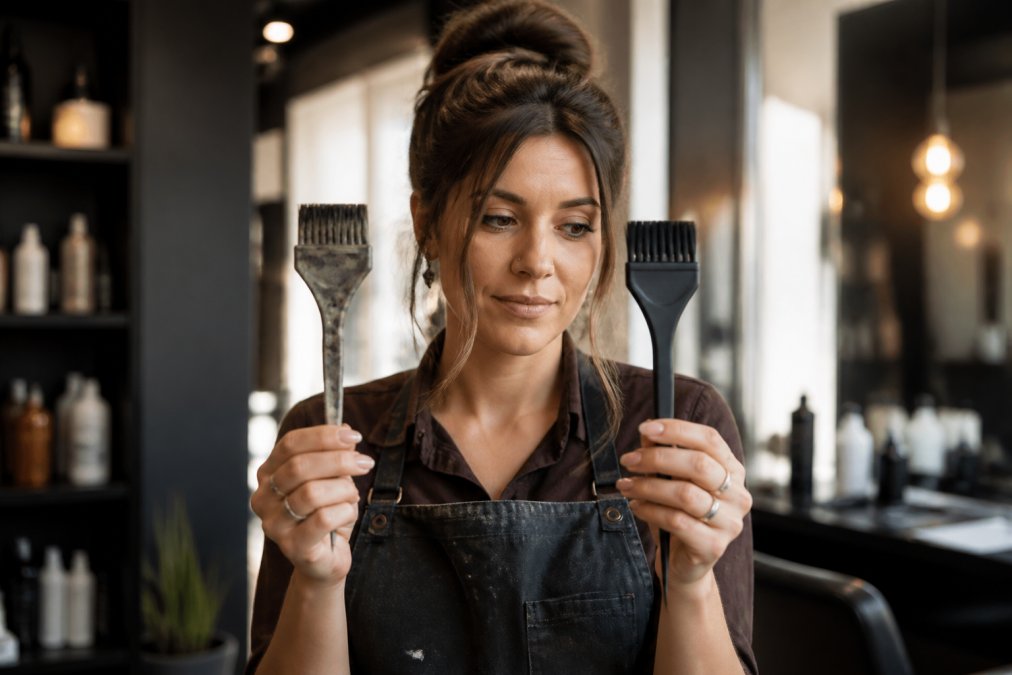
For most working colorists, yes: the payoff comes from fewer replacements, less product waste, and less hand strain, not from a dramatic jump in speed. But "it feels better" is not a number. Here is how to actually run the math.
The three numbers that decide it
Ignore sticker price. Track these instead:
- Replacement cycle: how many weeks a brush stays usable before the tip splays or sheds
- Reloads per head: how many times you stop mid-section to pick up more product
- Service minutes: total time from first section to last blend, measured on the same client type
A cheap brush that frays after a few weeks gets replaced several times a year. A professional-grade brush that holds its shape lasts far longer, and the cost per month drops below the budget option. That is the whole argument, and it only holds if you measure it.
A simple side-by-side test you can run this week
Pick two clients with similar density and length. Use your current brush on one and the new brush on the other. Log three things on a notepad:
- Reloads per head
- Minutes from first application to final blend
- Any re-blend or correction passes
Where the value actually shows up
- Durability: bristles that keep their taper instead of splaying
- Stain resistance: bowls and brushes that don't carry pigment between clients
- Ergonomics: a wide base that reduces tension and pinching
- Consistency: the same feel on client one and client ten
ESTL+CO's Hair Color Brush is priced at $16.00 for a box of two. That's the number to compare against, not the price of a single cheap brush. When you factor in the second brush in the box and the stain resistance, the cost-benefit ratio shifts quickly.
How to Maintain Your Tint Brushes for Longevity
Brush longevity is mostly about how you clean and store them, not how much you paid. Two habits matter more than everything else combined, and both are about protecting the two parts that fail first: the feathered tip and the glue at the ferrule.
Why these two habits matter mechanically
A feathered tip works because the bristles taper to a fine edge. That taper is a shape, and bristles have memory. Let pigment dry in them and the dried film locks the bristles into whatever position they were in when they dried. Reshape them while damp and they hold the intended profile. Skip that step and you are training the brush to splay.
A simple weekly routine
- Rinse bristles under warm water until the water runs clear
- Work a drop of mild soap through the bristles with your fingers, never a comb
- Rinse again and press gently between a towel, don't wring
- Reshape the feathered tip by hand while damp
- Store flat or bristle-down in a case for transport
For stylists moving between rental studios, a rigid case matters as much as the cleaning. Bristles crushed in a bag lose their taper faster than bristles that wear out from use. A case that holds the brush flat, tip protected, does more for longevity than any cleaning product.
What to never do
- Never soak overnight. It softens the ferrule glue.
- Never wring or twist the bristles. It breaks the taper.
- Never store bristle-up in a jar. Gravity bends the tip.
- Never comb dried color out of the bristles. You will pull the taper apart.
A common mistake is treating maintenance as an afterthought. On a professional-grade brush, the maintenance routine is what converts the higher upfront price into a lower cost per month. Clean it right and the taper survives. Clean it wrong and you have paid premium money for a brush that fails like a cheap one.
The Verdict on Expensive Tools
The honest answer is that expensive tint brushes pay off when you use them daily and cheap ones don't when you don't. The deciding factor isn't the price tag, it's your volume, your technique demands, and how much hand fatigue costs you by Friday.
Frequently Asked Questions
What makes a professional hair tint brush different from a cheap one?
Professional tint brushes use denser, synthetic fibers that hold their shape and resist staining, while cheap versions often have sparse bristles that splay after a few uses. The bristle density affects how evenly color transfers to the hair. Professional brushes also feature ergonomic handles designed to reduce hand tension during long appointments. ESTL+CO's feathered brushes, for example, have a wide base for easier grip and a tapered tip for neater sections.
Do expensive tint brushes last longer than drugstore versions?
In most cases, yes. A $16 professional brush like the ESTL+CO Hair Color Brush set (two brushes per box) can outlast multiple cheap alternatives because the bristles resist fraying and the handle maintains its shape through repeated washing. Drugstore brushes often need replacing every few weeks, which adds up over a year. The cost-benefit ratio shifts in favor of professional-grade tools when you factor in replacement frequency and the time saved on application.
How does brush bristle quality affect hair color application?
Bristle quality determines how smoothly color spreads and how much control you have at the edges. Feathered bristles, like those on ESTL+CO brushes, create a softer sweep that helps blend color without harsh lines, which matters for balayage and foil work. Stiff or sparse bristles can cause uneven saturation and require more passes, slowing down your first-pass application and increasing the risk of creases or patchy results.
How often should professional colorists replace their tint brushes?
With proper cleaning, a high-quality tint brush can last six months to a year or more in a busy salon. Signs it's time to replace: bristles that splay outward, a handle that feels loose, or staining that won't wash out. Rotating between two brushes, like the pair included in each ESTL+CO box, extends the life of both and ensures you always have a clean tool ready during back-to-back appointments.