

Benefits of Ergonomic Hair Tinting Tools for Colorists
Table of Contents
- How Ergonomic Hair Tinting Tools Reduce Hand Fatigue and Strain
- Ergonomic Hair Brushes for Professional Colorists: Grip, Weight, and Precision
- Preventing Repetitive Strain Injury in Hairdressing: What the Research Shows
- Stain-Resistant Bowls and Feathered Brushes: Practical Benefits for Daily Workflow
- Ergonomic Exercises for Colorists: Stretches That Protect Your Hands and Wrists
- Tool Maintenance and Cleaning: Keeping Ergonomic Benefits Intact
- Is the Investment Worth It? ROI Analysis of Ergonomic Hair Tinting Tools
- Frequently Asked Questions
Last Updated: September 11, 2026
How Ergonomic Hair Tinting Tools Reduce Hand Fatigue and Strain
The benefits of ergonomic hair tinting tools start with basic biomechanics: a tool that matches your hand's natural grip requires less muscular effort per stroke, which compounds across hundreds of applications each week. ESTL+CO designs its tinting tools around that principle, and this guide breaks down exactly where the payoff shows up.
Think about how many times you dip a brush, sweep color across a section, and re-dip during a single foilayage service. Each motion recruits the same small muscles in your thumb, index finger, and forearm. When a brush handle is too thin, too smooth, or weighted toward the tip, your hand compensates by gripping harder. Over a full day of clients, that compensation becomes hand fatigue, and over months or years, it becomes a repetitive strain injury.
Ergonomic tinting tools address this by widening the grip area, adding surface friction so the brush doesn't rotate in your hand, and balancing weight toward the palm rather than the bristles. The result is fewer wasted micro-adjustments per stroke.
Ergonomic Hair Brushes for Professional Colorists: Grip, Weight, and Precision
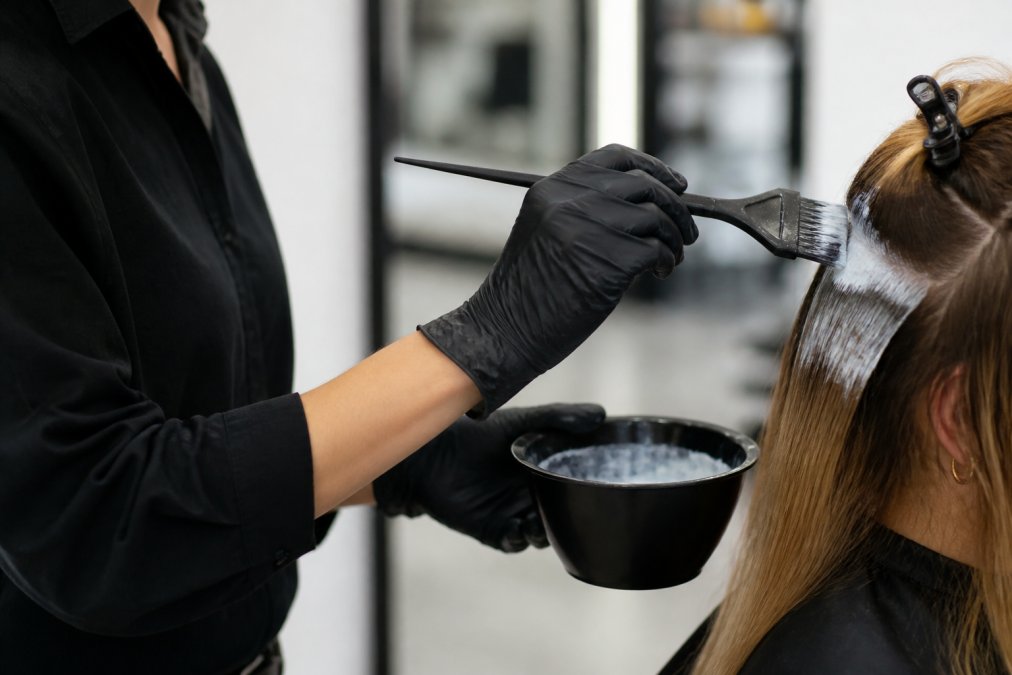
Ergonomic hair brushes for professional colorists solve three problems at once: grip diameter, weight distribution, and application control. A brush with a wide, tapered base lets your fingers rest in a natural curl instead of pinching, and that single design change affects everything downstream.
Grip diameter matters more than most colorists realize. A handle that's too narrow forces your thumb and index finger into a pinch grip, the same position that contributes to carpal tunnel syndrome over time (peer-reviewed research). A wider base, like the one on the Hair Color Brush from ESTL+CO, lets you hold the brush with a looser, more relaxed hand.

Weight distribution is the second lever. A tip-heavy brush pulls your wrist into extension, which strains the forearm extensors. A balanced brush keeps your wrist closer to neutral.
Precision is the third. A feathered tip spreads color evenly in one pass, so you make fewer corrective sweeps. Fewer sweeps means less repetitive motion, and less repetitive motion means less cumulative strain.
Preventing Repetitive Strain Injury in Hairdressing: What the Research Shows
Preventing repetitive strain injury in hairdressing comes down to reducing three variables: force, repetition, and awkward posture. Ergonomic tools address force and posture directly, and they reduce repetition by making each stroke more efficient. But to understand why that matters, you need to know what's actually happening inside the hand and wrist during a color service.
The mechanism behind the ache. Your finger flexor tendons run through narrow sheaths in the wrist and palm. Every time you grip a brush, those tendons slide through the sheaths, and every time you release, they slide back. Under light load, that's fine. Under sustained pinch grip, the tendons press against the sheath walls, and the friction generates localized inflammation. Over a career, that inflammation thickens the sheaths, which narrows the tunnel the tendons pass through, which increases friction on the next stroke. It's a compounding loop, not a single event.
The same anatomy drives carpal tunnel syndrome. The median nerve shares a passage in the wrist with nine flexor tendons. When the wrist sits in sustained extension or flexion, pressure inside that passage rises. A tip-heavy brush pulls your wrist into extension on every stroke, so the pressure spike repeats hundreds of times per service.
Occupational health guidance consistently identifies repetitive motion and sustained awkward postures as primary risk factors for musculoskeletal disorders in manual professions. The Occupational Safety and Health Administration's guidance on ergonomics outlines how tool design, workstation setup, and work pacing all influence injury risk.
For colorists, that translates into a few practical realities:
- Force: A non-slip grip reduces how hard you squeeze the brush, which lowers tendon-sheath friction per stroke.
- Repetition: A feathered tip covers more section per stroke, so the total number of tendon slides per service drops.
- Posture: A balanced handle keeps your wrist closer to neutral, which keeps carpal tunnel pressure lower during application.
What most guides miss is that these three factors interact. A lightweight brush with a poor grip still forces you to squeeze hard, and a well-shaped grip on a tip-heavy brush still pulls your wrist out of alignment. You need both.
There's also a timing factor. Tissue damage accumulates faster when you work without micro-breaks. A common pattern among colorists who develop chronic issues is back-to-back bookings with no gap between clients, which means the flexor tendons never get a recovery window. Ergonomic tools reduce the load per stroke, but they don't replace the need for pacing. The tool and the schedule work together.
Stain-Resistant Bowls and Feathered Brushes: Practical Benefits for Daily Workflow
Stain-resistant bowls and feathered brushes change your daily workflow in ways that go beyond comfort. A stain-resistant bowl wipes clean between clients instead of holding pigment in its surface, which saves time on every color change. The Hair Color Bowl from ESTL+CO also has a U-shaped cutout that holds your brush in place between sweeps, so you're not juggling tool and bowl with one hand.

| Tool Feature | Daily Workflow Benefit | Ergonomic Impact |
|---|---|---|
| Stain-resistant bowl surface | Faster cleanup between clients | Less scrubbing motion |
| U-shaped brush rest | Hands-free brush holding | Fewer awkward wrist holds |
| Feathered brush tip | Even color spread in one pass | Fewer corrective strokes |
| Wide tapered grip | Relaxed finger position | Reduced grip force |
The feathered tip deserves its own note. Colorists doing balayage and complex foil work need a brush that lays down product evenly without dragging. A feathered edge gives you that precision while reducing the number of passes you make over the same section.
Ergonomic Exercises for Colorists: Stretches That Protect Your Hands and Wrists
Ergonomic exercises for colorists are the piece most colorists skip entirely, and it's the cheapest intervention available. Five minutes of targeted stretching between clients keeps your hands and wrists from stiffening into the positions your work demands.
Try this sequence between appointments:
- Wrist flexor stretch: Extend one arm, palm up, and gently pull the fingers back with the other hand. Hold 20 seconds per side.
- Wrist extensor stretch: Extend one arm, palm down, and gently pull the fingers down. Hold 20 seconds per side.
- Thumb opposition: Touch your thumb to each fingertip in sequence, then reverse. Repeat 10 times per hand.
- Tendon glides: Move through a straight hand, hook fist, full fist, and straight fist. Five repetitions per hand.
- Forearm rotation: With your elbow at 90 degrees, rotate your palm up and down slowly. Ten repetitions per side.
Do these between clients, not just at the end of the day. Stretching while tissue is still warm and mobile is more effective than stretching a hand that's already stiffened.
Tool Maintenance and Cleaning: Keeping Ergonomic Benefits Intact
Tool maintenance is where ergonomic benefits quietly erode. A brush that's been cleaned carelessly loses its feathered edge, and a bowl with a scratched surface holds pigment and requires more scrubbing force to clean.
Here's what to protect:
- Bristles: Rinse under warm water immediately after use. Dried color stiffens the feathered tip and changes how it lays down product.
- Grip surface: Wipe the handle clean. Color residue on a non-slip grip defeats the friction that makes it work.
- Bowl surface: Avoid abrasive scrubbers. A stain-resistant surface stays stain-resistant only if you don't scratch it.
- Storage: Store brushes flat or bristle-up. Bristle-down storage bends the feathered tip out of shape.
A brush with a bent tip forces you to make extra passes, which reintroduces the repetitive motion you bought the tool to reduce. Maintenance isn't a chore separate from ergonomics. It's part of it.
Is the Investment Worth It? ROI Analysis of Ergonomic Hair Tinting Tools
The ROI on ergonomic hair tinting tools comes from three places: reduced fatigue, fewer replacement purchases, and fewer lost workdays from hand and wrist pain. Most articles stop at the first one. The real business case lives in the third.
The replacement math. Run it on your own usage. If you replace a low-cost bowl and brush set several times a year, compare that annual total against a single durable set. ESTL+CO's Hair Color Brush is $16.00 and the Hair Color Bowl is $19.00, so a complete set runs $35.00. For a working colorist, that's a one-time cost against tools you use every single day. A cheap set that stains, cracks, or loses its feathered edge within a few months costs more over a year than the durable set costs once.
The medical-cost side. This is the part almost no guide quantifies. According to the Bureau of Labor Statistics' data on workplace musculoskeletal disorders, musculoskeletal disorders remain among the most common categories of workplace injury, and for professions built on repetitive hand motion, prevention is the only real cost control. A single hand or wrist injury that requires medical evaluation, imaging, and physical therapy can run into the thousands of dollars in out-of-pocket costs even with insurance, and that's before you count the income lost while you're off the floor. A colorist who misses even a week of booked clients loses far more than the cost of every ergonomic tool in the salon.
The retention angle for salon owners. For a salon owner, the ROI calculation is different. Replacing a colorist who leaves because of chronic hand pain costs recruiting time, training time, and client relationships. Equipping a chair with ergonomic tools is a small capital expense against that risk. The same logic applies to independent colorists building a book: your hands are the asset that generates every dollar, and protecting them is a business decision, not a comfort upgrade.
How to run your own numbers. Add up what you spend on replacement tools in a year. Add the value of one lost workday. If the annual replacement total plus even a fraction of one lost day exceeds the cost of a durable ergonomic set, the math is already settled. Most working colorists find the break-even point arrives within the first few months.
Frequently Asked Questions
What is the purpose of ergonomic tools in a salon setting?
Ergonomic tools in a salon are designed to reduce physical strain on stylists during repetitive tasks like hair coloring. They improve grip, minimize wrist deviation, and distribute weight more evenly, which helps prevent hand fatigue and musculoskeletal issues. For colorists doing multiple applications daily, these tools support better posture and allow for more precise, controlled movements, ultimately extending career longevity.
How do ergonomic hair tinting tools reduce repetitive strain injuries?
Ergonomic hair tinting tools reduce repetitive strain injuries by promoting natural hand and wrist positions. Features like non-slip grips, lightweight materials, and balanced weight distribution lessen the force needed to hold and maneuver the tool. This decreases stress on tendons and muscles, lowering the risk of conditions like carpal tunnel syndrome and tendonitis. Regular use of these tools, combined with proper technique, can significantly cut down on strain.
Why is grip design important for hair color brushes?
Grip design is critical because it directly affects control and comfort. A brush with an ergonomic grip reduces the amount of force you need to apply, minimizing hand fatigue. It also helps maintain a neutral wrist position, which is essential for precision during application. For colorists, a well-designed grip means less slipping, better accuracy, and reduced risk of long-term injury.
What are the long-term health risks for stylists using non-ergonomic tools?
Long-term use of non-ergonomic tools can lead to chronic musculoskeletal disorders, including repetitive strain injuries, carpal tunnel syndrome, and joint inflammation. These conditions often develop gradually and can become debilitating, forcing stylists to reduce hours or leave the profession. Using ergonomic tools is a preventive measure that supports occupational health and helps maintain a sustainable career.
Colorists work with their hands for a living, and every tool decision either protects that asset or wears it down. ESTL+CO builds tinting tools designed by professionals for professionals, with stain-resistant bowls, ergonomic feathered brushes, and grips shaped to reduce tension and pinching. If you're ready to make your daily workflow easier on your hands, get started with ESTL+CO and give your studio the salon-grade equipment it deserves.