

Elevated Workflow vs Precision for Stable Mixing Bowls
Table of Contents
- Why Stable Mixing Bowls Decide Your Workflow and Precision
- Stainless Steel vs. Glass: Material Trade-Offs for Stable Mixing Bowls
- Non-Slip Silicone Rings and Countertop Grip: The Stability Foundation
- How to Clean Professional Hair Tint Brushes Without Damaging Them
- Ergonomic Hair Color Tools for Stylists: Grip, Weight, and Hand Strain
- Bowl Geometry, Centrifugal Force, and Whisking Efficiency
- Capacity, Nesting Storage, and Electric Mixer Compatibility
- Conclusion
- Frequently Asked Questions
Last Updated: September 22, 2026
Why Stable Mixing Bowls Decide Your Workflow and Precision
A stable mixing bowl is a tint bowl engineered to stay locked in place on the counter while you whisk, fold, and emulsify color. At ESTL+CO, we build stain-resistant tint bowls and ergonomic feathered brushes for colorists who mix dozens of formulas a day, and the most common complaint we hear is not about pigment or developer, it is about the bowl sliding mid-whisk.
The Real Cost of a Wobbling Bowl
The cost is not the bowl. It is the rework.
Stainless Steel vs. Glass: Material Trade-Offs for Stable Mixing Bowls
Food-grade stainless steel wins for daily salon use; tempered glass wins for color visibility and heat resistance. Both can be stable, but what matters most is how each surface interacts with the chemistry you are mixing.
| Factor | Food-Grade Stainless Steel | Tempered Glass |
|---|---|---|
| Weight | Light | Heavier |
| Stain resistance | High | Moderate |
| Breakage risk | Low | Higher |
| Color visibility | Opaque | Transparent |
| Heat tolerance | High | High |
| Thermal response | Fast | Slow |
| Surface reactivity | Inert | Inert until etched |
| Best for | High-volume studios | Color-matching work |
Thermal Conductivity, Surface Reactivity, and Stain Resistance
Surface reactivity is how much a bowl's material interacts with the chemicals in your tint. Stainless steel is largely inert, so it will not react with developer or dye intermediates and holds up to repeated exposure without discoloring. The practical test: if a bowl develops a chalky film or faint color ghost after cleaning, the surface is holding residue that can carry into the next formula.
Why Material Choice Changes Mixing Behavior, Not Just Durability
The material of your bowl changes how your product moves inside it.
- Aeration and egg-white-style foams: On a smooth, non-porous surface, foam bubbles slide and coalesce predictably. On a scratched or etched surface, bubbles catch in the pits and break early, so a worn glass bowl produces a less stable foam than a new one.
- Pigment dispersion: Oxidative dyes disperse more evenly against an inert, non-porous wall because no surface charge pulls pigment out of suspension. A bowl that has absorbed prior color will pull new color unevenly.
- Chocolate and heat-sensitive mixes: Steel's fast thermal response lets you move a mixture toward or away from a target temperature quickly. Glass holds heat, so it can overshoot if you are not watching.
Matching Material to Your Actual Workflow
If your day is back-to-back single-process color, steel is the lower-friction choice: lighter, faster to clean, and less likely to break in a packed kit. If your day leans toward color correction or tone matching, glass earns its weight. The mistake is buying one material for every task and compensating with technique forever.
Non-Slip Silicone Rings and Countertop Grip: The Stability Foundation
A non-slip silicone ring is the single most important stability feature on a mixing bowl, creating friction between the bowl and the counter so the bowl stays put while your whisk moves.
How to Clean Professional Hair Tint Brushes Without Damaging Them
To clean professional hair tint brushes without damaging them, rinse immediately after each service, deep clean weekly, and never soak the ferrule or handle in water or solvent. Bristle damage almost always comes from neglect, not use.
- Rinse bristles under lukewarm water within 10 minutes of finishing a service
- Work a drop of mild soap through the bristles with your fingertips, not a comb
- Rinse until the water runs clear, pointing bristles down
- Blot dry on a lint-free towel and reshape the bristles by hand
- Lay flat or store bristle-up; never stand a wet brush bristle-down
- Once a week, deep clean with a dedicated brush cleanser
- Inspect monthly for splayed bristles and replace as needed
Daily Rinse, Weekly Deep Clean, and What to Avoid
What to avoid is a longer list than most colorists expect.
- Never soak the ferrule; water breaks down the adhesive and the bristles shed
- Never use hot water; it softens and warps synthetic bristles
- Never use acetone or strong solvents on feathered brushes
- Never scrub bristles against the sink wall
- Never store a damp brush in a closed kit
Ergonomic Hair Color Tools for Stylists: Grip, Weight, and Hand Strain
Ergonomic hair color tools for stylists are designed around weight distribution and grip diameter, not just shape, to reduce the force your hand must apply to control the tool.
Bowl Geometry, Centrifugal Force, and Whisking Efficiency
Bowl geometry determines whisking efficiency more than most colorists realize, and the reason is centrifugal force. Every whisk stroke imparts rotational velocity to the product, throwing the mass outward, away from the center of rotation. Whether the product comes back is entirely a function of the bowl's interior curve.
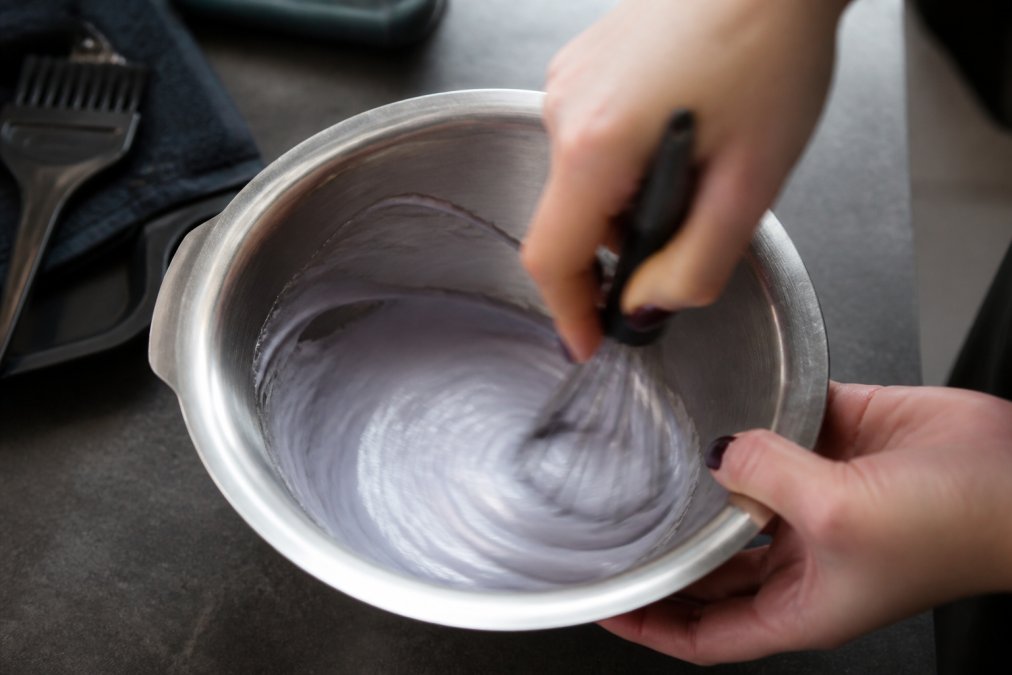
The Mechanism, Step by Step
- Your whisk accelerates the product. Each pass adds rotational energy; the faster and more consistent your stroke, the more energy enters the mix.
- Centrifugal force pushes the mass outward. Product climbs the interior wall in proportion to its velocity and the bowl's radius.
- The wall's curvature decides what happens next. In a tight, steep-sided bowl, product reaches the wall and stays there, out of the active mixing zone. You compensate by scraping, which adds time and inconsistent aeration.
- A wide, gently curved interior redirects the mass back toward the center. The curve converts outward motion into a return path, so product keeps circulating instead of parking on the wall.
- Circulation equals incorporation. The more product stays in motion, the faster and more even your emulsification.
Geometry is not a cosmetic detail, it decides whether your whisk is doing work or just moving the top layer.
What to Look For in the Interior Profile
- A wide base relative to the rim. A narrow base with a wide rim creates a steep wall that traps product; a base closer to the rim width keeps the curve gentle.
- A continuous curve, not a hard shoulder. A sharp floor-to-wall transition is where product stalls; a smooth radius keeps the mass moving.
- No dead corners. Any flat interior corner is a place product settles and escapes the whisk. Rounded interiors eliminate them.
- A depth-to-width ratio that suits your batch size. Too deep for a small batch leaves product below the whisk's reach; too shallow and it climbs out.
The Rim, the Spout, and Why They Matter to Efficiency
The rim matters too. A rolled rim gives your fingers a brace point, reducing the grip force needed to steady the bowl. A pouring spout directs product precisely without drips down the outside, keeping your station clean and your measurement markings readable. Both compound across a full day of mixing.
How Geometry Interacts With Stability
Geometry and stability are not separate problems. A bowl with a wide base and a non-slip silicone ring resists tipping when you tilt it to pour, because the base footprint does the work. A narrow base with no grip tips the moment you tilt it, no matter how good the interior curve is. Evaluate the base footprint and interior curve together, one without the other leaves efficiency on the table.
A Note on Whisk Pairing
Geometry only pays off if your whisk matches the bowl. Too small leaves the outer ring of product untouched; too large scrapes the wall instead of sweeping through the mass. The practical rule: a whisk whose tines reach roughly two-thirds of the way from the center to the wall, covering the active zone without dragging.
Capacity, Nesting Storage, and Electric Mixer Compatibility
Capacity and nesting storage decide how a bowl set fits into a real studio, not a showroom. A set that nests saves drawer space; one that does not becomes clutter.
Conclusion
The gap between a frustrating mix and a controlled one comes down to stability, geometry, and grip, not brand names or price tags. Get those three right and your workflow speeds up on its own.
Frequently Asked Questions
What features make a mixing bowl stable for professional hair color application?
A non-slip silicone ring on the base is the single most important feature. It keeps the bowl anchored when you whisk, fold batter, or use an electric mixer. Weight distribution matters too: a heavier gauge stainless steel bowl resists tipping better than thin metal. Look for a rim design that gives your hand a ledge to grip, and check that the base diameter is wide enough to sit flat on a salon counter without rocking.
Is there a difference between general-purpose mixing bowls and salon-grade tinting bowls?
Yes. Salon-grade tinting bowls are built with food-grade stainless steel or tempered glass that resists staining from oxidative dyes and lighteners. They include measurement markings, a pouring spout, and a non-slip base tuned for countertop grip. General kitchen bowls often lack measurement markings and use materials that absorb color over time. Salon-grade bowls also handle the repeated cleaning and chemical exposure that comes with high-volume color work.
How do I clean professional hair tint brushes without damaging the bristles?
Rinse bristles under warm water immediately after each client to remove wet tint before it sets. Work a small amount of gentle shampoo through the bristles with your fingers, then rinse until the water runs clear. For dried color, soak only the bristle tips in warm water for five minutes, never the full brush. Reshape the bristles and lay the brush flat to dry. Avoid hot water, harsh solvents, and standing the brush upright, which lets water seep into the handle and break down the glue.
Why is ergonomic design important for professional tinting brushes and bowls?
Colorists hold tinting tools for hours each day, and a brush that forces your wrist into an awkward angle adds up to real hand strain by the end of a shift. Ergonomic hair color tools use a contoured handle that matches your natural grip, a lightweight body that reduces fatigue, and feathered bristles that cut down the pressure needed to blend. A stable bowl with a grip-friendly rim also reduces the need to steady it with your non-dominant hand, which frees both hands for precise application.