

Why Professional Colorists Need Specialized Root Touch-Up Brushes
Table of Contents
- What Sets Specialized Root Touch-Up Brushes Apart
- How to Apply Hair Color to Roots Without Overlapping
- Selecting the Right Professional Tint Brush for Your Technique
- Hair Color Application Tools: Bristle Type, Width, and Density
- Precision Hair Color Application: Sectioning and Technique
- Brush Hygiene and Preventing Color Cross-Contamination
- Performance Outcomes: What Professional-Grade Brushes Deliver
- Frequently Asked Questions
Last Updated: October 21, 2026
What Sets Specialized Root Touch-Up Brushes Apart
A root touch-up brush is a precision tool designed specifically to apply hair color to new growth without overlapping onto previously colored hair. The difference between a specialized brush and a generic applicator comes down to control, comfort, and results.
Most colorists start with whatever brush came in their color kit. Then their hands ache by day three. The bristles fray after a few weeks. Color bleeds onto the hair lengths they didn't mean to touch.
A professional-grade root touch-up brush solves these problems. The feathered bristles grip the color and release it exactly where you direct. The ergonomic handle reduces hand fatigue during long days. The stain-resistant material means the brush stays clean and precise, session after session.

At ESTL+CO, we've designed root touch-up brushes specifically for the demands of modern color studios. Our brushes feature a tapered tip for neat sectioning and feathered bristles that give you control without cramping your fingers. When you're applying color to dozens of clients a week, that precision and comfort add up fast.
The real difference shows in three ways: how the brush feels in your hand, how the color applies to the hair, and how long the tool lasts before it needs replacing.
How to Apply Hair Color to Roots Without Overlapping
The biggest mistake colorists make is treating roots like a full-head color application. You're not coloring the entire head. You're targeting only the new growth.
Here's the process:
Step 1: Section Your Hair Divide the head into four quadrants. Use clips to keep each section separate. This prevents you from accidentally coloring hair you've already treated.
Step 2: Start at the Hairline Begin applying color at the front hairline where regrowth is most visible. Work in thin, horizontal subsections. Each subsection should be about half an inch wide.
Step 3: Apply Color with Precision Load your brush with color. Position the tapered tip at the base of the hair shaft. Apply color in a single stroke along the root area. Do not drag the brush down the hair length.
Step 4: Work Section by Section Move through each quadrant systematically. Apply color only to the new growth. Keep the demarcation line clean by stopping where the previously colored hair begins.
Step 5: Check for Coverage Gaps Once you've applied color to all roots, scan for missed spots. The part line and hairline are common problem areas. Touch up any gaps before processing time begins.
Step 6: Set Processing Time Most root touch-ups process for 20-30 minutes. Check the color formula for specific timing. Overprocessing damages hair and can create uneven color.
The key is using a brush that gives you the control to apply color only where you need it.
Selecting the Right Professional Tint Brush for Your Technique
The brush you choose determines how much control you have during application. Not all tint brushes are the same, and the differences matter.
A professional tint brush should have three qualities: a tapered tip, feathered bristles, and an ergonomic handle. The tapered tip creates neat sections and lets you place color exactly where you want it.
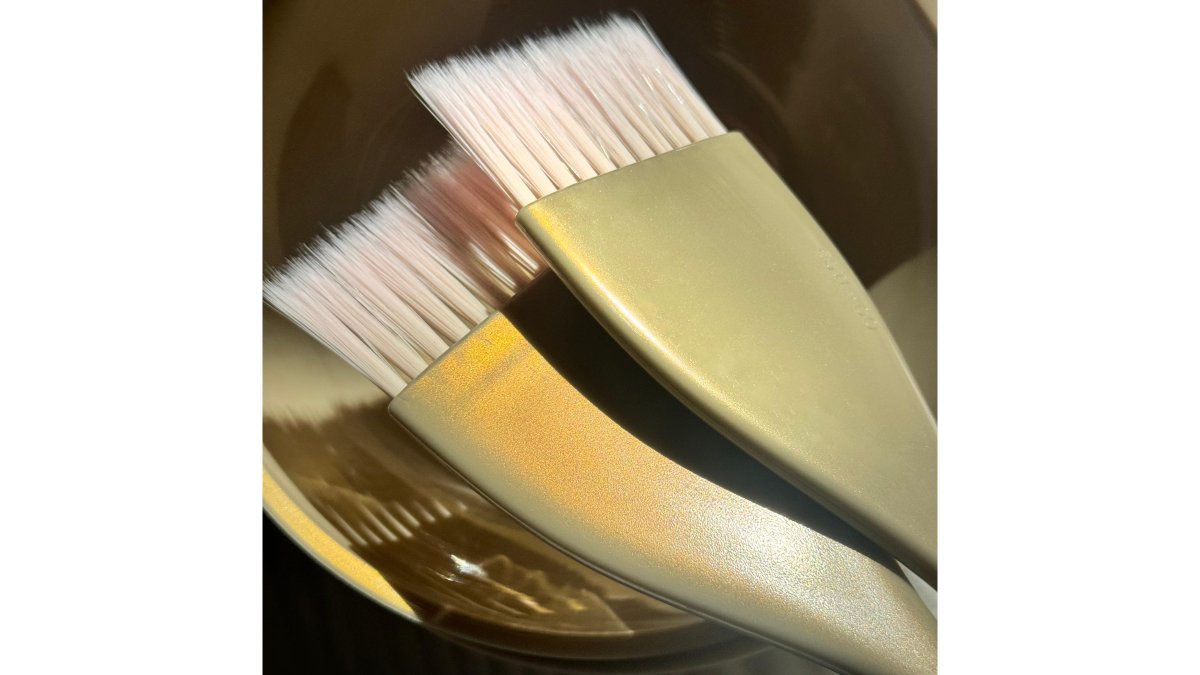
For balayage and complex techniques with foils, you need a brush that lets you paint color onto specific strands without affecting surrounding hair. A narrower brush with a fine point works better here than a wide, blunt applicator.
For full-head color or dense regrowth, a slightly wider brush covers more area per stroke. This speeds up application without sacrificing precision. The width should still allow you to work along the part line and hairline without bleeding color onto the hair lengths.
The material matters too. A stain-resistant brush stays cleaner longer and resists color buildup. This keeps your brush performing at its best across multiple clients and multiple applications. Brushes that stain trap color particles in the bristles, which can transfer unwanted pigment to the next client's hair.
Hair Color Application Tools: Bristle Type, Width, and Density
The bristle type determines how the brush handles color and how it feels against the scalp. Feathered bristles are the professional standard because they grip color without dragging, release it smoothly, and adapt to different hair textures and scalp sensitivities.
Blunt-cut bristles apply color quickly but can scratch the scalp and drag through the hair. They also tend to fray faster, which means the brush loses precision after a few weeks of use.
Width affects your speed and accuracy. Here's how to think about it:
- Narrow brushes (under 1 inch): Best for detail work, balayage, foils, and fine sectioning. Slower application but maximum control.
- Medium brushes (1 to 1.5 inches): Versatile for most applications. Fast enough for full-head color, precise enough for root touch-ups.
- Wide brushes (over 1.5 inches): Best for full-head color on thick, dense hair. Covers more area per stroke but less precise at the hairline and part line.
Density refers to how many bristles are packed into the brush. A denser brush holds more color and applies it more evenly. A less dense brush is lighter and faster but may require more passes to get even coverage.
For root touch-ups specifically, a medium-width brush with moderate-to-high density works best. You need enough bristles to hold color but not so many that the brush becomes bulky or hard to control.
The ESTL+CO Hair Color Brush features a wide feathered tip designed for easier and perfect color spread. The wide base makes for an easier grip, and the tapered tip creates neater sections. At $16.00 per box (two brushes included), you get professional-grade tools that eliminate hand strain and deliver consistent results across your client roster.
Precision Hair Color Application: Sectioning and Technique
Sectioning is the foundation of precise color application. Without proper sections, you'll miss spots, overlap color, or spend extra time correcting mistakes.
The four-quadrant method works for most applications:
- Create a vertical part from the center of the forehead to the nape of the neck.
- Create a horizontal part from ear to ear across the crown.
- Clip each quadrant separately to keep it out of the way.
- Work through each quadrant methodically before moving to the next.
Within each quadrant, use subsections about half an inch wide. This is the standard width that lets you see exactly where you're applying color and prevents gaps in coverage.
Application angle matters. Hold the brush at a 45-degree angle to the scalp. This angle lets the bristles contact the root area without pressing too hard against the scalp. Too flat and you'll miss the roots. Too vertical and you'll scratch the scalp or push color onto the hair lengths.
Pressure control is where professional technique separates from amateur work. Use light, consistent pressure. Let the brush do the work. Pressing hard doesn't apply more color. It just causes scalp irritation and wastes product.
Start at the hairline where regrowth is most visible. Work back toward the crown. This ensures that the areas clients see first get the most attention and the most even coverage.
For clients with sensitive scalps, use a brush with softer bristles and lighter pressure. For clients with dense, coarse hair, use a slightly firmer brush and work in smaller subsections to ensure complete coverage.
The goal is to apply color in a single, smooth stroke along each subsection. Multiple passes over the same area waste time and can cause uneven processing or over-saturation.
Brush Hygiene and Preventing Color Cross-Contamination
A brush that isn't cleaned between clients transfers color pigment to the next client's hair. This causes staining, unwanted tone shifts, and client dissatisfaction.
Proper hygiene starts immediately after you finish coloring. Don't let color dry on the bristles. Rinse the brush under warm water right away. Use your fingers to work the color out of the bristles.
For stubborn color buildup, soak the brush in warm water for a few minutes. Then rinse and work the bristles gently with your fingers. Do not soak for extended periods or use harsh chemicals.
Between clients, store your brushes in a clean, dry place. Do not leave them bristles-down in a cup of water. This causes mildew and bristle degradation. Stand them upright or lay them flat on a clean towel.
At the end of each day, do a deeper clean. Rinse the brush thoroughly and stand it upright to dry completely.
A stain-resistant brush like the ESTL+CO Hair Color Brush resists color buildup much better than standard brushes. This means less time spent cleaning and more time available for clients.
For high-volume salons with multiple colorists, assign each colorist their own brush. This prevents color cross-contamination between team members and ensures consistent results. It also makes it easier to track which brushes need replacing.
Performance Outcomes: What Professional-Grade Brushes Deliver
The difference between a generic brush and a professional-grade tool shows up in measurable ways: time per application, color consistency, client satisfaction, and brush longevity.
Application speed improves with a brush designed for precision.
Color consistency matters to your reputation. A brush that applies color evenly means every client gets the same quality result. No more dark spots from over-application or light spots from under-application. Even coverage builds trust and encourages repeat bookings.
Client comfort is part of the experience. A brush with soft, feathered bristles and an ergonomic handle doesn't scratch the scalp or cause irritation. Clients notice this.
Hand and wrist health is critical for colorists who work full-time. A brush with poor ergonomics causes hand strain, wrist pain, and eventually repetitive strain injury. A professional brush with an ergonomic handle distributes pressure evenly and reduces fatigue.
Tool longevity affects your bottom line. A professional-grade brush made from stain-resistant material lasts months longer than a cheap brush.
The quality of the tool directly impacts the quality of your work.
Professional hair colorists need specialized root touch-up brushes because the work demands precision, speed, and comfort that generic applicators simply don't deliver.
The ESTL+CO Hair Color Brush delivers that precision with feathered bristles, a tapered tip for neat sectioning, and an ergonomic design that prevents hand strain.
Frequently Asked Questions
Why do professional colorists use specialized root touch-up brushes instead of standard brushes?
Specialized root touch-up brushes are engineered with tapered tips and feathered bristles that allow colorists to apply color precisely to regrowth without overlapping onto previously colored hair. Standard brushes lack this control, leading to uneven coverage, color overlap, and faster hand fatigue. Professional brushes also feature ergonomic handles that reduce tension and cramping during high-volume applications, making them essential for salon efficiency and client results.
What makes a professional tint brush different from a basic color applicator?
Professional tint brushes are designed with wider feathered tips for controlled color spread, tapered edges for sectioning precision, and stain-resistant materials that withstand frequent washing and color exposure. The bristle density and shape are engineered to distribute color evenly without dragging or pulling the hair. Basic applicators lack these specifications and often cause uneven saturation, visible demarcation lines, and client discomfort.
Can using the wrong brush affect root coverage or color placement?
Yes. An incorrect brush can cause color bleed onto the lengths, uneven root coverage, or visible demarcation lines between the root area and previously colored hair. The wrong bristle density may deposit too much or too little color, while an improper tip shape makes it difficult to section cleanly. Professional brushes eliminate these issues by providing the control needed for targeted application and natural-looking results.
How often should professional colorists replace their root touch-up brushes?
High-quality, stain-resistant brushes last 6-12 months with proper care and regular cleaning. Replace brushes sooner if bristles become frayed, lose shape, or show signs of color staining that affects performance. Investing in durable professional brushes reduces replacement frequency compared to cheaper alternatives that deteriorate faster, making them more cost-effective over time.